Study provides insight into evolution of first flowers
(PhysOrg.com) -- Charles Darwin described the sudden origin of flowering plants about 130 million years ago as an abominable mystery, one that scientists have yet to solve.
But a new University of Florida study, set to appear next week in the online edition of the Proceedings of the National Academy of Sciences, is helping shed light on the mystery with information about what the first flowers looked like and how they evolved from nonflowering plants.
"There was nothing like them before and nothing like them since," said Andre Chanderbali, lead author of the study and a postdoctoral associate at UF's Florida Museum of Natural History. "The origin of the flower is the key to the origin of the angiosperms (flowering plants)."
The goal of this research is to understand the original regulatory program, or set of genetic switches, that produced the first flower in the common ancestor of all living flowering plants, said Pam Soltis, study co-author and curator of molecular systematics and evolutionary genetics at the Florida Museum. Better understanding of these genetic switches could one day help scientists in other disciplines such as medicine or agriculture, including help in growing plants used to fight disease or developing more drought-resistant crops.
The flower is one of the key innovations of evolution, responsible for a massive burst of evolution that has resulted in perhaps as many as 400,000 angiosperm species. Before flowering plants emerged, the seed-bearing plant world was dominated by gymnosperms, which have cone-like structures instead of flowers and include pine trees, sago palms and ginkgos. Gymnosperms first appeared in the fossil record about 360 million years ago.
The new study provides insight into how the first flowering plants evolved from pre-existing genetic programs found in gymnosperms and then developed into the diversity of flowering plants we see today.
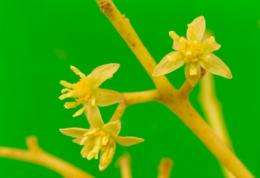
The study compares the genetic structure of two vastly different flowering plants to see whether differences exist in the set of circuits that create each species' flower. Researchers examined the genetic circuitry of Arabidopsis thaliana, a small flowering plant commonly used as a model organism in plant genetics research, and the avocado tree Persea americana, which belongs to an older lineage of so-called basal angiosperms.
"What we found is that the flower of Persea is a genetic fossil, still carrying genetic instructions that would have allowed for the transformation of cones into flowers," Chanderbali said.
Advanced angiosperms have four organ types: female organs (carpels), male organs (stamens), petals (typically colorful) and sepals (typically green). Basal angiosperms have three: carpels, stamens and tepals, which are typically petal-like structures. The researchers expected each type of organ found in Persea's flowers would have a unique set of genetic instructions. Instead they found significant overlap among the three organ types.
"Although the organs are developing to ultimately become different things, from a genetic developmental perspective, they share much more than you would expect," Chanderbali said. "As you go back in time, the borders fade to a blur."
"With these facts established, we can now think about the vast space open to natural selection to establish ever more rigid borders," said Virginia Walbot, a biology professor at Stanford University who is familiar with the research. The selection process arrived at a "narrow solution in terms of four discrete organs but with fantastic diversity of organ numbers, shapes and colors that provide the defining phenotypes of each flowering plant species."
Researchers don't know exactly which gymnosperms gave rise to flowering plants, but previous research suggests some genetic program in the gymnosperms was modified to make the first flower, Soltis said. A pine tree produces pine cones that are either male or female, unlike flowers, which contain both male and female parts. But a male pine cone has almost everything that a flower has in terms of its genetic wiring.
Douglas Soltis, chairman of the UF botany department, emphasized that the study highlights the importance of studying primitive flowering plants such as the avocado to gain insight into the early history of the flower. Survivors of ancient lineages represent a crucial link to the first flowers and provide insight that cannot be obtained by studying highly derived models such as Arabidopsis, he said.
Source: University of Florida (news : web)


