Mockingbirds, no bird brains, can recognize a face in a crowd
May 18, 2009 Mockingbirds, no bird brains, can recognize a face in a crowd

Enlarge

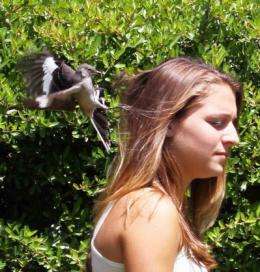
A mockingbird grazes University of Florida biology major Devon Duffy in an attempt to drive her away from its nest on the UF campus on April 19, 2009. The bird apparently recognized her as the person who had threatened its nest during previous visits. Student volunteers approached and touched mockingbirds’ nests as part of research that found that mockingbirds recognize, remember and respond to people they deem as threats — while completely ignoring other passersby or nearby strangers. (Lou Guillette/University of Florida)

(PhysOrg.com) -- The birds are watching. They know who you are. And they will attack. Nope, not Hitchcock. It's science.

University of Florida biologists are reporting that mockingbirds recognize and remember people whom the birds perceive as threatening their nests. If the white-and-grey common in cities and towns throughout the Southeast spot their unwelcome guests, they screech, dive bomb and even sometimes graze the visitors' heads -- while ignoring other passers-by or nearby strangers.

"We tend to view all mockingbirds as equal, but the feeling is not mutual," said Doug Levey, a UF professor of biology. "Mockingbirds certainly do not view all humans as equal."

The research is described in a paper set to appear next week in the online edition of the .

The paper describes the first published research showing that wild animals living in their natural settings recognize individuals of other species, Levey said. It may provide clues as to why mockingbirds and selected other bird and animal species flourish in heavily populated cities and suburbs -- while other species either grow rare or disappear entirely.

"The real puzzle in the field of urban ecology is to figure out why certain species thrive around humans," Levey said. "One of the hypotheses is that they have some innate ability to adapt and innovate in ways that other species don't."

Mockingbirds are among the most common birds on the University of Florida campus in Gainesville, where they nest in trees and shrubs close to the ground. For the research, student volunteers walked up to the nests, reached through the foliage and gently touched the nests' edges, then walked away. The same volunteers repeated the same visits again the next day, and again for two more days. On the fifth day, however, different volunteers approached the

nests. All told, 10 volunteers tested 24 nests at least five times last spring and summer, during the mockingbird nesting season.

It didn't take a bird's eye view to spot the resulting pattern, Levey said.

On the third and fourth days, the birds flushed from their nests more rapidly each time the increasingly familiar students appeared -- even though the students took different paths toward the nests on successive days and wore different clothes. The birds also gave more alarm calls and flew more and aggressively each succeeding day, with some especially defensive birds even grazing intruders' heads -- not exactly deadly, but annoying, because the birds tend to hit the same spot repeatedly, Levey said.

And yet when different students approached the nests on the fifth day, the hardly ruffled their feathers, waiting to flush until last moment. They also gave fewer alarm calls and attacked much less than on the previous day with the familiar intruder.

On a campus of 51,000-plus students, paths are filled with students walking back and forth from class all day every weekday -- so it's no stretch to say that thousands of different people come within a few feet of mockingbird nests during the breeding season.

And yet, the mockingbirds in the study were clearly able to recognize and remember a single individual, based on just two brief negative encounters at their nest. Levey said that sharply contrasts with laboratory studies, in which pigeons recognized people only after extensive training. "Sixty seconds of exposure was all it took for mockingbirds to learn to identify different individuals and pick them out of all other students on campus," Levey said.

For most wild animals, urban development brings less habitat and more predators. Many species flee or die off, but a few persist, and some thrive. It seems obvious that these species do better around people, but why?

Few people bother mockingbird nests, so that is hardly an answer. Rather, Levey said, the birds' ability to recognize people suggests perceptual powers that give them an edge in dealing with the complexities of urban environments -- such as being able to judge which cats may be aware of nests and which are simply passing blithely nearby.

"We don't believe mockingbirds evolved an ability to distinguish between humans. Mockingbirds and humans haven't been living in close association long enough for that to occur." Levey said. "We think instead that our experiments reveal an underlying ability to be incredibly perceptive of everything around them, and to respond appropriately when the stakes are high."

Source: University of Florida (news : web)


print this article email this article download pdf blog this article bookmark this article     Stumble it Digg this share on Facebook retweet share on Reddit add to delicious
Rate this story - 4.5 /5 (12 votes)

Rank Filter

Move the slider to adjust rank threshold, so that you can hide some of the comments.


Display comments: newest first

  • Schnarr - May 18, 2009
    • Rank: not rated yet
    Worst. Title. Ever.
  • dev2000 - May 18, 2009
    • Rank: 5 / 5 (1)
    Best. Photo. Ever.
  • OregonWind - May 18, 2009
    • Rank: 5 / 5 (1)
    I agree. Great photo!

    I really liked the last paragraph: ... "We think instead that our experiments reveal an underlying ability to be incredibly perceptive of everything around them, and to respond appropriately when the stakes are high."
  • docknowledge - May 19, 2009
    • Rank: 5 / 5 (3)
    Great experiment. I don' wanna be negative, but...couldn't science have made these discoveries 300 years ago? Why is so much investigation of animal behavior waiting until now?
  • latersville - May 19, 2009
    • Rank: 3.7 / 5 (3)
    @ OregonWind

    You've probably had professors like him before too. He's the kind of guy whose class is easy to pass as long as you parrot what he says :)

May 18, 2009 all stories

Comments: 5

4.5 /5 (12 votes)
  • Stumble this up

  • Digg this

  • share this

  • hide
  • Related Stories

  • Some migratory birds can't find success in urban areas, study finds
    created Apr 01, 2008 | popularity not rated yet | comments 0
  • Rooted plants move mysteriously down greenways, scientists say
    created Dec 03, 2008 | popularity not rated yet | comments 0
  • Study documents evidence of 'mafia' behavior in cowbirds
    created Mar 05, 2007 | popularity not rated yet | comments 0
  • Loggerhead turtles on decline in Florida
    created Apr 20, 2008 | popularity not rated yet | comments 0
  • Sea turtles make comeback on Texas coast
    created Aug 12, 2007 | popularity not rated yet | comments 0


  • hide
  • Relevant PhysicsForums posts

  • Is it true that
    created 7 hours ago
  • Selenocysteine in pH=7
    created Nov 26, 2009
  • What is the formula for calculating the speed of thought?
    created Nov 26, 2009
  • What does word "absorption" mean in the intestine?
    created Nov 26, 2009
  • What is transpulmonary pressure?
    created Nov 24, 2009
  • Is there a gay gene?
    created Nov 23, 2009
  • More from Physics Forums - Biology

Other News

Hammerhead shark

Wide heads give hammerheads exceptional stereo view

Biology / Plants & Animals

created 23 hours ago | popularity 4.5 / 5 (6) | comments 4

Hammerhead sharks are some of the Ocean's most distinctive residents. 'Everyone wants to understand why they have this strange head shape,' says Michelle McComb from Florida Atlantic University. One possible ...


Golden Oldie: Key Role for Ancient Protein in Algae Photosynthesis

Golden Oldie: Key Role for Ancient Protein in Algae Photosynthesis

Biology / Biotechnology

created 14 hours ago | popularity not rated yet | comments 1

The discovery that an ancient light harvesting protein plays a pivotal role in the photosynthesis of green algae should help the effort to develop algae as a biofuels feedstock. Researchers with the Lawrence ...


Tough yet stiff deer antler is materials scientist's dream

Biology / Plants & Animals

created 23 hours ago | popularity 3 / 5 (2) | comments 2

Prized for their impressive antlers, red deer have been caught in the hunters' sights for generations. But a deer's antlers are much more than decorative. They are lethal weapons that stags crash together when duelling. John ...


Indonesia rejects Bali plan for turtle sacrifices (AP)

Indonesia rejects Bali plan for turtle sacrifices

Biology / Ecology

created 20 hours ago | popularity 5 / 5 (1) | comments 0

(AP) -- Indonesia has rejected a push by the resort island of Bali for rare turtles to be legally slain in Hindu ceremonies, siding with conservationists of the protected reptiles against religious advocates, ...


Ecologists sound out new solution for monitoring cryptic species

Biology / Ecology

created 23 hours ago | popularity not rated yet | comments 0

Ecologists have at last worked out a way of using recordings of birdsong to accurately measure the size of bird populations. This is the first time sound recordings from a microphone array have been translated into accurate ...