Astronauts say goodbye to Hubble for good (Update)
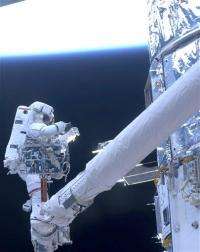
May 19, 2009 Astronauts say goodbye to Hubble for good (AP)

Enlarge

In this photo provided by NASA, astronaut John Grunsfeld, STS-125 mission specialist, positioned on a foot restraint on the end of Atlantis' remote manipulator system (RMS), participates in the mission's fifth and final session of extravehicular activity (EVA) to refurbish and upgrade the Hubble Space Telescope on Monday May 18, 2009. The last humans to lay hands on Hubble outfitted the observatory with another set of fresh batteries, a new sensor for precise pointing and protective covers. That equipment, along with other improvements made over the last five days, should allow the telescope to provide views of the universe for another five to 10 years. (AP Photo/NASA)

(AP) -- Atlantis' astronauts tenderly dropped the Hubble Space Telescope overboard Tuesday, sending the restored observatory off on a new voyage of discovery and bidding it farewell on behalf of the planet.

Hubble - considered better than new following five days of repairs and upgrades - will never be seen up close by humans again. This was NASA's last service call.

The shuttle and telescope had just crossed the Atlantic, and were soaring 350 miles above the coast of northwestern Africa, when astronaut Megan McArthur used a robot arm to release the snares gripping Hubble. Then the shuttle slowly backed away.

"Hubble has been released," reported commander Scott Altman. "It's safely back on its journey of exploration as we begin steps to conclude ours. Looking back on this mission, it's been an incredible journey for us as well."

Mission Control radioed congratulations: "It's wonderful to see Hubble, the most famous of all time, newly upgraded and ready for action thanks to you."

With Hubble flying on its own again, the seven looked ahead to Friday's planned landing. But first they had to inspect their ship one last time to make sure it had not been smacked by space junk. The telescope's unusually high orbit had placed the shuttle and its crew at increased risk and, because of the lack of a refuge, prompted to keep a rescue ship on standby until the end of the 11-day flight.

During five consecutive days of spacewalks loaded with drama, Atlantis' crew labored tirelessly on the 19-year-old observatory. Four men working in teams of two gave the telescope two new high-powered science instruments and a suite of other up-to-date equipment, and fixed two broken instruments, something never before attempted in orbit.

The astronauts persevered, despite stuck bolts, ill-fitting gyroscopes and flyaway shreds of insulation. Two of them were ready to jump into spacewalking action one last time if the telescope's aperture door had not opened Tuesday morning or some other last-minute problem cropped up. None did.

NASA said the astronauts' extraordinary effort not only fixed Hubble, but should give the iconic telescope another five to 10 years and allow it to reveal even more mysteries of the cosmos.

"This morning, you watch us from the pinnacle of human existence, representing the pinnacle of our craft, and leaving Hubble at the apex of its scientific power," Hubble program officials said in a message to the crew.

"Hubble is now ready to resume its role as humankind's most powerful eyes on the universe."

The Hubble team hopes to resume celestial observations by the end of summer, following an intensive series of tests.

As for the space telescope's future, there will be no more visits. Sometime after 2020, NASA will send a robotic craft to steer it back into the and a watery grave. The spacewalkers installed a docking ring for just that purpose.

That day, however, was far from the astronauts' minds as they reflected on their success.

"It's a little bittersweet that it's over," telescope repairman Michael Massimino said late Monday after the final .

"The big drama's coming," teased pilot Gregory Johnson. "Landing, baby."

---

On the Net:

NASA: http://www.nasa.gov/mission-pages/hubble/main/index.html

©2009 The Associated Press. All rights reserved. This material may not be published, broadcast, rewritten or redistributed.


print this article email this article download pdf blog this article bookmark this article     Stumble it Digg this share on Facebook retweet share on Reddit add to delicious
Rate this story - 5 /5 (5 votes)

Rank Filter

Move the slider to adjust rank threshold, so that you can hide some of the comments.


Display comments: newest first

  • docknowledge - May 19, 2009
    • Rank: 5 / 5 (1)
    "This morning, you watch us from the pinnacle of human existence, representing the pinnacle of our craft, and leaving Hubble at the apex of its scientific power"

    And that, my friends, is why we need to emphasize unmanned space exploration. To get egomaniacs far away from the scientific process.

May 19, 2009 all stories

Comments: 1

5 /5 (5 votes)
  • Stumble this up

  • Digg this

  • share this

  • hide
  • Related Stories


  • hide
  • Relevant PhysicsForums posts

  • The shape of our solar system's orbits.
    created Nov 07, 2009
  • Above or Below the Line of Nodes
    created Nov 07, 2009
  • Supernova vs. Nova?
    created Nov 07, 2009
  • Supernova's Gamma Rays and Comets
    created Nov 06, 2009
  • More from Physics Forums - General Astronomy

Other News

Deep creep means milder, more frequent earthquakes along Southern California's San Jacinto fault

Deep creep means milder, more frequent earthquakes along Southern California's San Jacinto fault

Space & Earth / Earth Sciences

created 18 hours ago | popularity 4.5 / 5 (4) | comments 0

With an average of four mini-earthquakes per day, Southern California's San Jacinto fault constantly adjusts to make it a less likely candidate for a major earthquake than its quiet neighbor to the east, the ...


Success in 'space elevator' competition (AP)

Success in 'space elevator' competition (Update 3)

Space & Earth / Space Exploration

created Nov 05, 2009 | popularity 4.3 / 5 (33) | comments 50

(AP) -- A robot powered by a ground-based laser beam climbed a long cable dangling from a helicopter on Wednesday to qualify for prize money in a $2 million competition to test the potential reality of the ...


In a Galaxy Far, Far Away...

In a Galaxy Far, Far Away...

Space & Earth / Astronomy

created Nov 06, 2009 | popularity 4.8 / 5 (5) | comments 17

(PhysOrg.com) -- Astronomers have published the discovery of the farthest known object in the cosmos: a star that exploded when the universe was only 630 million years old -- only 4.6% of its current age. ...


'Dropouts' pinpoint earliest galaxies

'Dropouts' pinpoint earliest galaxies

Space & Earth / Astronomy

created Nov 06, 2009 | popularity 4.2 / 5 (10) | comments 13

Astronomers, conducting the broadest survey to date of galaxies from about 800 million years after the Big Bang, have found 22 early galaxies and confirmed the age of one by its characteristic hydrogen signature ...


Space hotel taking bookings for 2012 opening

Space hotel taking bookings for 2012 opening

Space & Earth / Space Exploration

created Nov 05, 2009 | popularity 4.4 / 5 (21) | comments 11

(PhysOrg.com) -- The first orbiting space hotel is on track to open for its first customers in 2012, but hurry, as bookings are filling fast.