Dental researchers ID new target in fight against osteoporosis, periodontitis
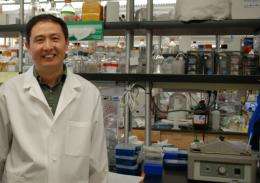
(PhysOrg.com) -- Osteoporosis and periodontitis are common diseases whose sufferers must cope with weakness, injury and reduced function as they lose bone more quickly than it is formed. While the mechanism of bone destruction in these diseases is understood, scientists have had less information about how bone formation is impaired.
Now, researchers at the UCLA School of Dentistry, working with scientists at the University of Michigan and the University of California, San Diego, have identified a potential new focus of treatments for osteoporosis, periodontitis and similar diseases.
In a paper published May 17 in the online edition of the journal Nature Medicine, Cun-Yu Wang, who holds UCLA's No-Hee Park Endowed Chair in the dental school's division of oral biology and medicine, and colleagues suggest that inhibiting nuclear factor-kB (NF-kB), a master protein that controls genes associated with inflammation and immunity, can prevent disabling bone loss by maintaining bone formation.
The findings could offer new hope to millions who struggle with osteoporosis and periodontitis each year. The National Institutes of Health estimates that in the United States alone, more than 10 million people have osteoporosis, and many more have low bone mass, putting them at risk for the disease, as well as for broken bones. According to the American Academy of Periodontology, mild to moderate periodontitis affects a majority of adults, with between 5 and 20 percent of the population suffering from a more severe stage of the disease.
The NF-kB protein, a culprit in inflammatory and immune disorders, plays a major role in both osteoporosis and periodontitis, disrupting the healthy balance of bone destruction and formation. It is this balance that Wang and his fellow scientists seek to restore, and perhaps even improve upon, by finding new ways to promote net bone accumulation.
"Most studies focus on the part that NF-kB plays in the regulation of osteoclasts — bone-resorbing cells. For the past five years, we looked closely at the effect of NF-kB on osteoblasts — bone-forming cells," said Wang, the study's principal investigator and a member of UCLA's Jonsson Comprehensive Cancer Center. "We knew that NF-kB promoted resorption. What we discovered in our in vitro and in vivo studies is that this protein also inhibits new bone formation, giving us a fuller picture of its role in inflammation and immune responses."
"This landmark paper by Dr. Wang and his colleagues is not only top-notch molecular science, but it also holds promise for clinicians trying to provide the most enlightened treatment of women with postmenopausal osteoporosis," said John Adams, a UCLA professor of orthopedic surgery. "The paper shows how the molecular manipulation of a previously unsuspected pro-inflammatory pathway in the bone-forming cell, the osteoblast, can regulate the capacity of that cell to make new bone."
Many currently available treatments work to prevent further bone loss but are not able to increase bone mass. Wang's research results support the idea that a new drug that prevents the action of NF-kB in cells may represent a major therapeutic advance.
"Although it has been known for some time that inflammation inhibits bone formation, the groundbreaking work by Dr. Wang and his colleagues elucidates the critical role of NF-kB in the mechanism that underlies this phenomenon," said Philip Stashenko, a professor at the Harvard School of Dental Medicine and president and CEO of the Forsyth Institute, an oral health treatment and research organization. "Many drugs that block NF-kB are in development, and these findings suggest that new treatments to preserve bone in periodontitis, osteoporosis and related bone diseases are imminent."
As a next step, Wang and his research team are planning to test small molecules that inhibit the specific bone-resorption and bone-inhibition actions of NF-kB in osteoporosis and periodontitis.
More information: An abstract of the paper is available at dx.doi.org/10.1038/nm.1954 .
Source: University of California - Los Angeles


