Fifth century BC objects returned to Greece
May 19, 2009
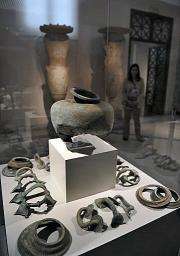
Fragments of antiques are displayed at the Athens archeological museum after being returned to Greece

Enlarge

Fragments of antiques, among which the oldest dates back to the 5th century BC, are displayed at the Athens archeological museum after being returned to Greece from Germany, Belgium and Great Britain. The objects, comprising a majority of ceramic or brass containers, are believed to come from a necropolis in Thessalie and date back to the third and fourth century, according to the archaeologists.

Greece on Tuesday reclaimed scores of ancient objects dating to the fifth century BC that Belgian, British and German authorities returned, the culture ministry said.

The list includes over 100 clay fragments and coins held by the Belgian Archaeological School, 70 ancient funerary offerings seized by German customs officials in Nuremberg in 2007 and a marble decorative fragment from a Byzantine church donated by a British ceramist, the ministry said.

"Today societies increasingly realise that cultural goods are not just art objects...but vital links of peoples' historic identities and continuity," Greek Culture Minister Antonis Samaras said.

The ancient clay fragments and coins returned by the Belgian government came from digs at Thoriko, south of Athens, and the island of Salamis. They were taken out of Greece 40 years ago and were found at the museum of Ghent during an inventory check.

The Byzantine church fragment had been picked up in the 1950s by a British tourist from the Athenian Agora, the city's ancient marketplace, Greece's cultural attache Victoria Solomonidou told AFP.

"After his death his wife offered it to a British ceramist who delivered it to the Greek embassy in London," she said.

In recent years Greece has stepped up efforts to recover ancient objects that illegally left the country and ended up in the possession of foreign museums and collectors.

Its main aim is to reclaim the Parthenon Marbles, priceless friezes removed in 1806 by Lord Elgin when Greece was occupied by the Ottoman Empire, which the British Museum refuses to repatriate.

The capital's new Acropolis museum that will be inaugurated on June 20 has a special section reserved for the disputed friezes.

(c) 2009 AFP


Rank 5 /5 (2 votes)
Related Stories
Relevant PhysicsForums posts
  • Factors affecting beet root cell membrane
    created14 hours ago
  • Stem cell question.
    createdFeb 10, 2012
  • Protease cleavage
    createdFeb 10, 2012
  • Pertubance in a model
    createdFeb 10, 2012
  • Cancer drugs and Alzheimer's, Oh my!
    createdFeb 09, 2012
  • Squishing cells
    createdFeb 09, 2012
  • More from Physics Forums - Biology

More news stories

A frank discussion of the power law and linking correlation to causation

(PhysOrg.com) -- Michael Stumpf a mathematics professor at Imperial College in London, and Mason Porter a lecturer at Oxford have teamed together to write and publish a perspective piece in Science regarding the in ...

Other Sciences / Mathematics

created Feb 10, 2012 | popularity 5 / 5 (5) | comments 11 | with audio podcast report

US workers are 'giving away the store,' costing firms billions

Nearly 70 percent of the nation's service employees give away free goods and services – from hamburgers to cable TV – costing companies billions of dollars a year, according to a groundbreaking study.

Other Sciences / Economics & Business

created Feb 09, 2012 | popularity 3 / 5 (5) | comments 11

Employers feel no love for unscrupulous practice of 'service sweethearting'

A new study led by two Florida State University marketing professors finds that some frontline service employees who are rewarded for hikes in customer loyalty and satisfaction also may engage in "service ...

Other Sciences / Economics & Business

created Feb 10, 2012 | popularity 3.3 / 5 (3) | comments 10

New insights into how to correct false knowledge

The abundance of false information available on the Internet, in movies and on TV has created a big challenge for educators.

Other Sciences / Social Sciences

created Feb 07, 2012 | popularity 4.9 / 5 (7) | comments 9 | with audio podcast

Neanderthal demise due to many influences, including cultural changes: study

As an ice age crept upon them thousands of years ago, Neanderthals and modern human ancestors expanded their territory ranges across Asia and Europe to adapt to the changing environment.

Other Sciences / Archaeology & Fossils

created Feb 07, 2012 | popularity 4.4 / 5 (5) | comments 8 | with audio podcast


Scientists discover molecular secrets of 2,000-year-old Chinese herbal remedy

For roughly two thousand years, Chinese herbalists have treated Malaria using a root extract, commonly known as Chang Shan, from a type of hydrangea that grows in Tibet and Nepal. More recent studies suggest that halofuginone, ...

New method to examine batteries -- MRI from the inside

There is an ever-increasing need for advanced batteries for portable electronics, such as phones, cameras, and music players, but also to power electric vehicles and to facilitate the distribution and storage of energy derived ...

Google might launch Drive for cloud storage soon

(PhysOrg.com) -- Google's next big move, according to the Wall Street Journal, is a cloud storage service called Drive. Hardly first to the plate, Google is simply catching up to introducing its cloud reposi ...

A mitosis mystery solved: How chromosomes align perfectly in a dividing cell

Although the process of mitotic cell division has been studied intensely for more than 50 years, Whitehead Institute researchers have only now solved the mystery of how cells correctly align their chromosomes during symmetric ...

Lab study raises questions over nano-particle impact

Tests involving chickens have raised questions about the impact on health from engineered nano-particles, the ultra-fine grains commonly used in drugs and processed foods, scientists said on Sunday.

Starve a virus, feed a cure? Findings show how some cells protect themselves against HIV

A protein that protects some of our immune cells from the most common and virulent form of HIV works by starving the virus of the molecular building blocks that it needs to replicate, according to research published online ...