Refurbished Hubble Ready to Resume Exploration
May 19, 2009 by Don Savage and Rob Garner Refurbished Hubble Space Telescope Ready to Resume Mission of Explorat

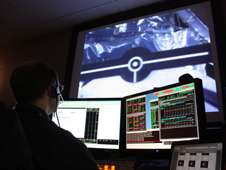
An operator in Goddard's Space Telescope Operations Control Center keeps a watchful eye on his readouts as shuttle Atlantis deploys the Hubble Space Telescope on May 19, 2009. Credit: NASA/Wade Sisler

(PhysOrg.com) -- The Hubble Space Telescope has been with us for nearly two decades. In that time, its breathtaking images have captured people’s imaginations and its groundbreaking science has revealed some of the many secrets of our universe.

This morning, at precisely 8:57 a.m. ET, a carefully orchestrated maneuver was carried out 350 miles above the Atlantic coastline of Africa, marking the successful end of the fifth and final shuttle servicing mission.

Ever so gently, the crew released the grapple fixture on the shuttle’s , allowing Hubble to resume orbiting Earth on its own, as it has done since its deployment in April 1990. After Hubble’s thousands of orbits, thousands of images, five tune-ups and countless discoveries, a space shuttle crew is leaving this great observatory for the last time.

Maryland Sen. Barbara Mikulski visited controllers in Goddard's Space Telescope Operations Control Center. Mikulski, who praised the Hubble team for their hard work and dedication during this mission.

Because of Hubble, we know the age of our universe. We know how planets are born. We’ve seen into the atmospheres of alien worlds. We’ve begun to unravel the mysteries of and .

But despite all of this telescope’s groundbreaking work, there are still discoveries to be made. Thanks to the hard work of seven astronauts and countless people on the ground, Hubble is at the apex of its capabilities.

Thanks to new gyros, new batteries, new thermal blanketing and new science instruments, Hubble is poised to peer deeper into the cosmos than ever before. Spectacular images and data should start flowing from Hubble in about three months, after controllers have checked out and calibrated each of the observatory’s instruments and systems.

After that, Hubble will continue to do what it’s done for 19 years now: making discovery after discovery, pushing the limits of what we can see and what we know about our universe, rewriting textbooks and amazing us with spectacular, amazing images like nothing we’ve ever seen.

As astronaut John Grunsfeld said at the end of the last Hubble spacewalk, “Hubble isn’t just a satellite. It’s about humanity’s quest for knowledge.” Thanks to this fifth and final shuttle servicing mission, Hubble can continue that quest for years to come.

Provided by NASA's Goddard Space Flight Center (news : web)


print this article email this article download pdf blog this article bookmark this article     Stumble it Digg this share on Facebook retweet share on Reddit add to delicious
Rate this story - 4.9 /5 (7 votes)

Rank Filter

Move the slider to adjust rank threshold, so that you can hide some of the comments.


Display comments: newest first

  • yyz - May 19, 2009
    • Rank: not rated yet
    I thought it appropriate that the lone astrophysicist on the mission, John Grunsfeld, was the last person to physically touch Hubble prior to its release. Sorta analogous to lone Apollo geologist Jack Schmidt and fellow astronaut Gene Cernan being the last two men to walk on the moon. Except, of course, that HST is now fully refurbished and well equipped to keep exploring the cosmos well into the next decade. To paraphrase Grunsfeld, WOOO HOOOO............
  • barkster - May 19, 2009
    • Rank: not rated yet
    Ditto. Hubble was/is worth every bit of the cost and effort. Three cheers to HST and everyone involved with it.
  • Mercury_01 - May 20, 2009
    • Rank: not rated yet
    Three months! Balogna! You cant tell me they wont be snapping any pictures right away.
  • jimbo92107 - May 20, 2009
    • Rank: not rated yet
    Congratulations and thank you to NASA and the Space Shuttle crew. Great job!

May 19, 2009 all stories

Comments: 4

4.9 /5 (7 votes)
  • Stumble this up

  • Digg this

  • share this

  • hide
  • Related Stories

  • IEEE-USA Supports Prolonging Life of Hubble
    created Feb 03, 2005 | popularity not rated yet | comments 0
  • NASA Updates Shuttle Target Launch Date for Hubble Mission
    created Jun 07, 2007 | popularity not rated yet | comments 0
  • NASA announces details of Hubble servicing mission
    created Jan 08, 2008 | popularity not rated yet | comments 0
  • Hubble astronauts begin training
    created Feb 13, 2007 | popularity not rated yet | comments 0
  • Hubble Space Telescope Begins 'Two-Gyro' Science Operations
    created Aug 31, 2005 | popularity not rated yet | comments 0


  • hide
  • Relevant PhysicsForums posts

  • The shape of our solar system's orbits.
    created Nov 07, 2009
  • Above or Below the Line of Nodes
    created Nov 07, 2009
  • Supernova vs. Nova?
    created Nov 07, 2009
  • Supernova's Gamma Rays and Comets
    created Nov 06, 2009
  • More from Physics Forums - General Astronomy

Other News

Deep creep means milder, more frequent earthquakes along Southern California's San Jacinto fault

Deep creep means milder, more frequent earthquakes along Southern California's San Jacinto fault

Space & Earth / Earth Sciences

created 16 hours ago | popularity 4.5 / 5 (4) | comments 0

With an average of four mini-earthquakes per day, Southern California's San Jacinto fault constantly adjusts to make it a less likely candidate for a major earthquake than its quiet neighbor to the east, the ...


Success in 'space elevator' competition (AP)

Success in 'space elevator' competition (Update 3)

Space & Earth / Space Exploration

created Nov 05, 2009 | popularity 4.3 / 5 (33) | comments 50

(AP) -- A robot powered by a ground-based laser beam climbed a long cable dangling from a helicopter on Wednesday to qualify for prize money in a $2 million competition to test the potential reality of the ...


In a Galaxy Far, Far Away...

In a Galaxy Far, Far Away...

Space & Earth / Astronomy

created Nov 06, 2009 | popularity 4.8 / 5 (5) | comments 17

(PhysOrg.com) -- Astronomers have published the discovery of the farthest known object in the cosmos: a star that exploded when the universe was only 630 million years old -- only 4.6% of its current age. ...


'Dropouts' pinpoint earliest galaxies

'Dropouts' pinpoint earliest galaxies

Space & Earth / Astronomy

created Nov 06, 2009 | popularity 4.2 / 5 (10) | comments 13

Astronomers, conducting the broadest survey to date of galaxies from about 800 million years after the Big Bang, have found 22 early galaxies and confirmed the age of one by its characteristic hydrogen signature ...


Space hotel taking bookings for 2012 opening

Space hotel taking bookings for 2012 opening

Space & Earth / Space Exploration

created Nov 05, 2009 | popularity 4.4 / 5 (21) | comments 11

(PhysOrg.com) -- The first orbiting space hotel is on track to open for its first customers in 2012, but hurry, as bookings are filling fast.