SETI@home project celebrates 10th anniversary, though no ETs
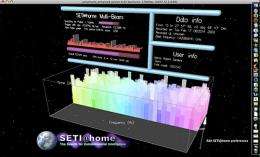
(PhysOrg.com) -- The world's largest and longest-running volunteer computing project, SETI@home, celebrates its tenth anniversary this month with 140,000 participants and 235,000 computers powering the search for intelligent signals from space.
No extraterrestrials have been found yet. But the project will hold a day-long symposium at the University of California, Berkeley's Space Sciences Laboratory on May 21 to celebrate the birthday and discuss the future of a project that still excites the public and has spurred the development of dozens of similar volunteer distributed computing projects.
Launched May 17, 1999, SETI@home uses home computers to sift through radio data acquired from the Arecibo Observatory in Puerto Rico in search of patterns that might indicate an intelligent source. The at-home Search for ExtraTerrestrial Intelligence (SETI) quickly attracted a worldwide following: Three months after its debut, 1 million people had signed up in 223 countries, running the screensaver software on home and work computers and in grade school classrooms, universities and even government offices.
Over the past decade, more than 5 million people have signed up, and today, despite more than 80 competing volunteer computing projects, SETI@home still has the largest core of dedicated users.
A big draw is being able to participate in a search that conceivably could detect life elsewhere in the universe - and to get credit for helping find ETs.
"The number of members has ebbed and flowed," said project director David Anderson, "but we have more computing power than ever, thanks to the steadily increasing power of computer processors."
The challenge, according to chief scientist Dan Werthimer, is scanning all frequencies, all areas of the sky, and all possible signal patterns for signs of extraterrestrial intelligence. During its 10 years of operation, SETI@home has steadily improved the capture of radio signals from the Arecibo radio telescope and subsequent signal analyses. Today, more frequencies are covered and more points in the sky are scanned simultaneously, and, as of March, the SETI@home software also searches for one-time pulses in addition to repeating signals.
SETI@home was conceived in 1995 when David Gedye, a software engineer now at Microsoft Live Labs, first thought about harnessing the immense, unused computing power of desktop computers around the world. He approached University of Washington astronomer Woody Sullivan, who suggested contacting Werthimer, whose SERENDIP project was already doing SETI at Arecibo. Gedye also called on the expertise of Anderson, a specialist in distributed computing. Together, the four developed a way to link desktop computers through the Internet into a virtual supercomputer able to perform complex signal analysis of Arecibo data.
Since the 1999 launch, a group led by Anderson has developed software called BOINC that lets scientists anywhere create projects like SETI@home and allows volunteers to mix and match these projects on their PCs. SETI@home moved to BOINC in 2005; other projects are using BOINC to study disease-related proteins (Rosetta@home), search for gravitational waves (Einstein@home), and predict the Earth's future climate (ClimatePrediction.net).
Boosting even more the number-crunching power of volunteer computers, SETI@home now uses not only CPUs (central processing units), but also the graphics processing units (GPUs) found in newer PCs.
"GPUs are much faster than CPUs at this point," Anderson said. A new version of SETI@home, released five months ago, automatically uses GPUs and typically runs about 10 times faster than the CPU version.
As for the radio data that feeds SETI@home, SERENDIP started collecting data two years ago from a new multibeam receiver at Arecibo that now brings in 14 times more data than the previous receiver with much greater sensitivity, all of it now feeding the number-crunching SETI@home computers. Now that the federal government is again funding SETI projects - software and hardware development for SETI searches through SERENDIP and the Allen Telescope Array, a joint project of UC Berkeley and the SETI Institute, are in part funded by the National Science Foundation and NASA - Werthimer is more optimistic about the future of SETI.
"It's scary that, until recently, only a handful of people on the planet were doing SETI, and all of them were aging," he said. "Now, it's changed."
SETI@home, however, remains a shoestring operation. It got off the ground with just $100,000 in funding from The Planetary Society and Paramount Pictures, and although companies like Sun Microsystems and Intel supply it with server computers, it is now solely funded by donations from volunteers, Werthimer said. But he and Anderson intend to keep it running as long as there is interest.
"We're in this for the long haul. We're looking for a needle in a haystack. It could take a hundred years," Werthimer said. "As long as we have some way to increase the sensitivity of our radio detectors or the frequency range or the part of the sky we're looking at, we'll still be doing something worthwhile."
Provided by University of California - Berkeley (news : web)


