Perfect Pitch: Language Wins Out Over Genetics
May 19, 2009 Tone language is key to perfect pitch

Enlarge

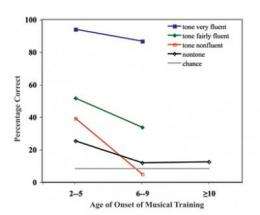
The figure shows, for each group and subgroup of subjects, the average percentage correct on the test for perfect pitch. Within each group, early musical training mattered. However, holding ethnicity constant, there was also an overwhelmingly strong effect of tone language fluency. Courtesy Diana Deutsch.

Mozart, Tchaikovsky, Sinatra and Hendrix -- these and many other of the world's most famous musicians have had "perfect" or "absolute" pitch. The ability, defined as recognizing the pitch of a musical note without having to compare it to any reference note, is quite rare in the U.S. and Europe, where only about one person in 10,000 is thought to have it. Often lumped into the mysterious realm of Talent, perfect pitch is - according to Diana Deutsch of the University of California, San Diego - probably more the result of nurture than nature, more environment than genes.

In a study published in the Journal of the Acoustical Society of America and being presented at the ASA meeting in Portland on May 21, Deutsch and her coauthors find that musicians who speak an East Asian tone fluently are much more likely to have perfect pitch.

"Perfect pitch for years seemed like a beautiful gift - given only to a few genetically endowed people. But our research suggests that it might be available to virtually everybody," Deutsch said.

Unlike English, many East Asian languages, such as Mandarin, Cantonese and Vietnamese, are "tonal," so that a word's meaning often depends on the tone in which it is said (not to be confused with intonation such as sarcasm). Deutsch surmises that learning perfect pitch is, for fluent speakers of a tone language, akin to learning a second tone language.

The study follows up on one Deutsch did in 1999, which found that native speakers of Vietnamese and Mandarin exhibited a form of perfect pitch in enunciating words, which led her to hypothesize that pitch was an extra-musical ability. Deutsch then set out to investigate perfect pitch in music. In 2004, she found that students at the Central Conservatory of Music in Beijing, China, all of whom spoke Mandarin, were almost nine times more likely to have perfect pitch than students at the Eastman School of Music in New York. That last study, however, left open the question of whether perfect pitch might be a genetic trait - since all the Mandarin speakers were East Asian.

The present study looked at 203 students at the University of Southern California's Thornton School of Music, all of whom agreed to take the test in class (so there was no self-selection in the sample). The students listened to the 36 notes that haphazardly spanned three octaves. They attempted to identify the notes, and they self-reported their musical, ethnic and linguistic backgrounds - including whether they were very fluent in an East Asian tone language, fairly fluent or not at all fluent. Deutsch and her colleagues found that students who spoke an East Asian tone language very fluently scored nearly 100 percent on the test, and that students who were only fairly fluent in a tone language scored lower overall. Those - either Caucasian or East Asian - who were not at all fluent in speaking a tone language scored the worst on average.

FLV player

Listen to the brief test. (Here are the answers to the brief test:D E G#/Ab C#/Db D#/Eb G)

Deutsch acknowledges that it still remains to be discovered why and how it is that some speakers of non-tone languages - Mozart, Sinatra et al., as well as Deutsch herself - have perfect pitch. She expects it to be related to either an exceptionally long "critical window" for language (and tone) acquisition, a very early musical upbringing, or both.

The research suggests, Deutsch said, that parents who want their kids to acquire perfect pitch should expose them to musical tones together with their verbal labels from infancy onwards.

"It also raises," she said, "the interesting question: What other exceptional abilities might be latent in an infant that we could bring out if we only knew what 'buttons' to push?"

Source: University of California - San Diego (news : web)


print this article email this article download pdf blog this article bookmark this article     Stumble it Digg this share on Facebook retweet share on Reddit add to delicious
Rate this story - 4 /5 (8 votes)

Rank Filter

Move the slider to adjust rank threshold, so that you can hide some of the comments.


Display comments: newest first

  • brant - May 19, 2009
    • Rank: not rated yet
    Try the Dave Berg Perfect pitch course.
  • KBK - May 19, 2009
    • Rank: not rated yet
    Famous Jesuit Priest quote: "Give me the child until he is seven and I will show you the man."


    Very frightening.
  • TJ_alberta - May 19, 2009
    • Rank: not rated yet
    American Idol, now made in China
  • el_gramador - May 20, 2009
    • Rank: not rated yet
    The thing about this is that it is sort of already known by psychologists everywhere. If you take into consideration that every child is a blank slate upon birth, and any information can be trained into him, then the question is one of ethicality rather than action. What I mean to say is, is it ethical to teach a child the meaning of the world, or is it fit to rear him for the system we already have in place?

May 19, 2009 all stories

Comments: 4

4 /5 (8 votes)
  • Stumble this up

  • Digg this

  • share this

  • hide
  • Related Stories

  • 'Perfect Pitch' in Humans Far More Prevalent than Expected
    created Aug 25, 2008 | popularity not rated yet | comments 0
  • Mandarin language is music to the brain
    created Dec 12, 2006 | popularity not rated yet | comments 0
  • Research finds music training 'tunes' human auditory system
    created Mar 12, 2007 | popularity not rated yet | comments 0
  • Learning a second language -- Is it all in your head?
    created Jul 25, 2007 | popularity not rated yet | comments 0
  • Linguist tunes in to pitch processing in brain
    created Feb 16, 2008 | popularity not rated yet | comments 0


  • hide
  • Relevant PhysicsForums posts

Other News

Growth in secular attitudes leaves Americans room for belief in God

Other Sciences / Social Sciences

created Oct 31, 2009 | popularity 4 / 5 (6) | comments 120

(PhysOrg.com) -- The nature of the American religious experience is changing as a rising number of people report having no formal religious affiliation, even though the number of Americans who say they pray is increasing, ...


Forest clearances sealed ancient civilisation's downfall

Forest clearances sealed ancient civilisation's downfall

Other Sciences / Archaeology & Fossils

created Nov 02, 2009 | popularity 4.9 / 5 (9) | comments 6

(PhysOrg.com) -- An ancient South American civilisation which disappeared around 1,500 years ago helped to cause its own demise by damaging the fragile ecosystem that held it in place, a study has found. ...


Oscar Pistorius

New study further disputes notion that amputee runners gain advantage from protheses

Other Sciences / Other

created Nov 04, 2009 | popularity 5 / 5 (4) | comments 5

A study by six researchers, including a University of Colorado at Boulder associate professor and his former doctoral student, shows that amputees who use running-specific prosthetic legs have no performance ...


Racial segregation key factor in subprime lending

Other Sciences / Economics

created Nov 06, 2009 | popularity 3 / 5 (2) | comments 3

(PhysOrg.com) -- New study examines impact of segregation on the prevalence of high-cost loans in U.S. metro areas. Subprime loans disproportionately located in segregated areas.


New theory on fairness in economics targets CEO pay

Other Sciences / Economics

created Nov 03, 2009 | popularity 4.3 / 5 (11) | comments 3

(PhysOrg.com) -- Chief executives in 35 of the top Fortune 500 companies were overpaid by about 129 times their "ideal salaries" in 2008, according to a new type of theoretical analysis proposed by a Purdue University researcher ...