Hubble departs shuttle for new discoveries
May 19, 2009 By MARCIA DUNN , AP Aerospace Writer
Hubble departs shuttle for new discoveries (AP)

Enlarge

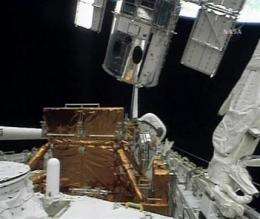
In this image from NASA TV, the Hubble Space Telescope, top, is lifted by the Shuttle Atlantis' robotic arm out of the shuttle's cargo bay Tuesday, May 19, 2009, in preparation for its release. (AP Photo/NASA TV)

(AP) -- A rejuvenated Hubble Space Telescope, more powerful than ever, departed the space shuttle Tuesday and sailed off for new discoveries.

"It's showtime for us now," said program scientist Eric Smith.

Hubble - considered to be at its prime following five days of repairs and upgrades - was gently dropped overboard by the shuttle astronauts, the last humans to see the 19-year-old observatory up close.

It was NASA's last service call and, despite spacewalking moments ranging from anguish to elation, turned out to be "a 110 percent successful mission," said senior project scientist David Leckrone.

"Today begins the second Hubble revolution," an emotional Leckrone said from Houston.

Smith happily ticked off a few of Hubble's early accomplishments: determining the age of the universe, finding dark matter, studying planets around other stars. "Now it's even better. I am really looking forward to what comes next," he said.

The shuttle and telescope had just crossed the Atlantic, and were soaring 350 miles above the coast of northwestern Africa, when operator Megan McArthur set Hubble free. Then the shuttle slowly backed away.

"It's safely back on its journey of exploration as we begin steps to conclude ours," radioed commander Scott Altman. "Looking back on this mission, it's been an incredible journey for us as well."

With Hubble flying on its own again, the seven astronauts looked ahead to Friday's planned landing. But first they had to inspect their ship one last time to make sure it had not suffered any serious damage from space junk. The wing and nose survey, similar to one performed last week to check for launch damage, consumed their afternoon.

The telescope's unusually high orbit had placed the shuttle and its crew at increased risk and, because of the lack of a refuge, prompted NASA to keep a rescue ship on standby until the end of the 11-day flight. To improve their safety, the astronauts dropped Atlantis into an egg-shaped orbit that is, much of the time, lower than the telescope's junk-ridden orbit.

During five consecutive days of spacewalks loaded with drama, Atlantis' crew labored tirelessly on the observatory. Four men working in teams of two gave the telescope two new high-powered science instruments and a suite of other up-to-date equipment, and fixed two broken instruments, something never before attempted in orbit.

The persevered, despite stuck bolts, ill-fitting gyroscopes and flyaway shreds of insulation. Two of them were ready to jump into spacewalking action one last time if a last-minute problem had cropped up Tuesday morning. None did.

At a news briefing, flight director Tony Ceccacci noted there were those "who thought we couldn't do this."

"They always told us, 'you're too aggressive, you're going to get in trouble,'" he said. "I don't want to say, we told you so, but we told you so."

The Hubble team hopes to resume celestial observations by the end of summer.

At the end of this month, the improved Hubble will take its first pictures, but only to make sure its instruments are working. The image will be a well-studied cluster of stars in the constellation Sagittarius that go by the boring name NGC6681. Astronomers have known about this group of stars for nearly 230 years. It is about 29,000 light years away.

Astronomers expect to get another five to 10 years of use out of the iconic telescope, thanks to the astronauts' extraordinary effort.

As for Hubble's future after that, there will be no more visits. Sometime after 2020, NASA will send a robotic craft to steer it back into the atmosphere and a watery grave. The spacewalkers installed a docking ring for just that purpose.

---

On the Net:

NASA: http://www.nasa.gov/mission-pages/hubble/main/index.html

©2009 The Associated Press. All rights reserved. This material may not be published, broadcast, rewritten or redistributed.

4.3 /5 (3 votes)  

Rank 4.3 /5 (3 votes)
Related Stories
Relevant PhysicsForums posts
  • Never ending outer space.....
    created22 hours ago
  • Neutron Star fragments?
    createdFeb 11, 2012
  • stationary or not?
    createdFeb 11, 2012
  • Scale of the Universe
    createdFeb 10, 2012
  • Titan's lack of impact craters
    createdFeb 09, 2012
  • Real pictures of black hole eating a star?
    createdFeb 08, 2012
  • More from Physics Forums - General Astronomy

More news stories

Salvage workers begin pumping fuel from Italian shipwreck

Salvage workers Sunday began pumping fuel from the shipwrecked Italian cruise liner Costa Concordia, a day ahead of schedule, officials said.

Space & Earth / Environment

created 7 hours ago | popularity 5 / 5 (1) | comments 0

Latin America mining boom clashes with conservation

Latin America is experiencing a mining boom as prices rise fuelled by a hike in global demand, but the region is also being hit by a wave of violent protests, strikes and rallies by environmentalists.

Space & Earth / Environment

created 15 hours ago | popularity 5 / 5 (1) | comments 1

Political leaders play key role in how worried Americans are by climate change: study

More than extreme weather events and the work of scientists, it is national political leaders who influence how much Americans worry about the threat of climate change, new research finds.

Space & Earth / Environment

created Feb 06, 2012 | popularity 5 / 5 (7) | comments 73

NASA budget will axe Mars deal with Europe: scientists

US President Barack Obama's budget proposal to be submitted next week for 2013 will cut NASA's budget by 20 percent and eliminate a major partnership with Europe on Mars exploration, scientists said Thursday.

Space & Earth / Space Exploration

created Feb 10, 2012 | popularity 5 / 5 (3) | comments 58

Humans may have helped the decline of African rainforests 3000 years ago

(PhysOrg.com) -- Large areas of rainforests in Central Africa mysteriously disappeared over three thousand years ago, to be replaced by savannas. The prevailing theory has been that the cause was a change ...

Space & Earth / Environment

created Feb 10, 2012 | popularity 4.1 / 5 (14) | comments 21 | with audio podcast report


Scientists discover molecular secrets of 2,000-year-old Chinese herbal remedy

For roughly two thousand years, Chinese herbalists have treated Malaria using a root extract, commonly known as Chang Shan, from a type of hydrangea that grows in Tibet and Nepal. More recent studies suggest that halofuginone, ...

New method to examine batteries -- MRI from the inside

There is an ever-increasing need for advanced batteries for portable electronics, such as phones, cameras, and music players, but also to power electric vehicles and to facilitate the distribution and storage of energy derived ...

A mitosis mystery solved: How chromosomes align perfectly in a dividing cell

Although the process of mitotic cell division has been studied intensely for more than 50 years, Whitehead Institute researchers have only now solved the mystery of how cells correctly align their chromosomes during symmetric ...

Google might launch Drive for cloud storage soon

(PhysOrg.com) -- Google's next big move, according to the Wall Street Journal, is a cloud storage service called Drive. Hardly first to the plate, Google is simply catching up to introducing its cloud reposi ...

Lab study raises questions over nano-particle impact

Tests involving chickens have raised questions about the impact on health from engineered nano-particles, the ultra-fine grains commonly used in drugs and processed foods, scientists said on Sunday.

Overeating may double risk of memory loss

New research suggests that consuming between 2,100 and 6,000 calories per day may double the risk of memory loss, or mild cognitive impairment (MCI), among people age 70 and older. The study was released today and will be ...