Big Bear Solar Observatory captures sun's magnetic field
May 19, 2009 Big Bear Solar Observatory captures sun's magnetic field better

Enlarge

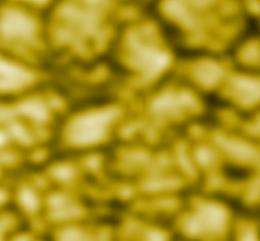
This image was degraded by the researchers to show what the old telescope would have seen. Credit: Big Bear Solar Observatory

NJIT's new 1.6-meter clear aperture solar telescope—the largest of its kind in the world—is now operational. The unveiling of this remarkable instrument—said to be the pathfinder for all future, large ground-based telescopes—could not have come at a more auspicious moment for science. This year marks the 400th anniversary of Galileo's telescope that he used to demonstrate that sunspots are indeed on the Sun.

"With our new big, beautiful white machine, Galileo's work can leap ahead with a capability never before available," said NJIT distinguished professor of physics Philip R. Goode. Goode, the heart and soul of the project, has been director of Big Bear Solar Observatory (BBSO), since NJIT took over management of BBSO in 1997 from California Institute of Technology. Located high above sea level in Big Bear Lake, CA, the observatory is one of six major land-based facilities supported by federal funding.
Big Bear Solar Observatory captures sun's magnetic field better
Enlarge

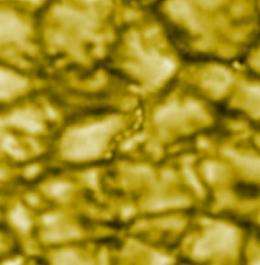
This photo is the first light image from the new solar telescope at Big Bear Solar Observatory. Credit: Big Bear Solar Observatory

"We are already seeing photos offering a better understanding of the Sun," said Goode. "With this instrument we should be able to have a better understanding of dynamic storms and space weather—which can have dramatic effects on Earth."

Earlier this month, researchers achieved what is called first scientific light. This means the is finally operational. To achieve its full powers, at least three more years of work will be needed. Photos from the first observations are still being processed.

Nevertheless, Goode and his researchers were able to extract a few unique images and one is shown here. It clearly illustrates the before-and-after capabilities of the old versus new telescope. "Our prized first image shows the Sun's ever-present, turbulent granular field with its largest granules being about the size of Alaska," Goode said. "The small, bright points in the dark lanes are the smallest-scale magnetic structures on the Sun. Look closely at the "after" photo (which you may want to enlarge) and you will see a string of pearls. Each pearl is a cross-section of an intense, single fiber of the Sun's magnetic field - the basic building block of the solar magnetism."

Goode adds that the Sun is now in a state of prolonged magnetic inactivity, perhaps the longest such time in a century. "The new telescope is ideal for studying the Sun as it rises from this strange state of quietude," he added.

The new instrument has three times the of the old telescope. It represents a significant advance in high-resolution observations of the Sun, since it has the largest aperture of any solar telescope in existence, said Goode. Other pluses include a marvelous location-- high in a Southern California mountain lake, and since it is an off-axis instrument, there is no part of sunlight blocked by the telescope, itself.

The new telescope will be used in joint observation campaigns with NASA satellites to optimize the scientific output of all observations of the . BBSO has always operated in such campaigns, but now can do so with greatly-enhanced capabilities. The National Science Foundation (NSF), Air Force Office of Special Research (AFOSR) and NASA have provided more than $5 million in hardware components.

The telescope is filled with new technologies. The 1.7-meter (equivalent to 4.6 feet) primary mirror was polished by the world-renowned Steward Observatory Mirror Laboratory at the University of Arizona (UA). The extremely-precise measurements of the mirror's shape required the application, for the first time, of a computer-generated hologram. The development of this technology will be essential for figuring the next generation of even-larger night time telescopes. The final error in the primary mirror is only a few parts in a billion from its desired parabolic shape. "Buddy Martin at the UA Mirror Lab has described the mirror in ours as the pathfinder for large nighttime telescopes that are about-to-be built," said Goode.
Big Bear Solar Observatory captures sun's magnetic field better
Enlarge

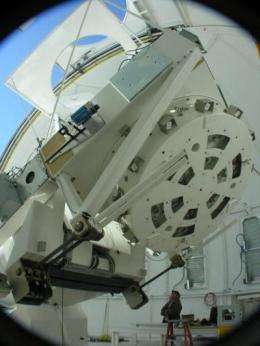
This is the new solar telescope at Big Bear Solar Observatory. Credit: Big Bear Solar Observatory

Another key design issue for this large-aperture solar telescope was the creation of a thermal control system capable of maintaining the temperature of the mirrors near or below ambient air. To achieve this, the dome employs a wind-gate and exhaust system which controls the airflow from the wind.

The structure maintains the same temperature inside and outside the dome, and clears concentrations of heat in and around the optical paths. In addition, BBSO engineers implemented a closed-cycle, chilled-air system as part of the telescope mount to limit so-called "mirror seeing." This sweeps away turbulent cells and directly cools the primary mirror. After a day of observations, the mirror must be cooled overnight to ensure that it is somewhat cooler than ambient in the morning.

DFM Engineering, Longmont, CO, built and tested the optical support structure and active-support mirror cell for the enormous mirror. It is supported by 36 actuators that can bend out low-order aberrations, such as those due to gravity and/or thermal effects.

The telescope is now in its commissioning phase in which more sophisticated observations are made possible with the implementation of advanced hardware. These include adaptive optics to correct for atmospheric distortion and hardware to measure magnetic fields in visible and infrared light.

"It is good at last to have our destiny in our own hands rather than those of our capable partners," said Goode. "Seeing first light was a great moment because the team in BBSO finally knew that its big white machine works as we had planned."

Source: New Jersey Institute of Technology


print this article email this article download pdf blog this article bookmark this article     Stumble it Digg this share on Facebook retweet share on Reddit add to delicious
Rate this story - 4.7 /5 (12 votes)

Rank Filter

Move the slider to adjust rank threshold, so that you can hide some of the comments.


Display comments: newest first

  • omatumr - May 19, 2009
    • Rank: 1 / 5 (1)
    CONGRATULATIONS!

    Professor Goode and staff members of the Big Bear Solar Observatory (BBSO) are to be congratulated.

    Hopefully the new instrument will bring a better understanding of the familiar cycles of magnetic activity at the solar surface that are historically linked with changes in Earth's climate.

    With kind regards,
    Oliver K. Manuel
    http://www.omatumr.com

  • deatopmg - May 19, 2009
    • Rank: 5 / 5 (1)
    @OKM; This ignored work pretty much explains those cycles;

    http://nzclimates...2707.pdf

    I hope BBSO can contribute more.
  • omatumr - May 20, 2009
    • Rank: 1 / 5 (1)
    Thanks,

    Please see also the data and references to observations on the link of solar magnetic activity to our climate in "Earth's heat source - The Sun," Energy & Environment 20 (2009) pages 131-144.

    http://arxiv.org/abs/0905.0704

    With kind regards,
    Oliver K. Manuel
    http://www.omatumr.com
  • Damon_Hastings - May 20, 2009
    • Rank: 5 / 5 (1)
    Guys, this article is about a telescope. Not AGW. Let's not start another debate here, shall we?
  • brant - Jul 22, 2009
    • Rank: 5 / 5 (1)
    "Each pearl is a cross-section of an intense, single fiber of the Sun's magnetic field - the basic building block of the solar magnetism."

    No, no, no. There are no such thing as magnetic field lines. They are a pedagogical construct to represent field strength and direction at that point in space and time.

    And magnetism is caused by electrical currents.

    This article ignores basic physics.
  • omatumr - Aug 08, 2009
    • Rank: 1 / 5 (1)
    And magnetism is caused by electrical currents.

    This article ignores basic physics.


    Solar magnetic fields probably arise from:

    a.) Bose-Einstein condensation of iron-rich, zero-spin material into a rotating, superfluid, superconductor surrounding the solar core, and/or

    b.) Superfluidity and quantized vortices of nucleon-paired Fermions in the Sun's neutron core [1].

    http://tinyurl.com/2et3mc

    With kind regards,
    Oliver K. Manuel
    http://www.omatumr.com

    1. "Superfluidity in the solar interior: Implications for solar eruptions and climate", Journal of Fusion Energy 21 (December 2002) 193-198: http://arxiv.org/.../0501441


May 19, 2009 all stories

Comments: 6

4.7 /5 (12 votes)
  • Stumble this up

  • Digg this

  • share this

  • hide
  • Related Stories


  • hide
  • Relevant PhysicsForums posts

  • The shape of our solar system's orbits.
    created 4 hours ago
  • Above or Below the Line of Nodes
    created 8 hours ago
  • Supernova vs. Nova?
    created 14 hours ago
  • Supernova's Gamma Rays and Comets
    created Nov 06, 2009
  • Our Moon
    created Nov 06, 2009
  • Question about a Carl Zeiss lens
    created Nov 05, 2009
  • More from Physics Forums - General Astronomy

Other News

Seattle team wins $900,000 in Space Elevator Games (AP)

Seattle team wins $900,000 in Space Elevator Games

Space & Earth / Space Exploration

created 17 hours ago | popularity 5 / 5 (6) | comments 4

(AP) -- A Seattle team has collected a $900,000 prize in a NASA-backed competition to develop the concept of an elevator to space - an idea spurred by science fiction novels.


Russian rocket to launch from French Guiana in 2010

Space & Earth / Space Exploration

created 17 hours ago | popularity 5 / 5 (2) | comments 0

A Russian rocket will next year for the first time blast off from a European launch pad in South America, officials said Saturday, as the first rockets headed for the site on board a ship.


Success in 'space elevator' competition (AP)

Success in 'space elevator' competition (Update 3)

Space & Earth / Space Exploration

created Nov 05, 2009 | popularity 4.3 / 5 (32) | comments 50

(AP) -- A robot powered by a ground-based laser beam climbed a long cable dangling from a helicopter on Wednesday to qualify for prize money in a $2 million competition to test the potential reality of the ...


Space hotel taking bookings for 2012 opening

Space hotel taking bookings for 2012 opening

Space & Earth / Space Exploration

created Nov 05, 2009 | popularity 4.3 / 5 (19) | comments 11

(PhysOrg.com) -- The first orbiting space hotel is on track to open for its first customers in 2012, but hurry, as bookings are filling fast.


'Dropouts' pinpoint earliest galaxies

'Dropouts' pinpoint earliest galaxies

Space & Earth / Astronomy

created Nov 06, 2009 | popularity 4.1 / 5 (9) | comments 11

Astronomers, conducting the broadest survey to date of galaxies from about 800 million years after the Big Bang, have found 22 early galaxies and confirmed the age of one by its characteristic hydrogen signature ...