Survey finds slower decline of honeybee colonies
May 20, 2009 By GARANCE BURKE , Associated Press Writer
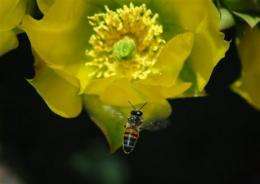
A bee descends on a blooming cactus flower Tuesday morning, May 19, 2009, at Cielo Grande Recreation Area in Roswell, N.M. Federal officials say the decline of honeybee colonies may have slowed slightly but warn that mysterious ailments are still affecting the insects. U.S. Department of Agriculture researchers found that honeybee colonies declined by 29 percent between September 2008 and early April. (AP Photo/Roswell Daily Record Mark Wilson)
(AP) -- The decline of honeybee colonies has slowed slightly since last fall, but a mysterious combination of ailments is still decimating the insect's population, federal researchers say.
U.S. Department of Agriculture researchers found that honeybee colonies declined by 29 percent between September 2008 and early April. That's an improvement over the last two years, when researchers found that 32 percent and 36 percent of all beekeepers surveyed lost hives.
Domestic honeybee stocks have been waning since 2004 because of a puzzling illness scientists called colony collapse disorder, which causes adult bees to inexplicably forsake their broods. Bees now appear also to be suffering from other ailments.
Honeybees help pollinate many fruits and vegetables, including blueberries, tomatoes, apples and almonds.
The disorder has killed off the weakest colonies in recent years, and now pesticide drift and old foes such as the parasitic varroa mite are more likely threatening those that survived, said Jerry Hayes, a former president of the Apiary Inspectors of America, whose members helped carry out the survey.
"Whether it's CCD or pesticides, fungicides or chemicals affecting how the queens respond, I don't know that beekeepers care," said Hayes, chief of the apiary sector of the Florida Department of Agriculture. "The ones who I talk to are just beside themselves. If you are a small business person how many years of 30 percent losses can you take?"
Regardless of the cause, bees are still dying at rates that could put some keepers out of business, said Jeff Pettis, the USDA's top bee scientist.
The survey released Tuesday included 787 beekeepers who account for 20 percent of the country's approximately 2.3 million commercially managed bee hives. The data - collected through a spring telephone survey in which researchers polled keepers about how many of their hives survived the fall and winter, when queens go dormant - is being prepared for submission to a journal.
©2009 The Associated Press. All rights reserved. This material may not be published, broadcast, rewritten or redistributed.
-
Bee keepers across U.S. suffering losses
Apr 24, 2007 |
not rated yet |
0
-
Hives ferment a yeasty brew, attract beetle pest
May 16, 2007 |
not rated yet |
0
-
Probing Question: What's killing the honey bees?
Mar 01, 2007 |
not rated yet |
0
-
Genetic diversity in honeybee colonies boosts productivity
Jul 20, 2007 |
not rated yet |
0
-
Bee researchers close in on Colony Collapse Disorder
Sep 06, 2007 |
not rated yet |
0
-
Engineers build first sub-10-nm carbon nanotube transistor
Feb 01, 2012 |
4.9 / 5 (31) |
30
-
Something old, something new: Evolution and the structural divergence of duplicate genes
Jan 31, 2012 |
4.6 / 5 (7) |
1
-
The hidden nanoworld of ice crystals: Revealing the dynamic behavior of quasi-liquid layers
Jan 30, 2012 |
5 / 5 (3) |
1
-
Stock market network reveals investor clustering
Jan 27, 2012 |
3.9 / 5 (23) |
8
-
Of microchemistry and molecules: Electronic microfluidic device synthesizes biocompatible probes
Jan 26, 2012 |
5 / 5 (1) |
0
-
Mitosis
5 hours ago
-
Stem cell question.
7 hours ago
-
Protease cleavage
13 hours ago
-
Pertubance in a model
20 hours ago
-
Cancer drugs and Alzheimer's, Oh my!
Feb 09, 2012
-
Squishing cells
Feb 09, 2012
- More from Physics Forums - Biology
More news stories
The power of estrogen -- male snakes attract other males
A new study has shown that boosting the estrogen levels of male garter snakes causes them to secrete the same pheromones that females use to attract suitors, and turned the males into just about the sexiest ...
18 hours ago |
4.8 / 5 (6) |
2
|
Grass to gas: Researchers' genome map speeds biofuel development
Researchers at the University of Georgia have taken a major step in the ongoing effort to find sources of cleaner, renewable energy by mapping the genomes of two originator cells of Miscanthus x giganteus, a large perenn ...
15 hours ago |
3.8 / 5 (5) |
0
|
Miami battling invasion of giant African snails
No one knows how they got there. But an invasion of African giant snails has southern Florida in a panic over potential crop damage, disease and general yuckiness surrounding the slimy gastropods.
22 hours ago |
4 / 5 (1) |
4
Experts reveal how plants don't get sunburn
(PhysOrg.com) -- Experts at the University of Glasgow have discovered how plants survive the harmful rays of the sun.
18 hours ago |
4.8 / 5 (5) |
0
|
Protein libraries in a snap
(PhysOrg.com) -- A Rice University undergraduate will depart with not only a degree but also a possible patent for his invention of an efficient way to create protein libraries, an important component of biomolecular ...
22 hours ago |
4.8 / 5 (4) |
1
|
Anonymous knocks CIA website offline (Update)
The website of the Central Intelligence Agency was inaccessible on Friday after the hacker group Anonymous claimed to have knocked it offline.
New error-correcting codes guarantee the fastest possible rate of data transmission
Error-correcting codes are one of the triumphs of the digital age. Theyre a way of encoding information so that it can be transmitted across a communication channel such as an optical fiber o ...
Humans may have helped the decline of African rainforests 3000 years ago
(PhysOrg.com) -- Large areas of rainforests in Central Africa mysteriously disappeared over three thousand years ago, to be replaced by savannas. The prevailing theory has been that the cause was a change ...
New power source discovered
(PhysOrg.com) -- Researchers at the Massachusetts Institute of Technology (MIT) and RMIT University have made a breakthrough in energy storage and power generation.
Small modular reactor design could be a 'SUPERSTAR'
(PhysOrg.com) -- Though most of today's nuclear reactors are cooled by water, we've long known that there are alternatives; in fact, the world's first nuclear-powered electricity in 1951 came from a reactor ...
Google users warned of threat to smartphone wallets
Users of Google smartphone wallets were being warned on Friday that there is a way to crack pass codes intended to thwart thieves from going on illicit shopping sprees.