May 20, 2009 feature
Magnetic Cactus Experimentally Demonstrates Mathematical Plant Patterns
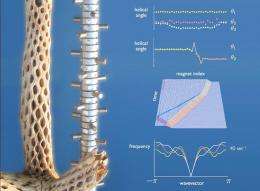
(PhysOrg.com) -- One of humanity’s earliest mathematical inquiries might have involved the geometric patterns in plants. The arrangement of leaves on a branch, seeds in a sunflower, and spines on a cactus appear with an intriguing regularity, providing a simple demonstration of mathematically complex patterns.
In a recent study, researchers have experimentally demonstrated for the first time a celebrated model of “phyllotaxis,” the study of mathematical regularities in plants. In 1991, S.L. Levitov proposed a model of phyllotaxis suggesting that the appearance of the Fibonacci sequence and golden mean in the pattern of spines on a cactus can be replicated for cylindrically constrained, repulsive objects. Now, researchers have constructed a “magnetic cactus” with 50 outward-pointing magnets acting as spines, which are mounted on bearings and free to rotate on a vertical axis acting as the plant stem. With this setup, the researchers, from Los Alamos National Laboratory in New Mexico; Cornell University in Ithaca, New York; and The Pennsylvania State University (PSU), have verified Levitov’s model, and their study has been published in a recent issue of Physical Review Letters.
In their experiment, the researchers put the system in a low-energy state by mechanical agitation. Then the scientists observed as the magnets (spines) arranged to form phyllotactic spirals, generating a so-called Farey tree of unfavorable angles. The unfavorable angles are fractional multiples of 2π (i.e. 2πi/j, such as 2π/3, 4π/3, etc.). The spines on the magnetic cactus, like those on a plant, form a helix around the cylindrical stem by growing around these particular angles.
The mathematical regularity of these static patterns of phyllotaxis surprised the researchers, until they made an even more surprising discovery. They found that the statics of phyllotaxis had been intriguing historical figures for the past several centuries and more.
“Initially, we rediscovered all of static phyllotaxis, not realizing that it had already been discovered and investigated by figures such as Kepler, da Vinci, Bravais, and even the ancient Romans/Greeks,” coauthor Vincent Crespi, a physics professor at PSU, told PhysOrg.com. “We were quite excited by the beautiful mathematics and physics of the static ground-state energy plots, with the commensurate peaks and valleys in between. Then Cristiano [Nisoli, lead author from PSU and Los Alamos] found Levitov's paper explaining similar static physics, but in a layered geometry. Only after that did we realize that our system had strong connections to biological phyllotaxis as well. We had made an independent re-discovery - several centuries later!”
Once the researchers realized that they had rediscovered static phyllotaxis, they decided to investigate the dynamics. Dynamic phyllotaxis had not previously been explored since historically people had been thinking in terms of biological systems. As Crespi explained, biological systems are highly damped and so don't have well-defined phonons or soliton modes.
“Having approached the system from the physics end, we were naturally equipped and disposed to study dynamics,” he said. “Cristiano's simulations of the dynamical system, coupled to Nathan [Gabor, coauthor from PSU and Cornell] and Jay's [Maynard, coauthor from PSU] experiments with the physical magnet system, then revealed fascinating new physics in the dynamical regime.”
The team found that the dynamics of the magnetic cactus reveal interesting physical processes. The researchers observed unusual excitations in the cactus’ energy landscape. For instance, the domain walls that separate regions of different dynamics can move axially while rotating. These domain wall “kinks” can convert a potential energy difference into rotational kinetic energy, moving as solitons, which are pulses with unusually rich properties. The researchers observed other excitations (rotons and maxons) having a classical origin, even though these excitations were previously thought to be intrinsically quantum mechanical when observed in helium superfluids.
The researchers explain that both the static and dynamic effects of phyllotaxis are purely geometrical. The various patterns can be described by the simple fact that a spine’s nearest neighbors in one dimension (along the stem) are not its nearest neighbors in three dimensions (around the curved surface of the stem).
Because phyllotaxis has a purely geometrical origin, the scientists explain that the excitations observed here could appear across nearly every field of physics. For example, similar dynamics could occur in crystallized ion beams, in which the system self-organizes into concentric cylindrical shells. Dynamical phyllotaxis could also occur in other physical systems such as Wigner crystals in curved nanostructures and trapped ions in cylindrical potentials, and have applications in electronics.
“The physical regime itself is defined in purely geometrical terms, so it is quite general across many sub-fields of physics,” Crespi said. “I am quite curious about the extension to the quantum regime, and also the charge-transport properties of a pinned lattice. If the lattice itself is pinned by external disorder (which is commonly the case), then the system will transport charge via motion of solitons (which, when the axial degree of freedom is released, will have a slightly different density than the rest of the system and hence carry charge). Different solitons will carry different charges, and when the solitons collide and/or merge, they can change identity and so change their charge. Quasiparticles that don't conserve (mobile) charge in collisions is a quite unusual regime. Novel physical regimes such as that always carry the potential for unanticipated new physics and new applications.”
More information: Cristiano Nisoli, Nathaniel M. Gabor, Paul E. Lammert, J.D. Maynard, and Vincent H. Crespi. “Static and Dynamical Phyllotaxis in a Magnetic Cactus.” Physical Review Letters 102, 186103 (2009).
Copyright 2009 PhysOrg.com.
All rights reserved. This material may not be published, broadcast, rewritten or redistributed in whole or part without the express written permission of PhysOrg.com.


