Asteroid Attack 4 Billion Years Ago May Have Accelerated Life on Earth
May 20, 2009
Asteroid attack 3.9 billion years ago may have enhanced early life on Earth, says CU-Boulder study

Enlarge

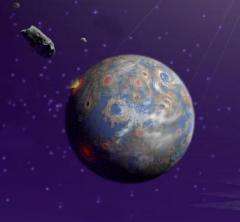
The bombardment of Earth by asteroids 3.9 billion years ago may have enhanced early life, according to a new University of Colorado study. Image: NASA/JPL

(PhysOrg.com) -- The bombardment of Earth nearly 4 billion years ago by asteroids as large as Kansas would not have had the firepower to extinguish potential early life on the planet and may even have given it a boost, says a new University of Colorado at Boulder study.

Impact evidence from lunar samples, meteorites and the pockmarked surfaces of the inner planets paints a picture of a violent environment in the solar system during the Hadean Eon 4.5 to 3.8 billion years ago, particularly through a cataclysmic event known as the Late Heavy Bombardment about 3.9 million years ago. Although many believe the bombardment would have sterilized , the new study shows it would have melted only a fraction of Earth's crust, and that microbes could well have survived in subsurface habitats, insulated from the destruction.

"These new results push back the possible beginnings of life on Earth to well before the bombardment period 3.9 billion years ago," said CU-Boulder Research Associate Oleg Abramov. "It opens up the possibility that life emerged as far back as 4.4 billion years ago, about the time the first oceans are thought to have formed."

A paper on the subject by Abramov and CU-Boulder geological sciences Professor Stephen Mojzsis appears in the May 21 issue of Nature.

Because physical evidence of Earth's early bombardment has been erased by weathering and plate tectonics over the eons, the researchers used data from Apollo moon rocks, impact records from the moon, Mars and Mercury, and previous theoretical studies to build three-dimensional computer models that replicate the bombardment. Abramov and Mojzsis plugged in asteroid size, frequency and distribution estimates into their simulations to chart the damage to the Earth during the Late Heavy Bombardment, which is thought to have lasted for 20 million to 200 million years.

The 3-D models allowed Abramov and Mojzsis to monitor temperatures beneath individual craters to assess heating and cooling of the crust following large impacts in order to evaluate habitability, said Abramov. The study indicated that less than 25 percent of Earth's crust would have melted during such a bombardment.

The CU-Boulder researchers even cranked up the intensity of the asteroid barrage in their simulations by 10-fold -- an event that could have vaporized Earth's oceans. "Even under the most extreme conditions we imposed, Earth would not have been completely sterilized by the bombardment," said Abramov.

Instead, hydrothermal vents may have provided sanctuaries for extreme, heat-loving microbes known as "hyperthermophilic bacteria" following bombardments, said Mojzsis. Even if life had not emerged by 3.9 billion years ago, such underground havens could still have provided a "crucible" for life's origin on Earth, Mojzsis said.

The researchers concluded subterranean microbes living at temperatures ranging from 175 degrees to 230 degrees Fahrenheit would have flourished during the Late Heavy Bombardment. The models indicate that underground habitats for such microbes increased in volume and duration as a result of the massive impacts. Some extreme microbial species on Earth today -- including so-called "unboilable bugs" discovered in hydrothermal vents in Yellowstone National Park -- thrive at 250 F.

Geologic evidence suggests that life on Earth was present at least 3.83 billion years ago, said Mojzsis. "So it is not unreasonable to suggest there was life on Earth before 3.9 billion years ago. We know from the geochemical record that our planet was eminently habitable by that time, and this new study sews up a major problem in origins of life studies by sweeping away the necessity for multiple origins of life on Earth."

Most planetary scientists believe a rogue planet as large as Mars smacked Earth with a glancing blow 4.5 billion years ago, vaporizing itself and part of Earth. The collision would have created an immense vapor cloud from which moonlets, and later our moon, coalesced, Mojzsis said. "That event, which preceded the Late Heavy Bombardment by at least 500 million years, would have effectively hit Earth's re-set button," he said.

"But our results strongly suggest that no events since the moon formation were capable of destroying Earth's crust and wiping out any biosphere that was present," Mojzsis said. "Instead of chopping down the tree of life, our view is that the bombardment pruned it."

The results also support the potential for microbial life on other planets like Mars and perhaps even rocky, Earth-like planets in other solar systems that may have been resurfaced by impacts, said Abramov.

"Exactly when life originated on Earth is a hotly debated topic," says NASA's Astrobiology Discipline Scientist Michael H. New, manager of the Exobiology and Evolutionary Biology program. "These findings are significant because they indicate life could have begun well before the LHB, during the so-called Hadean Eon of Earth's history 3.8 billion to 4.5 billion years ago."

Source: University of Colorado at Boulder (news : web)

4.5 /5 (14 votes)  

Filter


Move the slider to adjust rank threshold, so that you can hide some of the comments.


Display comments: newest first

out7x
May 21, 2009

Rank: 3.7 / 5 (3)
Apex chert, NW Australia, fossils 3.465Byr, cyanobacteria prokaryotes, already evolved.
KBK
May 25, 2009

Rank: 1 / 5 (1)
The Sumerian cuneiform tablets and archeological digs that were demolished when Iraq was invaded (the raping of the Baghdad museum on the very night of the bombardment is VERY telling!!!) would have told us this in specific detail. Yes, 12,000-6,000 year old cuneiform tablets had specific and prolific detail on the collision between a planet called 'Tiamat' and earth at that exact time period. Plus the information on a total of ~twelve~ original planets in the system.

That and other information which was FAR, FAR more explosive ---was eradicated.

Some of that information survives today in various cuneiform tablets that came before the invasion. The information in the museum was far more explicit, detailed,and involved. The conclusions they contained..were inescapable. They would have damned almost everything we know about history, archeology, humankind and specifically -technology-..to the trash bin. Worth invading a country for? When all that exists and runs the world today becomes HIGHLY suspect? What do you think?

Some say that this huge amount of explosive scientific data (alternative technologies and the specific devices) was the real reason that Iraq was invaded. for example, there was a HUGE 400 acre dig site right outside of Baghdad, before the invasion. It was considered/emerging as -THE- most important dig site in the history of mankind.

Now we have a 400 acre 'green zone' and not one single word has ever been heard about it again.

Think about that for a while.

If you think the whole consideration is wrong and psychotic..then look around. Look into it. Prove me wrong.

Thank you for your time.
wawadave
May 26, 2009

Rank: not rated yet
Makes perfect sense.And it would be hard to kill off all microbes at the same time every where.
Rank 4.5 /5 (14 votes)
Related Stories
Relevant PhysicsForums posts
  • Discrepancy between oxygen and carbon-dioxide levels
    createdFeb 09, 2012
  • where gems are found in the world
    createdFeb 09, 2012
  • Wind Waves in Reservoir ~ Wind run-up and Wind set-up
    createdFeb 08, 2012
  • Balance of oxygen in the atmosphere
    createdFeb 01, 2012
  • The case for a methanol-based economy
    createdJan 30, 2012
  • Weather in a rotating cylinder
    createdJan 25, 2012
  • More from Physics Forums - Earth

More news stories

Humans may have helped the decline of African rainforests 3000 years ago

(PhysOrg.com) -- Large areas of rainforests in Central Africa mysteriously disappeared over three thousand years ago, to be replaced by savannas. The prevailing theory has been that the cause was a change ...

Space & Earth / Environment

created Feb 10, 2012 | popularity 4.3 / 5 (13) | comments 13 | with audio podcast report

Could Venus be shifting gear?

(PhysOrg.com) -- ESA’s Venus Express spacecraft has discovered that our cloud-covered neighbour spins a little slower than previously measured. Peering through the dense atmosphere in the infrared, the ...

Space & Earth / Space Exploration

created 20 hours ago | popularity 5 / 5 (7) | comments 8 | with audio podcast

NASA budget will axe Mars deal with Europe: scientists

US President Barack Obama's budget proposal to be submitted next week for 2013 will cut NASA's budget by 20 percent and eliminate a major partnership with Europe on Mars exploration, scientists said Thursday.

Space & Earth / Space Exploration

created 23 hours ago | popularity 5 / 5 (2) | comments 20

Mars Science Laboratory computer issue resolved

(PhysOrg.com) -- Engineers have found the root cause of a computer reset that occurred two months ago on NASA's Mars Science Laboratory and have determined how to correct it.

Space & Earth / Space Exploration

created 21 hours ago | popularity 4.7 / 5 (6) | comments 4 | with audio podcast

Two new moons for Jupiter

Advances in technology have lead to the discovery of new planets outside of our Solar System, and now even new moons in our own backyard.

Space & Earth / Space Exploration

created 20 hours ago | popularity 4 / 5 (1) | comments 7


Anonymous knocks CIA website offline (Update)

The website of the Central Intelligence Agency was inaccessible on Friday after the hacker group Anonymous claimed to have knocked it offline.

New error-correcting codes guarantee the fastest possible rate of data transmission

Error-correcting codes are one of the triumphs of the digital age. They’re a way of encoding information so that it can be transmitted across a communication channel — such as an optical fiber o ...

Small modular reactor design could be a 'SUPERSTAR'

(PhysOrg.com) -- Though most of today's nuclear reactors are cooled by water, we've long known that there are alternatives; in fact, the world's first nuclear-powered electricity in 1951 came from a reactor ...

New power source discovered

(PhysOrg.com) -- Researchers at the Massachusetts Institute of Technology (MIT) and RMIT University have made a breakthrough in energy storage and power generation.

The power of estrogen -- male snakes attract other males

A new study has shown that boosting the estrogen levels of male garter snakes causes them to secrete the same pheromones that females use to attract suitors, and turned the males into just about the sexiest ...

Google users warned of threat to smartphone wallets

Users of Google smartphone wallets were being warned on Friday that there is a way to crack pass codes intended to thwart thieves from going on illicit shopping sprees.