NASA Conducts First Ares I Rocket Cluster Parachute Test
May 20, 2009 NASA Conducts First Ares I Rocket Cluster Parachute Test

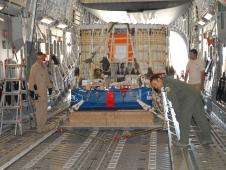
NASA and ATK test engineers at the US Army's Yuma Proving Ground prepare for the first test of all three Ares I main parachutes. Image Credit: U.S. Army Yuma Proving Grounds

(PhysOrg.com) -- Unfurling in majestic patriotic colors, a successful cluster test of the Ares I rocket's three, 1-ton main parachutes was conducted May 20 by NASA and industry engineers at the U.S. Army Yuma Proving Ground located near Yuma, Ariz. The main parachute is designed to slow the rapid descent of the spent first-stage motor and permit its recovery for use on future flights.

The Ares I, the first being designed for NASA's Constellation Program, will launch explorers to the , the moon and beyond in coming decades. The main parachutes -- the largest rocket parachute ever manufactured -- measure 150 feet in diameter and weigh 2,000 pounds each. They serve as the central element of the rocket's deceleration system, which includes a pilot parachute, a drogue parachute and the main parachutes. Deployed in a cluster, the main parachutes open at the same time, providing the drag necessary to slow the descent of the huge solid rocket motor for a soft landing in the ocean.

"The successful main chute cluster test today confirms the development and design changes we have implemented for the Ares I first stage recovery system," said Ron King, Ares I first stage deceleration subsystem manager for the Ares Projects at NASA's Marshall Space Flight Center in Huntsville, Ala. "Thanks to our great collaborative team the test went as anticipated and all of our design objectives were met."

Engineers from the Marshall Center managed the team that conducted this first cluster test with the newly designed parachutes. This was the eighth in an ongoing series of flight tests supporting development of the Ares I parachute recovery system. Researchers dropped the 41,500-pound load from a U.S. Air Force C-17 aircraft flying at an altitude of 10,000 feet. The parachutes and all test hardware functioned properly and landed safely.

As the test series progresses, engineers perform three classifications of testing: development, design load and overload. Each level of testing is designed to fully test the performance of the new parachute design with different size payloads and under varying conditions. The next test in the cycle -- scheduled for fall 2009 -- will involve the first design limit load test of a single main parachute.

The recovery system currently under development uses parachutes similar to those used for the four-segment space shuttle boosters, but they have been redesigned to accommodate new requirements of the Ares I first stage. The Ares I will have a five-segment solid rocket booster that will fly faster and fall from a higher altitude than the shuttle boosters.

Situated in the southwestern Arizona, the Army proving ground -- the site of more than 36,000 annual drops -- is in the heart of the great Sonoran Desert. Located near the Arizona-California state lines and adjacent to the Colorado River, it’s approximately 24 miles north of the city of Yuma.

ATK Space Systems near Promontory, Utah, is the prime contractor for the first stage booster. ATK's subcontractor, United Space Alliance of Houston, is responsible for design, development and testing of the parachutes at its facilities at NASA's Kennedy Space Center, Fla.

Provided by JPL/NASA (news : web)


print this article email this article download pdf blog this article bookmark this article     Stumble it Digg this share on Facebook retweet share on Reddit add to delicious
Rate this story - 4 /5 (1 vote)


May 20, 2009 all stories

Comments: 0

4 /5 (1 vote)
  • Stumble this up

  • Digg this

  • share this

  • hide
  • Related Stories

  • NASA Successfully Tests Parachute for Ares Rocket
    created Mar 02, 2009 | popularity not rated yet | comments 0
  • NASA Successfully Tests Parachute for Ares Rocket
    created Jul 25, 2008 | popularity not rated yet | comments 0
  • NASA to Test World's Largest Rocket Parachutes for Ares I
    created May 18, 2009 | popularity not rated yet | comments 0
  • NASA Conducts Second Test of Main Parachute for Ares Rockets
    created Nov 16, 2007 | popularity not rated yet | comments 0
  • Test in Development of NASA's New Crew Rocket is Successful
    created Jan 30, 2009 | popularity not rated yet | comments 0


  • hide
  • Relevant PhysicsForums posts

  • The shape of our solar system's orbits.
    created Nov 07, 2009
  • Above or Below the Line of Nodes
    created Nov 07, 2009
  • Supernova vs. Nova?
    created Nov 07, 2009
  • Supernova's Gamma Rays and Comets
    created Nov 06, 2009
  • More from Physics Forums - General Astronomy

Other News

Deep creep means milder, more frequent earthquakes along Southern California's San Jacinto fault

Deep creep means milder, more frequent earthquakes along Southern California's San Jacinto fault

Space & Earth / Earth Sciences

created 11 hours ago | popularity 4.7 / 5 (3) | comments 0

With an average of four mini-earthquakes per day, Southern California's San Jacinto fault constantly adjusts to make it a less likely candidate for a major earthquake than its quiet neighbor to the east, the ...


Success in 'space elevator' competition (AP)

Success in 'space elevator' competition (Update 3)

Space & Earth / Space Exploration

created Nov 05, 2009 | popularity 4.3 / 5 (33) | comments 50

(AP) -- A robot powered by a ground-based laser beam climbed a long cable dangling from a helicopter on Wednesday to qualify for prize money in a $2 million competition to test the potential reality of the ...


In a Galaxy Far, Far Away...

In a Galaxy Far, Far Away...

Space & Earth / Astronomy

created Nov 06, 2009 | popularity 4.8 / 5 (5) | comments 16

(PhysOrg.com) -- Astronomers have published the discovery of the farthest known object in the cosmos: a star that exploded when the universe was only 630 million years old -- only 4.6% of its current age. ...


'Dropouts' pinpoint earliest galaxies

'Dropouts' pinpoint earliest galaxies

Space & Earth / Astronomy

created Nov 06, 2009 | popularity 4.2 / 5 (10) | comments 13

Astronomers, conducting the broadest survey to date of galaxies from about 800 million years after the Big Bang, have found 22 early galaxies and confirmed the age of one by its characteristic hydrogen signature ...


Space hotel taking bookings for 2012 opening

Space hotel taking bookings for 2012 opening

Space & Earth / Space Exploration

created Nov 05, 2009 | popularity 4.4 / 5 (21) | comments 11

(PhysOrg.com) -- The first orbiting space hotel is on track to open for its first customers in 2012, but hurry, as bookings are filling fast.