Ancient handle with Hebrew text found in Jerusalem
May 20, 2009 By JOSEPH MARKS , Associated Press Writer Ancient handle with Hebrew text found in Jerusalem (AP)

Enlarge

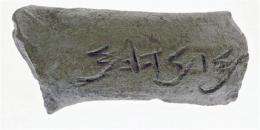
This image made available by Israel's Antiquities Authority Wednesday, May 20, 2009 shows an Iron Age handle inscribed with the Hebrew name "Menachem," which was the name of an Israelite king, discovered in an excavation in Jerusalem. Archaeologists digging on Jerusalem's Mount of Olives have discovered a nearly 3,000-year-old jar handle bearing ancient Hebrew script, a find significantly older than most inscribed artifacts dug up in the ancient city, an archaeologist said.(AP Photo/IAA)

(AP) -- Archaeologists digging on Jerusalem's Mount of Olives have discovered a nearly 3,000-year-old jar handle bearing ancient Hebrew script, a find significantly older than most inscribed artifacts unearthed in the ancient city, an archaeologist said. The Iron Age handle is inscribed with the Hebrew name Menachem, which was the name of an Israelite king and is still common among Jews.

The inscription also includes a partly intact letter, the Hebrew character "lamed," meaning "to." That suggests the jar was a gift to someone named Menachem, said Ron Beeri, who directed the excavation for the Antiquities Authority. There is no indication the inscription refers to the king himself.

The name and similar variants have been found on Egyptian pottery dating back 3,500 years, and the Bible lists Menachem Ben Gadi as an ancient king of Israel. But this is the first time an artifact bearing the name has been unearthed in Jerusalem, Beeri said.

"It's important because it shows that they actually used the name Menachem during that period," Beeri said. "It's not just from the Bible, but it's also in the archaeological record."

Based on the style of the inscription, he dated the handle to around 900 B.C., the time of the first Jewish Temple in as recounted in the Bible.

The vessel the handle was attached to did not survive, so it is impossible to tell what it was used for, Beeri said. Similar vessels were known to have held products like oil or wheat.

Construction workers uncovered the archaeological site while digging the foundation for a girl's school being built in the area, Beeri said.

Excavators also uncovered storage vessels and implements from two earlier nomadic settlements, both dating to around 2,000 B.C., he said, as well as artifacts dating from the time of the Roman Empire around 2,000 years ago.

have completed their dig, and construction workers building the school are back on the job, Beeri said.

The Mount of Olives is just outside Jerusalem's Old City. The hill is important to Jews because of its proximity to the destroyed Temple and to Christians, who believe it is the site where Jesus ascended to heaven.

©2009 The Associated Press. All rights reserved. This material may not be published, broadcast, rewritten or redistributed.


print this article email this article download pdf blog this article bookmark this article     Stumble it Digg this share on Facebook retweet share on Reddit add to delicious
Rate this story - 4.8 /5 (6 votes)

Rank Filter

Move the slider to adjust rank threshold, so that you can hide some of the comments.


Display comments: newest first

  • dhughes - May 27, 2009
    • Rank: not rated yet
    Interesting, I tried to decipher the word and letters on my own using Phoenician letters, from which Hebrew letters (and Greek letters, and Latin letters etc....!) originated.

    From what I can tell the first (right to left) and last letters are "mem", the third letter is "nun".

    I can't tell if the second letter (right to left) is a letter or some sort of vowel or accent symbol.

    Other than not I'm not too sure even though it's supposed to be "Menachem".

    http://www.omnigl...cian.htm

May 20, 2009 all stories

Comments: 1

4.8 /5 (6 votes)
  • Stumble this up

  • Digg this

  • share this

  • hide
  • Related Stories


  • hide
  • Relevant PhysicsForums posts

  • Human Leukocyte Antigen (HLA) typing
    created 4 hours ago
  • Breeding program
    created Nov 20, 2009
  • How does a concentration gradient provide energy?
    created Nov 20, 2009
  • Eyesight and Neural Damage from Electronics
    created Nov 19, 2009
  • More from Physics Forums - Biology

Other News

Museum: Galileo's fingers, tooth are found (AP)

Museum: Galileo's fingers, tooth are found

Other Sciences / Archaeology & Fossils

created 16 hours ago | popularity not rated yet | comments 5

(AP) -- Two fingers and a tooth removed from Galileo Galilei's corpse in a Florentine basilica in the 18th century and given up for lost have been found again and will soon be put on display, an Italian museum ...


Measure to change U. of Neb. stem-cell rule fails (AP)

Measure to change U. of Neb. stem-cell rule fails (Update 2)

Other Sciences / Other

created 16 hours ago | popularity 5 / 5 (1) | comments 0

(AP) -- The University of Nebraska's governing board on Friday voted not to place tighter restrictions on embryonic stem cell research than those outlined under federal guidelines, which were expanded after ...


Researcher: Faint writing seen on Shroud of Turin (AP)

Researcher: Faint writing seen on Shroud of Turin (Update)

Other Sciences / Archaeology & Fossils

created Nov 20, 2009 | popularity 1.9 / 5 (23) | comments 23

(AP) -- A Vatican researcher has rekindled the age-old debate over the Shroud of Turin, saying that faint writing on the linen proves it was the burial cloth of Jesus. Experts say the historian may be reading ...


Three of a kind

Three of a kind: Revealing language’s universal essence

Other Sciences / Social Sciences

created Nov 20, 2009 | popularity 3.8 / 5 (10) | comments 6

(PhysOrg.com) -- On the surface, English, Japanese, and Kinande, a member of the Bantu family of languages spoken in the Democratic Republic of Congo, have little in common. It is not just that the vocabularies ...


Maya

New insights into the life of the Maya

Other Sciences / Archaeology & Fossils

created Nov 16, 2009 | popularity 4.6 / 5 (15) | comments 7

(PhysOrg.com) -- Ancient artifacts are almost always concerned with rich and powerful religious and political leaders, but new excavations of an ancient Maya site have unearthed a pyramid decorated with murals ...