DNA molecules can detect pathogens, deliver drugs
May 20, 2009 By Anne Ju DNA molecules can detect pathogens, deliver drugs

Enlarge

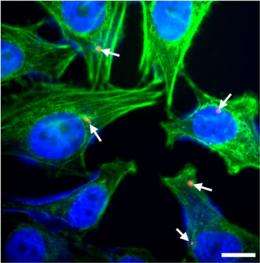
In the presence of certain pathogens, DNA-based molecules form chains and curl up into spheres. Visible here as red dots, the spheres are shown entering cells, which demonstrates their drug delivery capabilities. Image: Luo Labs

(PhysOrg.com) -- First, Cornell researchers created DNA "bar codes" -- strands of the genetic material that quickly identify the presence of different molecules by fluorescing. Now, they have created new DNA molecules that can detect pathogens and deliver drugs to cells when they form long chains called polymers.

Cornell researcher Dan Luo and colleagues describe in the May 4 online Nature that their simple DNA molecules, or monomers, link into polymers under and in the presence of such as SARS and HIV.

The research team, which included first author and postdoctoral associate Jong B. Lee and David Muller, associate professor of applied and engineering physics, report that the polymers, made up of thousands of monomers, allow for the fast detection of pathogens. The researchers used asymmetric strands of DNA, characterized by unique sequences at the ends of each branch, which they call zip codes. Each zip code can link to a corresponding sequence, including the DNA of such pathogens as HIV. When the zip codes and pathogens find each other, they form chains that curl up into spheres and are visible under a microscope.

Using the same principle, the researchers also demonstrated attaching multiple nucleic acid-based drugs, along with tracers, to the DNA strands, which were then absorbed by cells.

Luo, associate professor of biological and environmental engineering, explained that such work illustrates how DNA is not only a genetic material, but can be a useful structure to carry drugs or other substances.

"The genetic part is the recognition of the pathogen," he said. "The generic part is making the nanostructure."

Provided by Cornell University (news : web)


print this article email this article download pdf blog this article bookmark this article     Stumble it Digg this share on Facebook retweet share on Reddit add to delicious
Rate this story - 5 /5 (1 vote)

Rank Filter

Move the slider to adjust rank threshold, so that you can hide some of the comments.


Display comments: newest first

  • NeilFarbstein - May 20, 2009
    • Rank: 1 / 5 (1)
    Its sure to cause a big immune response, possibly pathogenic. Injecting them can result in lupus autoimmiune responses.

May 20, 2009 all stories

Comments: 1

5 /5 (1 vote)
  • Stumble this up

  • Digg this

  • share this

  • hide
  • Related Stories

  • Metal sheets with DNA framework may enable nanocircuits
    created May 20, 2009 | popularity not rated yet | comments 0
  • Synthetic DNA Makes Better Hydrogels for Drug Delivery
    created Sep 26, 2006 | popularity not rated yet | comments 0
  • Researchers create DNA buckyballs for drug delivery
    created Aug 29, 2005 | popularity not rated yet | comments 0
  • Researchers use 'nanopore channels' to precisely detect DNA
    created Apr 05, 2007 | popularity not rated yet | comments 0
  • DNA-based gel produces proteins without live cells
    created Apr 01, 2009 | popularity not rated yet | comments 0


  • hide
  • Relevant PhysicsForums posts

Other News

Findings show nanomedicine promising for treating spinal cord injuries

Findings show nanomedicine promising for treating spinal cord injuries

Nanotechnology / Bio & Medicine

created 16 hours ago | popularity 4.5 / 5 (4) | comments 0

(PhysOrg.com) -- Researchers at Purdue University have discovered a new approach for repairing damaged nerve fibers in spinal cord injuries using nano-spheres that could be injected into the blood shortly ...


New Digital 'Electronics' Concept May Continue Moore's Law

New Digital 'Electronics' Concept May Continue Moore's Law

Nanotechnology / Nanophysics

created Nov 05, 2009 | popularity 4.6 / 5 (55) | comments 9

(PhysOrg.com) -- Computers of the future could be operating not on electrons, but on tiny waves traveling through an electron "fluid," if a new proposal is successful. The new circuit design, recently introduced ...


Nanoparticles for gene therapy improve

Nanoparticles for gene therapy improve

Nanotechnology / Bio & Medicine

created Nov 06, 2009 | popularity 5 / 5 (4) | comments 3

(PhysOrg.com) -- About five years ago, Professor Janet Sawicki at the Lankenau Institute in Pennsylvania read an article about nanoparticles developed by MIT's Robert Langer for gene therapy, the insertion ...


Breakthrough in industrial-scale nanotube processing

Breakthrough in industrial-scale nanotube processing

Nanotechnology / Nanomaterials

created Nov 02, 2009 | popularity 4.9 / 5 (20) | comments 3

(PhysOrg.com) -- Rice University scientists today unveiled a method for the industrial-scale processing of pure carbon-nanotube fibers that could lead to revolutionary advances in materials science, power ...


Nanoparticles may cause DNA damage across a cellular barrier

Nanoparticles may cause DNA damage across a cellular barrier

Nanotechnology / Bio & Medicine

created Nov 05, 2009 | popularity 4.3 / 5 (9) | comments 1

(PhysOrg.com) -- Scientists have shown in the laboratory that metal nanoparticles damaged the DNA in cells on the other side of a cellular barrier. The research, by the University of Bristol, is published ...