Wide-field Infrared Survey Explorer Coming Together
May 20, 2009 By Eric Warren Wide-field Infrared Survey Explorer

Enlarge

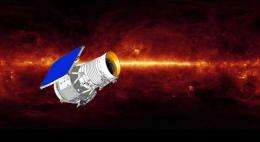
Artist's concept of the Wide-field Infrared Survey Explorer. Image credit: NASA/JPL-Caltech

(PhysOrg.com) -- The science instrument for NASA's Wide-field Infrared Survey Explorer has been shipped to Boulder, Colo., for a planned launch in November.

Space Dynamics Laboratory has completed ’s Wide‐field Infrared Survey Explorer (WISE) . The WISE instrument was shipped from SDL’s manufacturing and test facility in North Logan, Utah, to Ball Aerospace & Technologies Corp. in Boulder, Colo., where it will be integrated onto the satellite.

“Following a scheduled launch late this year, the SDL‐built WISE instrument will collect millions of images from which hundreds of millions of astronomical objects will be catalogued,” said Dr. Doug Lemon, director of SDL. “For decades SDL has worked with NASA to map the skies and our commitment to NASA continues as WISE prepares to chart space in infrared light, searching for the closest stars and asteroids, the origins of star systems, and some of the brightest galaxies in the Universe.”

Built for NASA by SDL, the WISE instrument is a super‐cooled infrared space‐based telescope designed to provide a full sky, infrared map that will advance the understanding of our Universe. Additionally, it will enable the James Webb Space Telescope to more efficiently target objects of interest in space. The James Webb Space Telescope is the next‐generation follow‐on to the Hubble Space Telescope.

With hundreds of times the infrared sensitivity of any previous all‐sky survey, WISE will measure the diameters of over 100,000 asteroids in our solar system, and provide a complete inventory of nearby young stars as well as of the debris disks associated with planetary systems around older nearby stars.

Standing approximately two meters tall and weighing over 360 kilograms at , the WISE instrument is designed to discover many cool, dim brown dwarf stars close to our sun, and detect far distant ultra-luminous infrared galaxies where star formation is taking place at a greatly accelerated rate.

Provided by Utah State University


print this article email this article download pdf blog this article bookmark this article     Stumble it Digg this share on Facebook retweet share on Reddit add to delicious
Rate this story - 5 /5 (1 vote)


May 20, 2009 all stories

Comments: 0

5 /5 (1 vote)
  • Stumble this up

  • Digg this

  • share this

  • hide
  • Related Stories

  • NASA approves construction of satellite to scan galaxies
    created Oct 19, 2006 | popularity not rated yet | comments 0
  • NASA OKs construction of satellite
    created Oct 25, 2006 | popularity not rated yet | comments 0
  • James Webb Telescope components pass tests
    created Sep 17, 2008 | popularity not rated yet | comments 0
  • NASA's Webb Telescope sunshield preliminary design review complete
    created Mar 20, 2008 | popularity not rated yet | comments 0
  • James Webb Space Telescope Testing to Find Infrared Light for Christmas
    created Dec 07, 2007 | popularity not rated yet | comments 0


  • hide
  • Relevant PhysicsForums posts

  • The shape of our solar system's orbits.
    created Nov 07, 2009
  • Above or Below the Line of Nodes
    created Nov 07, 2009
  • Supernova vs. Nova?
    created Nov 07, 2009
  • Supernova's Gamma Rays and Comets
    created Nov 06, 2009
  • More from Physics Forums - General Astronomy

Other News

Deep creep means milder, more frequent earthquakes along Southern California's San Jacinto fault

Deep creep means milder, more frequent earthquakes along Southern California's San Jacinto fault

Space & Earth / Earth Sciences

created 10 hours ago | popularity 4.7 / 5 (3) | comments 0

With an average of four mini-earthquakes per day, Southern California's San Jacinto fault constantly adjusts to make it a less likely candidate for a major earthquake than its quiet neighbor to the east, the ...


Success in 'space elevator' competition (AP)

Success in 'space elevator' competition (Update 3)

Space & Earth / Space Exploration

created Nov 05, 2009 | popularity 4.3 / 5 (33) | comments 50

(AP) -- A robot powered by a ground-based laser beam climbed a long cable dangling from a helicopter on Wednesday to qualify for prize money in a $2 million competition to test the potential reality of the ...


In a Galaxy Far, Far Away...

In a Galaxy Far, Far Away...

Space & Earth / Astronomy

created Nov 06, 2009 | popularity 4.8 / 5 (5) | comments 15

(PhysOrg.com) -- Astronomers have published the discovery of the farthest known object in the cosmos: a star that exploded when the universe was only 630 million years old -- only 4.6% of its current age. ...


'Dropouts' pinpoint earliest galaxies

'Dropouts' pinpoint earliest galaxies

Space & Earth / Astronomy

created Nov 06, 2009 | popularity 4.2 / 5 (10) | comments 13

Astronomers, conducting the broadest survey to date of galaxies from about 800 million years after the Big Bang, have found 22 early galaxies and confirmed the age of one by its characteristic hydrogen signature ...


Space hotel taking bookings for 2012 opening

Space hotel taking bookings for 2012 opening

Space & Earth / Space Exploration

created Nov 05, 2009 | popularity 4.4 / 5 (20) | comments 11

(PhysOrg.com) -- The first orbiting space hotel is on track to open for its first customers in 2012, but hurry, as bookings are filling fast.