New memory material may hold data for one billion years
May 20, 2009
New memory material may hold data for one billion years

Enlarge

Scientists are reporting an advance toward a memory device capable of storing data for more than one billion years. Credit: The American Chemical Society

(PhysOrg.com) -- Packing more digital images, music, and other data onto silicon chips in USB drives and smart phones is like squeezing more strawberries into the same size supermarket carton. The denser you pack, the quicker it spoils. The 10 to 100 gigabits of data per square inch on today’s memory cards has an estimated life expectancy of only 10 to 30 years. And the electronics industry needs much greater data densities for tomorrow’s iPods, smart phones, and other devices.

Scientists are reporting an advance toward remedying this situation with a new device that can store thousands of times more data than conventional chips with an estimated lifetime of more than one billion years. Their discovery is scheduled for publication in the June 10 issue of ACS’ Nano Letters.

Alex Zettl and colleagues note in the new study that some of today’s highest-density experimental storage media can retain ultra-dense data for only a fraction of a second. They note that William the Conqueror’s Doomsday Book, written on vellum in 1086 AD, has survived 900 years. However, the medium used for a digital version of the book, encoded in 1986, failed within 20 years.

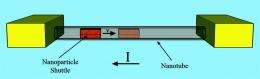
The researchers describe development of an experimental consisting of an iron nanoparticle (1/50,000 the width of a human hair) enclosed in a hollow . In the presence of electricity, the nanoparticle can be shuttled back and forth with great precision. This creates a programmable memory system that, like a silicon chip, can record digital information and play it back using conventional computer hardware. In lab and theoretical studies, the researchers showed that the device had a storage capacity as high as 1 terabyte per square inch (a trillion bits of information) and temperature-stability in excess of one billion years.

More information: Nano Letters, “Nanoscale Reversible Mass Transport for Archival Memory”

Provided by American Chemical Society (news : web)

4.6 /5 (45 votes)  

Filter


Move the slider to adjust rank threshold, so that you can hide some of the comments.


Display comments: newest first

Nik_2213
May 20, 2009

Rank: 4.6 / 5 (5)
Behold ! A genuine digital abacus !!
holoman
May 20, 2009

Rank: 3 / 5 (2)
A billion years, why not make it
a Gazillion Gazillion Gazillion Gazillion years !

Here's something else to think about that has been
verified over and over.

Ferroelectric densities of .2 to .5 Petabits = 200 to 500 Terabits sq. in. / 40 Petabits = 40,000 to 100 Petabits = 100,000 Terabits cu.cm. or 200,000 to 500,000 Gigabits sq.in. / 40,000,000 to 100,000,000 Gigabits cu.cm. with symmetrical read / write times of < 10 picoseconds for 100 year non-volatile storage having infinite rewrites.

Ferroelectrics space age material that has been shown to have robust Nuclear / EMF / Cosmic radiation protection exceeding all other materials used in data storage and display technology.


fixer
May 20, 2009

Rank: 5 / 5 (2)
Really? but I might buy a new laptop in only 50 000 years.
will it be compatible?
dirk_bruere
May 20, 2009

Rank: 5 / 5 (2)
Maybe the time will come with a fully mature computing technology where an update really is needed only every 50,000 years. But not soon.
NeilFarbstein
May 20, 2009

Rank: 3 / 5 (4)
I want a lifetime warrantee!!!
sender
May 20, 2009

Rank: not rated yet
I would like photopolymers in the nanotube that bunch up and diffract dithered LED's for computing and solid LED's for memory, optical computers now!
Azpod
May 20, 2009

Rank: 5 / 5 (1)
If they can make it last 10x as much, it may last long enough to be read by whatever species evolves in the star system that's created from the Sun's ashes.

I want to encode the time-honored phrase of extreme wisdom: 'kiss my shiny metal ass.' :p
PPihkala
May 21, 2009

Rank: not rated yet
So we know their memory can last long enough to outlast the devices used to interface it. Next challenge is to make it commercial success. If it can't compete, no one will be using it.
Sirussinder
May 21, 2009

Rank: not rated yet
Good start, but nothing today comes even close to the reliability of carving information into stone if you want to store it for 1 billion years. And its easily accessible/readable to anyone or I guess maybe at this point in time, anything alive and aware of it.

Egyptians still has us beat when it comes to data storage. It even survived the dark ages where unfortunately in Europe, tons of books and ancient knowledge was deliberately burned by the church or accidentally burned to be lost forever. My point is stone doesn't burn and its lots of work to destroy carvings on stone.
djp
May 21, 2009

Rank: 5 / 5 (1)
hehe, great but wait. Maybe there are already nanostorage devices left on earth in ancient locations around the world. We are probably rediscovering the tech. :-p

Whats the use of a device that will be used by a species with an amnesia cycle of every 5 to 10 thousand years. Hieroglyphs had to be re-deciphered, and that's talking about stuff people could see without highly specialized laser or electron telescopy.
Szkeptik
May 21, 2009

Rank: 5 / 5 (2)
Cool. We could program the highest degree of knowledge into it and put it onto satellites leaving the solar system. If at some distant day and location an intelligence might find them, and have sufficient technology to read the memory that could be the ultimate time capsule. Even if we were gone for millions of years by then, all the cities and colonies crumbled to dust long ago, we could still tell our story. Ah... just dreaming. Would be EPIC though.
wiyosaya
May 21, 2009

Rank: 5 / 5 (1)
I wonder if they have given this a "shock" test. To me, the article makes it sound like it is based on the electric field physically moving the iron nanoparticle. This sounds like it might be highly susceptible to physical shock.

Imagine yourself a scientist 10 million year from now. You've just discovered a memory device based on this technology that contains the sum of all knowledge from an ancient era. What you don't know is that the device is susceptible to shock, and you drop the device. DOH! :O
John_Doe
May 21, 2009

Rank: not rated yet
I imagine myself an alien scientist 100 thousand years from now finding a desert planet with thousands (maybe more) of landfills, full or carbon nanotubes (because they are the only thing that doesn't degrade, right?), then a couple of months later all my crew develops a strange cellular disease (why not, aliens with cells?). I research ancients databases created by the extinct civilization (and stored with nanotubes, of course) and guess what, the name of the disease is "CANCER" (LOL). This could be an episode of some SCI-FI series...
AstroGuardian
May 22, 2009

Rank: 5 / 5 (1)
When did one billion years of testing pass?
Or their lie is just too cheap.
nick7201969
May 22, 2009

Rank: 5 / 5 (4)
I would not buy this device because next year they will be coming out with *TWO* billion year capabilities. Thus, making this one obsolete.
jonnyboy
May 23, 2009

Rank: 3 / 5 (2)
When did one billion years of testing pass?
Or their lie is just too cheap.


They computer simulated the lifetime of the product. I am pretty sure that they ran the model at MIT
crackerhead
May 26, 2009

Rank: not rated yet
what about rust ? degradation of carbon nanotubes may be easy but anything made of iron will react . Y-not rust proof a few bridges now ?
Rank 4.6 /5 (45 votes)
Relevant PhysicsForums posts

More news stories

Harnessing plasmonics, engineers weld nanowires with light

At the nano level, researchers at Stanford have discovered a new way to weld together meshes of tiny wires. Their work could lead to exciting new electronics and solar applications. To succeed, they called ...

Nanotechnology / Nanophysics

created 17 hours ago | popularity 4.8 / 5 (10) | comments 1 | with audio podcast

The right recipe: Engineering research improves laser detectors, batteries

Think of it as cooking with carbon spaghetti: A Kansas State University researcher is developing new ways to create and work with carbon nanotubes -- ultrasmall tubes that look like pieces of spaghetti or string.

Nanotechnology / Nanomaterials

created 16 hours ago | popularity 5 / 5 (7) | comments 0 | with audio podcast

Nanorod-assembled order affects diffusion rate and direction

Some of the recent advancements in nanotechnology depend critically on how nanoparticles move and diffuse on a surface or in a fluid under non-ideal to extreme conditions. Georgia Tech has a team of researchers ...

Nanotechnology / Bio & Medicine

created 16 hours ago | popularity 5 / 5 (2) | comments 0 | with audio podcast

The butterfly effect in nanotech medical diagnostics

Tiny metallic nanoparticles that shimmer in the light like the scales on a butterfly's wing are set to become the color-change components of a revolutionary new approach to point-of-care medical diagnostics, according to ...

Nanotechnology / Bio & Medicine

created 16 hours ago | popularity 5 / 5 (4) | comments 0

Engineers build first sub-10-nm carbon nanotube transistor

(PhysOrg.com) -- Engineers have built the first carbon nanotube (CNT) transistor with a channel length below 10 nm, a size that is considered a requirement for computing technology in the next decade. Not ...

Nanotechnology / Nanophysics

created Feb 01, 2012 | popularity 4.9 / 5 (28) | comments 26 | with audio podcast feature


Nicira promises virtual networks will transform networking

(PhysOrg.com) -- For the past four years, founders of the start-up company Nicira have been developing cutting-edge software that they predict will transform the networking technology underlying the Internet. ...

Navy to begin tests on electromagnetic railgun prototype launcher

The Office of Naval Research (ONR)'s Electromagnetic (EM) Railgun program will take an important step forward in the coming weeks when the first industry railgun prototype launcher is tested at a facility ...

Study of diving beetles suggest sperm evolution may be driven by changes in female reproductive organs

Studying female reproductive tracts and sperm in diving beetles (Dytiscidae), researchers from the University of Arizona and Syracuse University have obtained a glimpse into a bizarre and amazing world of spe ...

Fossil cricket: Jurassic love song reconstructed

Some 165 million years ago, the world was host to a diversity of sounds. Primitive bushcrickets and croaking amphibians were among the first animals to produce loud sounds by stridulation (rubbing certain body parts together). ...

New insight from whole-genome sequencing of Europe's 2011 E. coli outbreaks

Using whole-genome sequencing, a team led by researchers from Harvard School of Public Health (HSPH) and the Broad Institute has traced the path of the E. coli outbreak that sickened thousands and killed over 50 people in Ger ...

Redder ladybirds more deadly, say scientists

A ladybird's colour indicates how well-fed and how toxic it is, according to an international team of scientists. Research led by the Universities of Exeter and Liverpool directly shows that differences between ...