May 21, 2009 weblog
Five-Dimensional DVD Could Hold Data of 30 Blu-ray Discs
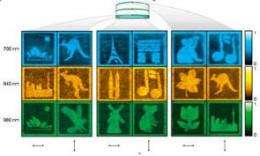
(PhysOrg.com) -- While many people think that Blu-ray will replace DVDs in the near future, a new study shows that DVDs may still have a lot to offer. Researchers have designed a five-dimensional DVD that can store 1.6 terabytes of data on a standard-size DVD, which is the equivalent of about 30 Blu-ray discs. The 5D DVDs could also be compatible with current DVD disc-drive technology.
The researchers, led by microphotonics researcher James Chon from the Swinburne University of Technology in Hawthorn, Australia, have presented the new DVD high-density data storage technique in a recent issue of Nature. While scientists have been considering 3D optical data storage for a while, this is the first time data has been recorded and read in five dimensions: three dimensions of stacked layers, and two new dimensions of wavelength (color) and polarization.
The new disc is made of three thin glass films stacked on top of each other, each coated with a solution containing gold nanorods of three different sizes. To record on the disc, the researchers focused a laser on the films, heating the nanorods so that they melted into spheres (marking the switch from 0 to 1). However, the rod-to-sphere transition depends on the wavelength and polarization of light. Nanotubes of the three different sizes absorb different wavelengths, and must be aligned with the direction of the light's polarization to turn into spheres.
These multiple variables mean that the same volume of space can hold multiple bits in multiple ways, the researchers explain. For instance, a space that responds to three different colors and two different polarizations can hold six bits. To read the bits, the researchers scanned the surface of the disc with a laser of lower energy but the same wavelength and polarization used during writing, identifying which areas had been previously melted with that light and which hadn't.
The researchers demonstrated the write and read technique on a small area of the disc, but predict that the disc could store 140 gigabytes of information per cubic centimeter. Since the volume of a typical DVD-sized disc was about 12 cm^3, the total data capacity would be 1.6 terabytes. Adding an extra dimension, say by using another polarization, could increase the storage capacity to 7.2 terabytes - about 140 times the capacity of a Blu-ray, which can store around 50 gigabytes.
The researchers are currently working with Samsung on the technology, and hope that it could be commercially available in the next 5 to 10 years. However, commercializing the technology will be challenging. For instance, it might be difficult to read the disk quickly because the information is packed so densely. Also, the large, expensive titanium-sapphire femtosecond laser used in the study is not practical, although the researchers say that a cheaper laser diode could also work.
More information: Peter Zijlstra, James W. M. Chon, and Min Gu. "Five-dimensional optical recording mediated by surface plasmons in gold nanorods." Nature 459, 410-413 (21 May 2009), doi:10.1038/nature08053
© 2009 PhysOrg.com


