Giant balloon flying high over Atlantic to catch cosmic rays
May 21, 2009 Giant balloon flying high over Atlantic to catch cosmic rays

Enlarge

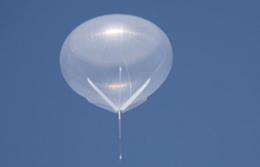
This picture shows the high-altitude balloon fully expanded to a diameter of 459 feet. The red immediately below the balloon is the parachute. The LEE payload of cosmic ray detectors is at the bottom of the chute shrouds. This photo was taken through a telescope by Drew Denney, NASA Columbia Scientific Balloon Facility.

(PhysOrg.com) -- University of Delaware researchers in Sweden have launched a giant balloon taller than a football field that is now flying at the edge of space to collect data on cosmic rays -- the most super-charged particles in the universe.

The balloon, which is 396 feet tall and 459 feet in diameter when fully inflated, was set aloft at 4:34 a.m. on May 17 from Esrange Space Center near Kiruna, Sweden, in the Arctic Circle. It is flying at a speed of more than 40 knots and an altitude of nearly 27 miles. Its payload of cosmic ray detectors, housed in a pressurized shell, will be cut free in northwestern Canada and float back down to Earth on a parachute, and then secured and recovered, likely by helicopter.

are extraterrestrial high-energy electrons, protons, and heavier nuclei that enter our atmosphere.

“The bulk of cosmic rays are likely produced by strong from Supernova explosions within our galaxy,” said John Clem, research associate professor of physics and astronomy at the University of Delaware's Bartol Research Institute. “It is well documented that these high-energy particles can threaten the health of astronauts in space and expose airline workers to radiation,” Clem noted.
Giant balloon flying high over Atlantic to catch cosmic rays
Enlarge

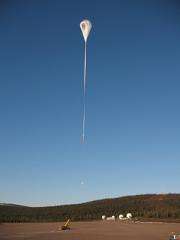
Launch of high-altitude balloon carrying cosmic ray detectors over Kiruna, Sweden, May 17, 2009. The balloon is made of a polyethylene film (the same material used to make trash bags) and weighs 4,150 pounds without its payload. Photo by James Roth/University of Delaware

With support from a $961,710 grant from NASA, Clem is leading a research team from UD and NASA's Columbia Scientific Balloon Facility in Palestine, Texas, to learn more about cosmic rays. The effort entails launching two helium-filled high-altitude balloons -- one to carry the “Low Energy Electrons” (LEE) instrument payload, which is now afloat, and one to carry the “Anti-Electron Sub-Orbital Payload” (AESOP), which will be in flight on May 23 and travel to the upper limits of the atmosphere.

Clem says about a thousand cosmic rays strike every square meter of Earth's atmosphere each second, depending somewhat on the location. The data from the balloon flights will be used to study solar modulation, the variation in cosmic ray intensity that is correlated with solar activity.

AESOP can detect electrons with energies up to about 10 gigaelectron volts, according to Clem. The instrument utilizes a system of different radiation detectors and a magnetic spectrometer to identify the particle's electric charge, energy, and mass. The major component in the magnetic spectrometer is the spark chamber.

AESOP's chambers contain five parallel aluminum plates connected, in alternate order, to ground and a high-voltage pulser. The medium between the plates is a slow-moving mixture of neon and helium. As a charged particle passes through a chamber, it leaves behind an ion trail in the gas. In the presence of a high electric field, the ions in the gas are accelerated toward the plate surface, resulting in a bright red vertical spark, which is digitized and recorded by a linear charge-coupled device (CCD) camera.

According to Clem, the level of solar activity rises and falls over a period of approximately 11 years and influences cosmic ray intensity. As solar activity rises, cosmic ray activity decreases. Currently, is low, and we are in a period of high cosmic ray intensity, Clem said.

“We're working to better understand how the sun's changing magnetic field affects cosmic ray propagation through the solar system,” Clem noted.

More information: You can follow the flight's path online.

Provided by University of Delaware (news : web)


print this article email this article download pdf blog this article bookmark this article     Stumble it Digg this share on Facebook retweet share on Reddit add to delicious
Rate this story - 5 /5 (3 votes)

Rank Filter

Move the slider to adjust rank threshold, so that you can hide some of the comments.


Display comments: newest first

  • Birger - May 22, 2009
    • Rank: 4 / 5 (1)
    It has been envisioned to design even larger balloon vehicles to carry "space" telescopes above 90% of the atmosphere. If the retrieval of the expensive instruments can be made safely and reliably, it will reduce the workload for real space telescopes, and enable many more astronomers to make "Hubble"-quality research.
  • NeilFarbstein - May 22, 2009
    • Rank: 1 / 5 (1)
    How much weight can they lift?
    It has been envisioned to design even larger balloon vehicles to carry "space" telescopes above 90% of the atmosphere. If the retrieval of the expensive instruments can be made safely and reliably, it will reduce the workload for real space telescopes, and enable many more astronomers to make "Hubble"-quality research.

  • el_gramador - May 22, 2009
    • Rank: not rated yet
    @Farbstein - depends on the payload and how big the balloon needs to be.
  • E_L_Earnhardt - May 22, 2009
    • Rank: 1 / 5 (2)
    Any DECREASE in cosmic rays would reduce the rate of CANCER! Now if we could only find a way to decrease exposure to X-RAYS!

May 21, 2009 all stories

Comments: 4

5 /5 (3 votes)
  • Stumble this up

  • Digg this

  • share this

  • hide
  • Related Stories

  • Antarctic "Telescopes" Look for Cosmic Rays
    created Feb 08, 2005 | popularity not rated yet | comments 0
  • Cosmic raise in cloud
    created Jan 19, 2006 | popularity not rated yet | comments 0
  • NASA: major step toward knowing origin of cosmic rays
    created Oct 09, 2007 | popularity not rated yet | comments 0
  • Mysterious Source of High-Energy Cosmic Radiation Discovered
    created Nov 19, 2008 | popularity not rated yet | comments 0
  • Chandra discovers relativistic pinball machine
    created Nov 15, 2006 | popularity not rated yet | comments 0


  • hide
  • Relevant PhysicsForums posts

  • The shape of our solar system's orbits.
    created 5 hours ago
  • Above or Below the Line of Nodes
    created 9 hours ago
  • Supernova vs. Nova?
    created 16 hours ago
  • Supernova's Gamma Rays and Comets
    created Nov 06, 2009
  • Our Moon
    created Nov 06, 2009
  • Question about a Carl Zeiss lens
    created Nov 05, 2009
  • More from Physics Forums - General Astronomy

Other News

Seattle team wins $900,000 in Space Elevator Games (AP)

Seattle team wins $900,000 in Space Elevator Games

Space & Earth / Space Exploration

created 18 hours ago | popularity 5 / 5 (7) | comments 4

(AP) -- A Seattle team has collected a $900,000 prize in a NASA-backed competition to develop the concept of an elevator to space - an idea spurred by science fiction novels.


Russian rocket to launch from French Guiana in 2010

Space & Earth / Space Exploration

created 18 hours ago | popularity 5 / 5 (3) | comments 0

A Russian rocket will next year for the first time blast off from a European launch pad in South America, officials said Saturday, as the first rockets headed for the site on board a ship.


Success in 'space elevator' competition (AP)

Success in 'space elevator' competition (Update 3)

Space & Earth / Space Exploration

created Nov 05, 2009 | popularity 4.3 / 5 (33) | comments 50

(AP) -- A robot powered by a ground-based laser beam climbed a long cable dangling from a helicopter on Wednesday to qualify for prize money in a $2 million competition to test the potential reality of the ...


Space hotel taking bookings for 2012 opening

Space hotel taking bookings for 2012 opening

Space & Earth / Space Exploration

created Nov 05, 2009 | popularity 4.3 / 5 (19) | comments 11

(PhysOrg.com) -- The first orbiting space hotel is on track to open for its first customers in 2012, but hurry, as bookings are filling fast.


'Dropouts' pinpoint earliest galaxies

'Dropouts' pinpoint earliest galaxies

Space & Earth / Astronomy

created Nov 06, 2009 | popularity 4.1 / 5 (9) | comments 11

Astronomers, conducting the broadest survey to date of galaxies from about 800 million years after the Big Bang, have found 22 early galaxies and confirmed the age of one by its characteristic hydrogen signature ...