NASA eyes water in Moon mission
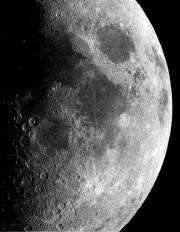
May 21, 2009 NASA on Thursday said it was on target for a June mission to scour the Moon's surface for landing sites and water

Enlarge

NASA on Thursday said it was on target for a June mission to scour the Moon's surface for landing sites and water that would allow humans to work and even live on Earth's nearest neighbor.

NASA on Thursday said it was on target for a June mission to scour the Moon's surface for landing sites and water that would allow humans to work and even live on Earth's nearest neighbor.

The space agency hopes to launch a dual craft in June, part of which would survey the Moon's surface from orbit while another unit ploughs into the lunar surface in search for water.

"We had the original target of providing information back for being able to safely return to the Moon for exploration," said Mike Wargo, NASA's chief lunar scientist.

The mission will focus on the little-known lunar poles, hoping to confirm reports of hydrogen accumulation and possible water-ice not found at the equatorial regions that where famously explored by humans in the last century.

It is scheduled to lift-off, strapped to an Atlas V rocket, from Cape Canaveral, Florida on June 17.

"One of the (resources) we are looking for is the potential of water ice at the lunar polar regions in these really mysterious permanently shadowed regions," said Wargo.

The permanently shadowed craters, which may not have seen sunlight for one or two billion years, could hold deposits of ice at a temperature of minus 328 degrees fahrenheit (200 degrees celsius).

Project manager Dan Andrews said the discovery of ice could be a crucial resource for future manned missions to the Moon, potentially providing oxygen for astronauts and oxidizer for .

The Lunar Reconnaissance Orbiter -- decked with instruments to measure temperature, topography, radioactivity and hydrogen levels -- will circle the polar areas, producing three dimensional maps and data on 100 sites, some of which could later be used for manned landings.

Another module, the Lunar Observation and Sensing Satellite, will hurtle towards the Moon's surface, crashing into a permanently shadowed crater.

The impact, scheduled for October, will kick-up lunar debris six miles (9.6 kilometers) into the atmosphere, allowing observers to scan for signs of ice-water as the LCO craft flies through the debris.

Although the event will be over in a matter of minutes, it may be visible from earth with the help of a telescope.

It follows up on work carried out by the Lunar Prospector mission, which detected hydrogen on the Moon, but failed to detect water when, like this mission, it crashed onto the lunar surface.

The mission, dubbed LCO/LCROSS, is the latest in a series of lunar missions that have become representative of the agency's work.

In 1969, the Apollo 11 mission touched down on the lunar surface, allowing Neil Armstrong to become the first human to set foot on the Moon.

In 2004, then president George W. Bush vowed to return Americans to the Moon by 2020.

But facing a massive budget deficit, President Barack Obama has called into question the fulfillment of that aim, with a review apparently underway that could delay the program.

There are technical barriers, too. The space shuttle vehicle that could deliver astronauts to the will be retired next year, with a new vehicle not expected in operation before 2015.

(c) 2009 AFP


print this article email this article download pdf blog this article bookmark this article     Stumble it Digg this share on Facebook retweet share on Reddit add to delicious
Rate this story - 4.4 /5 (7 votes)

Rank Filter

Move the slider to adjust rank threshold, so that you can hide some of the comments.


Display comments: newest first

  • Daein - May 21, 2009
    • Rank: 5 / 5 (5)
    "The space shuttle vehicle that could deliver astronauts to the Moon will be retired next year" The author of this story seems to think the shuttle could get people to the moon. Am I reading this right? The whole point in retiring the shuttle is to make way for development of crafts that can bring people to the moon.
  • gopher65 - May 21, 2009
    • Rank: 3.7 / 5 (3)
    Daein: The story was written by AFP. Nuff said.
  • Keno_Dan - May 21, 2009
    • Rank: 2 / 5 (2)
    Retiring the Space Shuttle in 2010 is a giant step backward for manned space exploration. Please see: www.cyrus-space-system.com The Space Shuttle should be the backbone of NASA. Help us save the Space Shuttle. Thanks, Daniel Sterling Sample Space Designs
  • Birger - May 22, 2009
    • Rank: 4.5 / 5 (2)
    The Atlas V to be used for this mission is a relatively low-cost launcher, and a good example of unmanned space research.

    The space shuttle -like the Concorde SST- was a great accomplishemt for its time, but -again like the Concorde- the technology for low-cost operation was not there, and it relied on scale of operation to bring costs down per flight. The market was not there, so the cost per flight became excessive. Also, the congress was "penny wise and pound foolish" when it chose a "cheap" shuttle design with solid fuel boosters, and ceramics instead of temperature-resistent metals. A "Shuttle-C" derivative could have become a heavy lift booster similar to Energiya, but the lobby for the contractors of the current project won the battle (politics again).
  • Archivis - May 22, 2009
    • Rank: 4 / 5 (2)
    Can someone tell me why we don't have people actively working on designing a craft capable of multiple re-entries? A light weight craft that is able to leave the planet without the aid of a huge fuel container to get it there.

    With all the advancements we've made, why hasn't this been done yet? I know a number of years ago there was a grant, or some sizable amount of money being offered for just that type of design, whatever happened to that?
  • zzthree - May 22, 2009
    • Rank: 4 / 5 (1)
    Can someone tell me why we don't have people actively working on designing a craft capable of multiple re-entries? A light weight craft that is able to leave the planet without the aid of a huge fuel container to get it there.


    With all the advancements we've made, why hasn't this been done yet? I know a number of years ago there was a grant, or some sizable amount of money being offered for just that type of design, whatever happened to that?


    there is a private company called Reaction Engines from UK developing single stage to orbit vehicle
    more info on http://www.reacti...s.co.uk/
  • gopher65 - May 22, 2009
    • Rank: 3 / 5 (2)
    Archivis: NASA was working on such a research program, for well over a decade. It was called VentureStar. It was intended to be a single-stage-to-orbit, reusable, low-maintenance vehicle.

    It was cancelled due to lack of funding, but NASA got reasonably far in their research, and even built a couple initial prototypes. The US Airforce was also involved in the project (a small amount of funding came from them), and a small piece of the project has now been picked up by them.

    It will be interesting to see if anything comes of it. (If you've ever watched Star Trek: Enterprise, the ship that you see undocking from the completed ISS is suppose to be one of the end results of VentureStar.)

    Wikipedia:
    http://en.wikiped...tureStar
  • Archivis - May 22, 2009
    • Rank: 4 / 5 (1)
    So then, what you are saying is, in order to save money, they pulled the plug on this so that they would have to spend even more money to go anywhere...

    Yeah that sounds like how we do things in the states... thanks for the info :)
  • blackle4ps3 - May 30, 2009
    • Rank: not rated yet
    maybe there's water deep inside asteroid moon

May 21, 2009 all stories

Comments: 9

4.4 /5 (7 votes)
  • Stumble this up

  • Digg this

  • share this

  • hide
  • Related Stories

  • Moon's polar craters could be the place to find lunar ice, scientists report
    created Dec 18, 2008 | popularity not rated yet | comments 0
  • NASA gets ready for moon water search
    created Jan 15, 2008 | popularity not rated yet | comments 0
  • NASA Moon-Impactor Mission Passes Major Review
    created Feb 02, 2007 | popularity not rated yet | comments 0
  • NASA Lunar Spacecraft Ships South in Preparation for Launch
    created Feb 11, 2009 | popularity not rated yet | comments 0
  • NASA Selects Team To Build Lunar Lander
    created Oct 03, 2005 | popularity not rated yet | comments 0


  • hide
  • Relevant PhysicsForums posts

  • The shape of our solar system's orbits.
    created 16 hours ago
  • Above or Below the Line of Nodes
    created 21 hours ago
  • Supernova vs. Nova?
    created Nov 07, 2009
  • Supernova's Gamma Rays and Comets
    created Nov 06, 2009
  • More from Physics Forums - General Astronomy

Other News

Deep creep means milder, more frequent earthquakes along Southern California's San Jacinto fault

Deep creep means milder, more frequent earthquakes along Southern California's San Jacinto fault

Space & Earth / Earth Sciences

created 2 hours ago | popularity 4 / 5 (1) | comments 0

With an average of four mini-earthquakes per day, Southern California's San Jacinto fault constantly adjusts to make it a less likely candidate for a major earthquake than its quiet neighbor to the east, the ...


Success in 'space elevator' competition (AP)

Success in 'space elevator' competition (Update 3)

Space & Earth / Space Exploration

created Nov 05, 2009 | popularity 4.3 / 5 (33) | comments 50

(AP) -- A robot powered by a ground-based laser beam climbed a long cable dangling from a helicopter on Wednesday to qualify for prize money in a $2 million competition to test the potential reality of the ...


'Dropouts' pinpoint earliest galaxies

'Dropouts' pinpoint earliest galaxies

Space & Earth / Astronomy

created Nov 06, 2009 | popularity 4.1 / 5 (9) | comments 12

Astronomers, conducting the broadest survey to date of galaxies from about 800 million years after the Big Bang, have found 22 early galaxies and confirmed the age of one by its characteristic hydrogen signature ...


Space hotel taking bookings for 2012 opening

Space hotel taking bookings for 2012 opening

Space & Earth / Space Exploration

created Nov 05, 2009 | popularity 4.4 / 5 (20) | comments 11

(PhysOrg.com) -- The first orbiting space hotel is on track to open for its first customers in 2012, but hurry, as bookings are filling fast.


In a Galaxy Far, Far Away...

In a Galaxy Far, Far Away...

Space & Earth / Astronomy

created Nov 06, 2009 | popularity 4.8 / 5 (4) | comments 11

(PhysOrg.com) -- Astronomers have published the discovery of the farthest known object in the cosmos: a star that exploded when the universe was only 630 million years old -- only 4.6% of its current age. ...