Tasmanian devils listed as endangered in Australia
May 22, 2009 By ROD McGUIRK , Associated Press Writer Tasmanian devils listed as endangered in Australia (AP)

Enlarge

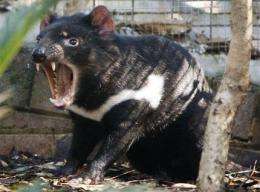
FILE - In this Oct. 17, 2008 file photo, Tex a Tasmanian Devil reacts in his enclosure at Sydney's Taronga Zoo. The Tasmanian devil, a snarling fox-sized marsupial made notorious by its Looney Tunes cartoon namesake Taz, was listed as an endangered species Friday, May 22, 2009 because of a contagious cancer that has wiped out most of the wild population. (AP Photo/Mark Baker, File)

(AP) -- The Tasmanian devil, a snarling fox-sized marsupial made notorious by its Looney Tunes cartoon namesake Taz, was listed in Australia as an endangered species Friday because of a contagious cancer that has wiped out most of the wild population.

The upgrade from "vulnerable" under Australian environmental law entitles the world's largest marsupial carnivore to greater protection in the island state of Tasmania, Environment Minister Peter Garrett said in a statement.

Devils do not exist in the wild outside Tasmania, although mainland zoos are breeding captive populations as a strategy against total extinction.

Their numbers have declined by 70 percent since the facial cancer was first reported in 1996. The disease is caused by bites inflicted on each other's faces as part of a bizarre ritual or while squabbling over food. It causes grotesque facial tumors that eventually prevent them from feeding, leading to starvation within months.

"Strong action is being taken to find out more about this disease and to stop its spread," Garrett said.

The government has already committed 10 million Australian dollars ($7.8 million) over five years to research the disease and support captive breeding programs, but scientists say more is needed.

Hamish McCallum, senior scientist in the government-backed devil rescue program, said the main advantage of the endangered listing was that it acknowledged the serious threat the species faced.

"I'm hoping that it might cause a philanthropist or corporate sponsors to say: 'Hey, this is serious' and to chip in some serious money," McCallum said.

"I guess my optimism has diminished a little bit, but I'm still hopeful that of the various angles we're looking at, one of them will come through and we won't lose the animals in the wild," he added.

Warner Bros., which owns Taz, and CNN founder Ted Turner, who started the Cartoon Network, have helped fund the fight against the disease.

McCallum fears that devils could be extinct in the wild in 20 years. He estimates there are as few as 10,000 now, as the cancer continues to spread west and south across Tasmania.

Scientists have been working since the disease first emerged to save the animals, known for their powerful jaws and bloodcurdling growl.

Programs to try to save them include plans to relocate breeding pairs to island sanctuaries and to protect disease-free populations on peninsulas with devil-proof fences several miles (kilometers) long.

McCallum said he is frustrated that disagreement among scientists has prevented the sanctuaries from being established on islands off Tasmania. Some scientists fear the introduced devils would threaten endangered birds.

Scientists had hoped to find a genetic solution to the disease through a young devil who showed signs of natural immunity in laboratory tests. But that devil last year contracted a second, mutated strain of the cancer.

A test that can potentially detect the disease in a devil before it becomes contagious is in trials. While scientists hope this will help keep small wild populations disease free, the test is not yet proven to be accurate.

©2009 The Associated Press. All rights reserved. This material may not be published, broadcast, rewritten or redistributed.


print this article email this article download pdf blog this article bookmark this article     Stumble it Digg this share on Facebook retweet share on Reddit add to delicious
Rate this story - 5 /5 (3 votes)


May 22, 2009 all stories

Comments: 0

5 /5 (3 votes)
  • Stumble this up

  • Digg this

  • share this

  • hide
  • Related Stories

  • Study: Tasmanian Devil may face extinction
    created Jun 29, 2006 | popularity not rated yet | comments 0
  • Tasmanian devils face extinction
    created Oct 03, 2007 | popularity not rated yet | comments 0
  • CSIRO scientists join fight to save 'Tassie devil'
    created Jun 05, 2007 | popularity not rated yet | comments 0
  • Synchrotron could help save the Tassie devil
    created Sep 29, 2008 | popularity not rated yet | comments 0
  • Cancer is threatening Tasmanian devils
    created Feb 01, 2006 | popularity not rated yet | comments 0


  • hide
  • Relevant PhysicsForums posts

  • What is transpulmonary pressure?
    created 2 hours ago
  • Is there a gay gene?
    created Nov 23, 2009
  • Super quick question about Starling forces?
    created Nov 22, 2009
  • Questions about diffusion
    created Nov 22, 2009
  • More from Physics Forums - Biology

Other News

Fish food fight: Fish don't eat trees after all, says new study

Fish food fight: Fish don't eat trees after all, says new study

Biology / Ecology

created 41 minutes ago | popularity not rated yet | comments 0

(PhysOrg.com) -- What constitutes fish food is a matter of debate. A high-profile study a few years ago suggested that fish get almost 50 percent of their carbon from trees and leaves, evidence for a very ...


Computational microscope peers into the working ribosome

Computational microscope peers into the working ribosome (w/ Video)

Biology / Cell & Microbiology

created 20 hours ago | popularity 4.9 / 5 (8) | comments 0

Two new studies reveal in unprecedented detail how the ribosome interacts with other molecules to assemble new proteins and guide them toward their destination in biological cells. The studies used molecular ...


New chameleon species discovered in East Africa

New chameleon species discovered in East Africa (w/ Podcast)

Biology / Plants & Animals

created 23 hours ago | popularity 5 / 5 (1) | comments 0

A new species of chameleon has been discovered in Tanzania by a team of scientists.


Spider secrets decoded in world-first database

Biology / Plants & Animals

created 15 hours ago | popularity not rated yet | comments 0

(PhysOrg.com) -- Queensland scientists have developed a world-first database that catalogues the venom components from hundreds of spiders.


A year after discovery, Congo's 'mother lode' of gorillas remains vulnerable

A year after discovery, Congo's 'mother lode' of gorillas remains vulnerable

Biology / Plants & Animals

created 18 hours ago | popularity 5 / 5 (1) | comments 0

A new study by the Wildlife Conservation Society says that western lowland gorillas living in a large swamp in the Republic of Congo—part of the "mother lode" of more than 125,000 gorillas discovered last ...