Space shuttle landing held up by stormy weather
May 22, 2009 By MARCIA DUNN , AP Aerospace Writer
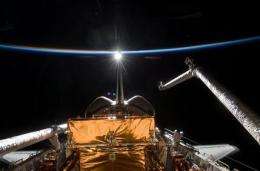
In this image provided by NASA, Space Shuttle Atlantis is backdropped by the blackness of space and the thin line of Earth's atmosphere Wednesday, May 20, 2009. (AP Photo/NASA)
(AP) -- Thunderstorms raking NASA's spaceport kept space shuttle Atlantis in orbit an extra day Friday, giving the crew unwanted downtime as they aimed for a landing the next day. After passing up two opportunities to land Friday at Kennedy Space Center, Mission Control thanked the seven astronauts for their patience.
"We know you looked at it hard," replied commander Scott Altman. A little later, he informed flight controllers, "We're enjoying the view."
The astronauts - fresh off successful repairs of the Hubble Space Telescope's sophisticated instruments - intended to spend part of their day off watching DVDs. But when they tried to play the movies, they found out that their laptops didn't have the proper software.
Engineers on the ground tried to troubleshoot the problem, but the astronauts gave up after more than an hour of trying.
"We'll be home tomorrow," an optimistic astronaut John Grunsfeld radioed to Earth. "We'll go to the movie theater and that will be our consolation."
The astronauts had been warned for days that the weather outlook was grim, and the forecasts proved true
NASA pressed ahead, instead, with a possible return to the landing site on Saturday morning. But the low-pressure system drenching Florida stretched from the Gulf of Mexico to the Caribbean, and forecasters anticipated only slightly improved conditions over the weekend.
As a precaution, NASA activated its backup touchdown site at Edwards Air Force Base in California, where good weather was expected. But landing there would mean more time and money - an estimated $1.8 million - to get Atlantis back to its Florida home base.
There are three Saturday landing opportunities at both Kennedy Space Center and Edwards Air Force Base.
The shuttle has enough supplies to stay in orbit until Monday.
During the 12-day flight, the astronauts carried out five back-to-back spacewalks to fix and upgrade Hubble for the final time. The 19-year-old observatory is now considered better than ever and should keep sending back breathtaking views of the cosmos for another five to 10 years. Scientists hope to get the first results by September.
Atlantis is also bringing back a wide-field camera that was replaced with a newer model, so it can be put on display at the Smithsonian Institution.
The six men and one woman were the last humans to set eyes on Hubble up close. NASA plans no more satellite-servicing missions of this type, with the space telescope or anything else. That's because the shuttle is being retired next year. The replacement craft will essentially be a capsule to ferry astronauts back and forth to the international space station and, ultimately, the moon.
NASA considered this fifth and final Hubble repair mission so dangerous that, in 2004, a year after the Columbia tragedy, it was canceled. The space agency reinstated it two years later after developing repair methods for astronauts in orbit and preparing a backup rescue plan that would have launched a second shuttle to bring astronauts back to earth.
The backup plan that kept the shuttle Endeavour on standby was called off Thursday after one last inspection found Atlantis' thermal shielding to be free of any serious damage from space junk.
---
On the Net:
NASA: http://www.nasa.gov/mission-pages/hubble/main/index.html
©2009 The Associated Press. All rights reserved. This material may not be published, broadcast, rewritten or redistributed.
-
NASA clears Atlantis for Monday launch to Hubble
May 10, 2009 |
not rated yet |
0
-
Weather looks great for Monday launch to Hubble
May 11, 2009 |
not rated yet |
0
-
Atlantis astronauts warily eye landing-day weather
May 21, 2009 |
not rated yet |
0
-
Astronauts inspect Atlantis while chasing Hubble
May 12, 2009 |
not rated yet |
0
-
Bad weather may disrupt shuttle landing schedule
May 20, 2009 |
not rated yet |
0
-
Engineers build first sub-10-nm carbon nanotube transistor
Feb 01, 2012 |
4.9 / 5 (30) |
30
-
Something old, something new: Evolution and the structural divergence of duplicate genes
Jan 31, 2012 |
4.6 / 5 (7) |
1
-
The hidden nanoworld of ice crystals: Revealing the dynamic behavior of quasi-liquid layers
Jan 30, 2012 |
5 / 5 (3) |
1
-
Stock market network reveals investor clustering
Jan 27, 2012 |
3.9 / 5 (23) |
8
-
Of microchemistry and molecules: Electronic microfluidic device synthesizes biocompatible probes
Jan 26, 2012 |
5 / 5 (1) |
0
-
Titan's lack of impact craters
Feb 09, 2012
-
Real pictures of black hole eating a star?
Feb 08, 2012
-
Hypothetical way to travel faster than light, but not technically exceed lightspeed
Feb 06, 2012
-
How do scientists monitor the Sun's activity?
Feb 05, 2012
-
Search patterns in observational studies
Feb 05, 2012
-
Derivation of Pogson's law
Feb 03, 2012
- More from Physics Forums - General Astronomy
More news stories
Could Venus be shifting gear?
(PhysOrg.com) -- ESAs Venus Express spacecraft has discovered that our cloud-covered neighbour spins a little slower than previously measured. Peering through the dense atmosphere in the infrared, the ...
Space & Earth / Space Exploration
4 hours ago |
5 / 5 (4) |
6
|
Humans may have helped the decline of African rainforests 3000 years ago
(PhysOrg.com) -- Large areas of rainforests in Central Africa mysteriously disappeared over three thousand years ago, to be replaced by savannas. The prevailing theory has been that the cause was a change ...
Mars Science Laboratory computer issue resolved
(PhysOrg.com) -- Engineers have found the root cause of a computer reset that occurred two months ago on NASA's Mars Science Laboratory and have determined how to correct it.
Space & Earth / Space Exploration
5 hours ago |
5 / 5 (5) |
3
|
Clam fields found at deep, low-temperature Mariana vents
(PhysOrg.com) -- Scientists have marveled at the unusual life forms thriving at high temperature hydrothermal vents of the deep ocean.
Space & Earth / Earth Sciences
4 hours ago |
not rated yet |
0
|
Two new moons for Jupiter
Advances in technology have lead to the discovery of new planets outside of our Solar System, and now even new moons in our own backyard.
Space & Earth / Space Exploration
4 hours ago |
not rated yet |
2
Hovering not hard if you're top-heavy, researchers find
Top-heavy structures are more likely to maintain their balance while hovering in the air than are those that bear a lower center of gravity, researchers at New York University's Courant Institute of Mathematical Sciences ...
Grass to gas: Researchers' genome map speeds biofuel development
Researchers at the University of Georgia have taken a major step in the ongoing effort to find sources of cleaner, renewable energy by mapping the genomes of two originator cells of Miscanthus x giganteus, a large perenn ...
Drug halts organ damage in inflammatory genetic disorder
A new study shows that Kineret (anakinra), a medication approved for the treatment of rheumatoid arthritis, is effective in stopping the progression of organ damage in people with neonatal-onset multisystem inflammatory disease ...
Cochlear implants may be safe, effective for organ transplant patients
Cochlear implants may be a safe, effective option for some organ transplant patients who've lost their hearing as an unfortunate consequence of their transplant-related drug regime, researchers report.
Researchers develop new method for creating tissue engineering scaffolds
Researchers at Northwestern University have developed a new method for creating scaffolds for tissue engineering applications, providing an alternative that is more flexible and less time-intensive than current technology.
Molecular profiling reveals differences between primary and recurrent ovarian cancers
There is a need to analyze tumor specimens at the time of ovarian cancer recurrence, according to a new study published in Molecular Cancer Therapeutics. Researchers used a diagnostic technology called molecular profiling to examine ...
May 22, 2009
Rank: not rated yet
I know I can get hubbles images of deep space, but I wonder what the breadth of it all looks like from their particular orbit at that cameras zoom-