ESA map reveals European shipping routes like never before
May 22, 2009
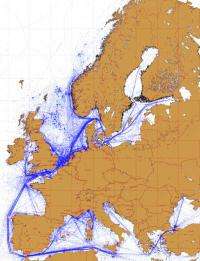
Animation comprised of a NO2 map placed on top of a shipping route map to show the routes clearly correspond to the pattern of detected NO2. The shipping route map derived from the analysis of Wide Swath Medium resolution mode products from the Advanced Synthetic Aperture Radar (ASAR) instrument on ESA's Envisat satellite between 2002 to 2009. The NO2 map shows yearly average tropospheric nitrogen dioxide measurements for 2008 as performed by the Ozone Monitoring Instrument (OMI) on the NASA EOS-Aura satellite. OMI represents the Dutch contribution to the mission. ESA is supporting OMI as a Third Party Mission, which means it uses its multi-mission ground systems to acquire, archive and distribute data from this instrument. Credit: CLS - KNMI - ESA
A synoptic view of European shipping routes can be seen for the first time thanks to a new map created using seven years of radar data from ESA's Envisat satellite.
Earth observation satellites have been providing ship-detecting services for several years, but this is the first time this amount of data collected over an extended period has been processed to produce an overview of ship traffic patterns.
Dr Vincent Kerbaol and Guillaume Hajduch of France's CLS (a subsidiary of the French space agency, CNES) created the map based on a new ship detection algorithm they developed. Using this algorithm, they processed near-real time products from Envisat's Advanced Synthetic Aperture Radar (ASAR) from 2002 to 2009.
Hajduch calibrated the products they retrieved from the ESA archive and then, because ships appear as bright points in radar images, identified the bright pixels located in marine areas.
Despite the fact that ships are more energy efficient than other forms of commercial transportation, many marine engines operate on extremely dirty fuel that causes large emissions of air pollutants like sulphur dioxide (SO2) and nitrogen dioxide (NO2).
SO2 and NO2 emissions from ships are responsible for acid rain, which is harmful to the environment, and particulate matter, which is harmful to humans. As well as detecting emissions from industry and other commercial means of transportation, NO2 emissions from ships can be measured from space along major shipping routes. To illustrate this, a NO2 map has been placed on top of the shipping route map in the above animation. The routes clearly correspond to the pattern of detected NO2.
Sea surface monitoring of ships is very important for observing marine transportation and can help marine authorities ensure admiralty routes are being observed.
For instance, the Maritime Safety Committee amended the traffic separation schemes off the coast of Portugal in 2005 to include the addition of two shipping lanes and to move the lanes farther away from the coast. These ASAR images on the right, acquired before and after the new schemes were enforced, show that they were implemented.
In addition to highlighting shipping routes, satellite views also detect harbours that are populated with vessels, as illustrated in the ASAR image of the North Sea to the left.
The ports of Calais in France, Antwerp in Belgium, Bremen and Hamburg in Germany and Europoort in the Netherlands, one of the busiest harbours on the planet, are all heavily populated with vessels in this image (denoted by dense, blue dots).
-
Vendee Globe route seen from above
Dec 15, 2008 |
not rated yet |
0
-
NOAA takes first broad look at soot from ships
Jul 09, 2008 |
not rated yet |
0
-
Pollution from marine vessels linked to heart and lung disease
Nov 07, 2007 |
not rated yet |
0
-
Cyclone Nargis and Myanmar floods seen from space
May 07, 2008 |
not rated yet |
0
-
Hurricane Ike tracked by ESA's Envisat
Sep 11, 2008 |
not rated yet |
0
-
Engineers build first sub-10-nm carbon nanotube transistor
Feb 01, 2012 |
4.9 / 5 (33) |
30
-
Something old, something new: Evolution and the structural divergence of duplicate genes
Jan 31, 2012 |
4.6 / 5 (7) |
1
-
The hidden nanoworld of ice crystals: Revealing the dynamic behavior of quasi-liquid layers
Jan 30, 2012 |
5 / 5 (4) |
1
-
Stock market network reveals investor clustering
Jan 27, 2012 |
3.9 / 5 (23) |
8
-
Of microchemistry and molecules: Electronic microfluidic device synthesizes biocompatible probes
Jan 26, 2012 |
5 / 5 (2) |
0
-
Do some geologists actually act a lot like Randy Marsh?
Feb 11, 2012
-
Discrepancy between oxygen and carbon-dioxide levels
Feb 09, 2012
-
where gems are found in the world
Feb 09, 2012
-
Wind Waves in Reservoir ~ Wind run-up and Wind set-up
Feb 08, 2012
-
Balance of oxygen in the atmosphere
Feb 01, 2012
-
The case for a methanol-based economy
Jan 30, 2012
- More from Physics Forums - Earth
More news stories
Salvage workers begin pumping fuel from Italian shipwreck
Salvage workers Sunday began pumping fuel from the shipwrecked Italian cruise liner Costa Concordia, a day ahead of schedule, officials said.
8 hours ago |
5 / 5 (1) |
0
Latin America mining boom clashes with conservation
Latin America is experiencing a mining boom as prices rise fuelled by a hike in global demand, but the region is also being hit by a wave of violent protests, strikes and rallies by environmentalists.
16 hours ago |
5 / 5 (1) |
1
Political leaders play key role in how worried Americans are by climate change: study
More than extreme weather events and the work of scientists, it is national political leaders who influence how much Americans worry about the threat of climate change, new research finds.
Feb 06, 2012 |
5 / 5 (7) |
73
NASA budget will axe Mars deal with Europe: scientists
US President Barack Obama's budget proposal to be submitted next week for 2013 will cut NASA's budget by 20 percent and eliminate a major partnership with Europe on Mars exploration, scientists said Thursday.
Space & Earth / Space Exploration
Feb 10, 2012 |
5 / 5 (3) |
58
Humans may have helped the decline of African rainforests 3000 years ago
(PhysOrg.com) -- Large areas of rainforests in Central Africa mysteriously disappeared over three thousand years ago, to be replaced by savannas. The prevailing theory has been that the cause was a change ...
Scientists discover molecular secrets of 2,000-year-old Chinese herbal remedy
For roughly two thousand years, Chinese herbalists have treated Malaria using a root extract, commonly known as Chang Shan, from a type of hydrangea that grows in Tibet and Nepal. More recent studies suggest that halofuginone, ...
New method to examine batteries -- MRI from the inside
There is an ever-increasing need for advanced batteries for portable electronics, such as phones, cameras, and music players, but also to power electric vehicles and to facilitate the distribution and storage of energy derived ...
A mitosis mystery solved: How chromosomes align perfectly in a dividing cell
Although the process of mitotic cell division has been studied intensely for more than 50 years, Whitehead Institute researchers have only now solved the mystery of how cells correctly align their chromosomes during symmetric ...
Google might launch Drive for cloud storage soon
(PhysOrg.com) -- Google's next big move, according to the Wall Street Journal, is a cloud storage service called Drive. Hardly first to the plate, Google is simply catching up to introducing its cloud reposi ...
Lab study raises questions over nano-particle impact
Tests involving chickens have raised questions about the impact on health from engineered nano-particles, the ultra-fine grains commonly used in drugs and processed foods, scientists said on Sunday.
Overeating may double risk of memory loss
New research suggests that consuming between 2,100 and 6,000 calories per day may double the risk of memory loss, or mild cognitive impairment (MCI), among people age 70 and older. The study was released today and will be ...
May 23, 2009
Rank: not rated yet