Better Supernovae Measurements Aim To Improve Understanding of Dark Energy
May 22, 2009 Better Supernovae Measurements Aim To Improve Understanding of Dark Energy

Enlarge

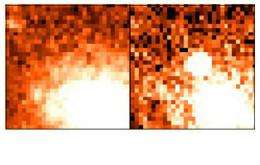
Baltay and his team used the QUEST camera to find 185 nearby supernovae like the one pictured above. On the left is a raw image of a galaxy; the center image was taken a month later, during a supernova explosion. (Credit: Charles Baltay/Yale University)

(PhysOrg.com) -- A new technique for measuring the distances to supernovae more accurately than ever before has been developed by a team of scientists from Yale University, Lawrence Berkeley National Laboratory and a consortium of French laboratories.

Type Ia supernovae are exploding stars that made the discovery of dark energy possible in 1998. Astronomers continue to use supernovae to understand the acceleration of the universe’s expansion. In recent years, astronomers have only been able to measure the distances to these “standard candles” to within about 10 percent accuracy, and as such, can only test current models of dark energy to within a certain limit.

These supernovae are so bright that we can see them even when they are billions of away. Because supernovae all have roughly the same inherent brightness, astronomers compare this with how bright they appear to be from here on Earth to determine how far away they actually are. Differences in any given star’s composition, however, mean it can be slightly brighter or dimmer when it explodes, which has made extremely precise measurements of their distances difficult.

The team began looking for supernovae several years ago with the creation of the Nearby Supernovae Factory, the largest supernovae survey ever conducted. To find the supernovae, the team uses QUEST, the world’s largest optical camera, which was designed and developed at Yale. They have discovered 185 nearby supernovae to date, out of which 58 were analyzed for the current study.

“Measuring the distance to supernovae has been a major problem in astronomy ever since the discovery of dark energy,” said Charles Baltay, Yale’s Eugene Higgins Professor of Physics, and one of the paper’s authors. “To understand how dark energy behaved in the early universe, we needed to make more precise measurements.”

Now the team has discovered a way to measure the distances to these supernovae more precisely than ever before, as reported in the forthcoming issue of the journal Astronomy & Astrophysics. Using a telescope in Hawaii to analyze the supernovae’s light signatures, they looked at each star’s individual composition. Providing a custom analysis of its inherent brightness, they were able to determine its distance to better than six percent accuracy.

Next, the team hopes to continue analysis on the remaining nearby supernovae so that they can ultimately test predictions about the history of and its behavior in the .

“The excitement of science is not knowing what you’re going to find,” Baltay said. “But it’s nice that this first set of has already proved useful.”

Other members of the Yale team include David Rabinowitz, Richard Scalzo and Will Emmet.

More information: DOI: 10.1051/0004-6361/200911973

Provided by Yale University (news : web)


print this article email this article download pdf blog this article bookmark this article     Stumble it Digg this share on Facebook retweet share on Reddit add to delicious
Rate this story - 4.6 /5 (9 votes)

Rank Filter

Move the slider to adjust rank threshold, so that you can hide some of the comments.


Display comments: newest first

  • NeilFarbstein - May 22, 2009
    • Rank: 2.5 / 5 (2)
    it makes finding supernovas look easy
  • omatumr - May 22, 2009
    • Rank: 1 / 5 (2)
    DARK ENERGY IS SIMPLY ASSUMED?

    As an experimentalist, I strongly favor measurements.

    But these quotes suggest that the authors of this study simply assume the existence of dark matter in interpreting the data.

    1. QUOTE: Measuring the distance to supernovae has been a major problem in astronomy ever since the discovery of dark energy,END QUOTE

    2. QUOTE: To understand how dark energy behaved in the early universe, we needed to make more precise measurements.END QUOTE

    If so, my question to them is "What dark energy?"

    With kind regards,
    Oliver K. Manuel
    http://www.omatumr.com


  • rwinners - May 22, 2009
    • Rank: 5 / 5 (1)
    Dark matter is stuff that can't be seen, touched, smelled or in any other way sensed, but is assumed to exist because nothing else explains a certain observation.
    Now, ask what dark energy is.
  • omatumr - May 22, 2009
    • Rank: 1 / 5 (3)
    SOUNDS MORE LIKE RELIGION THAN SCIENCE

    Dark matter is stuff that can't be seen, touched, smelled or in any other way sensed, but is assumed to exist because nothing else explains a certain observation.

    Now, ask what dark energy is.

  • PPihkala - May 23, 2009
    • Rank: 5 / 5 (1)
    SOUNDS MORE LIKE RELIGION THAN SCIENCE

    Have you ever heard of people practizing religion who are keen to measure anything about it? These scientists have made advances in their measurement of distances to supernovas and want to make more. And any progress helps to better define the phenomena we currently call dark matter. Maybe some day we will know the reason for this phenomena, which may as well eliminate the need for it as a hypothesis.
  • Slotin - May 23, 2009
    • Rank: 1 / 5 (2)
    ..ask what dark energy is..
    A surface tension effect of gravity field gradient, the vacuum around massive galaxies behaves like sparse bubbles or mercury droplets, which repels mutually at distance.

    http://aetherwave...ter.html

    dark matter itself can be explained in many ways
  • omatumr - May 23, 2009
    • Rank: 1 / 5 (1)
    RELIGION OR SCIENCE?

    SOUNDS MORE LIKE RELIGION THAN SCIENCE


    Have you ever heard of people practizing religion who are keen to measure anything about it? . . . Maybe some day we will know the reason for this phenomena, which may as well eliminate the need for it as a hypothesis.


    Yes, that would advance science.

    I saw no evidence of Dark Energy in experimental data from precise, space-age measurements of variations in:

    a.) Abundances of elements and isotopes in the solar system, and

    b.) Rest masses of the 3,000 different types of atoms that comprise the entire VISIBLE universe.

    The nuclear rest mass data are here:
    http://tinyurl.com/2otxps

    With kind regards,
    Oliver K. Manuel
    http://myprofile....anuelo09
  • Au-Pu - May 23, 2009
    • Rank: not rated yet
    "They" haven't discovered dark energy.
    So far it remains a superstitious explanation for what they need but cannot find.
    An explanation for the otherwise unexplainable.
    Or if you prefer, as omatumr (above) suggested, its the religious solution.
    If they do find it and prove and quantify it, then it will move into the realm of scientific reality.

May 22, 2009 all stories

Comments: 8

4.6 /5 (9 votes)
  • Stumble this up

  • Digg this

  • share this

  • hide
  • Related Stories

  • Supernovae not what they used to be
    created Oct 05, 2007 | popularity not rated yet | comments 0
  • Supernovae -- cosmic lighthouses
    created Feb 09, 2007 | popularity not rated yet | comments 0
  • First results describing the nature of dark energy (Update)
    created Nov 22, 2005 | popularity not rated yet | comments 0
  • Dirty Space and Supernovae
    created Feb 28, 2008 | popularity not rated yet | comments 0
  • Researchers examine Einstein's theories on the universe
    created Nov 27, 2007 | popularity not rated yet | comments 0


  • hide
  • Relevant PhysicsForums posts

  • Sideral question
    created 21 hours ago
  • Doppler shifted blackbody spectrum
    created Nov 21, 2009
  • Earth v. Moon
    created Nov 21, 2009
  • help me with coordinates and orbits
    created Nov 21, 2009
  • More from Physics Forums - General Astronomy

Other News

Baby can wait as expectant dad finishes spacewalk (AP)

Baby can wait as expectant dad finishes spacewalk

Space & Earth / Space Exploration

created 12 hours ago | popularity 3 / 5 (2) | comments 0

(AP) -- A spacewalking astronaut put aside the impending birth of his daughter and blazed through his first-ever venture outside the International Space Station on Saturday.


Unseasonably hot and dry weather combined with strong winds to fan scores of blazes in the country's southeastern states

Australia issues 'catastrophic' alerts as fires rage

Space & Earth / Environment

created 19 hours ago | popularity 4 / 5 (3) | comments 0

Australia has issued "catastrophic" alerts after record-breaking temperatures and wild lightning storms sparked more than 100 fires across the country, officials said Saturday.


Commuters wait on the platform shrouded by fog in London

Climate change not man-made, say majority of Britons: poll

Space & Earth / Environment

created Nov 15, 2009 | popularity 3.3 / 5 (15) | comments 46

Less than half of Britons believes that human activity is to blame for global warming, according to a poll carried out for The Times newspaper and published on Saturday.


Mysteriously warm times in Antarctica

Mysteriously warm times in Antarctica

Space & Earth / Earth Sciences

created Nov 18, 2009 | popularity 4.2 / 5 (21) | comments 28

(PhysOrg.com) -- A new study of Antarctica's past climate reveals that temperatures during the warm periods between ice ages (interglacials) may have been higher than previously thought. The latest analysis ...


UN: Fight climate change with free condoms (AP)

UN: Fight climate change with free condoms

Space & Earth / Environment

created Nov 18, 2009 | popularity 3.1 / 5 (11) | comments 24

(AP) -- The battle against global warming could be helped if the world slowed population growth by making free condoms and family planning advice more widely available, the U.N. Population Fund said Wednesday.