Atlantis, crew land in Calif. after Hubble mission
May 24, 2009 Atlantis, crew land in Calif. after Hubble mission (AP)

Enlarge

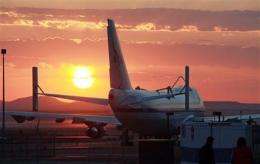
A NASA 747, modified to carry the Space Shuttle, is seen at sunrise at the NASA Dryden Flight Research Center at Edwards Air Force Base, Calif., Saturday, May 23, 2009. The landing of the Space Shuttle Atlantis was waved off for both Edwards, the primary backup landing site, and the primary site at Kennedy Space Center Saturday due to inclement weather in Florida, preferred because of the nearly $2 million in extra expense of a landing at Edwards. NASA will try again for a landing at either location Sunday. (AP Photo/Reed Saxon)

Space shuttle Atlantis landed at Edwards Air Force Base in California at 11:39 a.m. EDT, completing a 13-day journey of approximately 5.3 million miles in space.

Space shuttle Atlantis and its crew landed at 8:39 a.m. PDT Sunday at Edwards Air Force Base, Calif., completing the final servicing mission to the Hubble Space Telescope. Atlantis' astronauts conducted five successful spacewalks during their STS-125 flight to enhance and extend the life of the orbiting observatory.

"This mission highlights what the challenges of spaceflight can bring out in human beings," said Bill Gerstenmaier, associate administrator for Space Operations at NASA Headquarters in Washington. "This mission required the absolute best from the shuttle team, the Hubble science and repair teams, and the crew. The results are a tribute to the entire team and the years of preparation."

Atlantis' nearly 13-day mission of almost 5.3 million miles rejuvenated Hubble with state-of-the-art science instruments designed to improve the telescope's discovery capabilities by as much as 70 times, while extending its lifetime through at least 2014.

"This is not the end of the story but the beginning of another chapter of discovery by Hubble," said Ed Weiler, associate administrator for Science at NASA Headquarters. "Hubble will be more powerful than ever, continue to surprise, enlighten, and inspire us all and pave the way for the next generation of observatories."

Scott Altman commanded the shuttle flight and was joined by Pilot Gregory C. Johnson and Mission Specialists Megan McArthur, John Grunsfeld, Mike Massimino, Andrew Feustel and Michael Good. McArthur served as the flight engineer and lead for robotic arm operations, while the remaining mission specialists paired up for challenging spacewalks on Hubble.

Weather concerns prevented the crew from returning to NASA's Kennedy Space Center in Florida, the primary end-of-mission landing site. In seven to 10 days, Atlantis will be transported approximately 2,500 miles from California to Florida on the back of a modified 747 jumbo jet. Once at Kennedy, the shuttle will be separated from the aircraft to begin processing for its next flight, targeted for November 2009.

The STS-125 mission was the 126th shuttle flight, the 30th for Atlantis and the second of five planned for 2009. Hubble was delivered to space on April 24, 1990, on the STS-31 mission. Atlantis' landing at Edwards was the 53rd shuttle landing to occur at the desert air base.

Hubble has enabled a number of ground-breaking discoveries during its time in orbit. They include determining the age of the universe to be 13.7 billion years; finding that virtually all major galaxies have black holes at their center; discovering that the process of planetary formation is relatively common; detecting the first-ever organic molecule in the atmosphere of a planet orbiting another star; and providing evidence the expansion of the universe is accelerating because of an unknown force that makes up approximately 72 percent of the matter-energy content in the universe.

With Atlantis and its crew safely home, the focus will shift to the launch of STS-127, targeted for June 13. Endeavour's 16-day flight will deliver a new station crew member and complete construction of the Japan Aerospace Exploration Agency's Kibo laboratory. Astronauts will attach a platform to the outside of the Japanese module that will serve as a type of "back porch" for experiments that require direct exposure to space.


print this article email this article download pdf blog this article bookmark this article     Stumble it Digg this share on Facebook retweet share on Reddit add to delicious
Rate this story - 4.2 /5 (5 votes)

Rank Filter

Move the slider to adjust rank threshold, so that you can hide some of the comments.


Display comments: newest first

  • laserdaveb - May 25, 2009
    • Rank: not rated yet
    Welcome home! and thanks! on this day a moment not just for our soldiers who fell to preserve freedom but to our astronauts who fell to advance knowledge.We remember them too.

May 24, 2009 all stories

Comments: 1

4.2 /5 (5 votes)
  • Stumble this up

  • Digg this

  • share this

  • hide
  • Related Stories

  • NASA scraps landing for shuttle 2nd day in a row
    created May 23, 2009 | popularity not rated yet | comments 0
  • Space shuttle landing held up by stormy weather
    created May 22, 2009 | popularity not rated yet | comments 0
  • NASA clears Atlantis for Monday launch to Hubble
    created May 10, 2009 | popularity not rated yet | comments 0
  • Atlantis astronauts warily eye landing-day weather
    created May 21, 2009 | popularity not rated yet | comments 0
  • Astronauts take final spacewalk for Hubble repairs
    created May 18, 2009 | popularity not rated yet | comments 0


  • hide
  • Relevant PhysicsForums posts

  • Question about 2-body gravity
    created Nov 24, 2009
  • life on Mars
    created Nov 24, 2009
  • Semi-major axis from cartesian co-ordinates
    created Nov 23, 2009
  • Primary Mirror grinding
    created Nov 23, 2009
  • More from Physics Forums - General Astronomy

Other News

Monster Waves on the Sun are Real

Monster Waves on the Sun are Real (w/ Video)

Space & Earth / Astronomy

created 7 hours ago | popularity 5 / 5 (8) | comments 1

Sometimes you really can believe your eyes. That's what NASA's STEREO (Solar Terrestrial Relations Observatory) spacecraft are telling researchers about a controversial phenomenon on the sun known as the "solar ...


Cosmic 'dig' reveals vestiges of the Milky Way's building blocks

Cosmic 'Dig' Reveals Vestiges of the Milky Way's Building Blocks

Space & Earth / Astronomy

created 12 hours ago | popularity 4.9 / 5 (13) | comments 1

(PhysOrg.com) -- Peering through the thick dust clouds of our galaxy's "bulge" (the myriads of stars surrounding its center), a team of astronomers has unveiled an unusual mix of stars in the stellar grouping ...


No Wheel Stall in Diagnostic Drive

Spirit Mars Rover: No Wheel Stall in Diagnostic Drive

Space & Earth / Space Exploration

created 7 hours ago | popularity 4.5 / 5 (2) | comments 0

(PhysOrg.com) -- On Sol 2095 (Tuesday, Nov. 24), Spirit performed a set of diagnostic actions related to a stall of the right-rear wheel on the previous drive, three days earlier.


Climate experts debate strategies for reducing atmospheric carbon and future warming

Climate experts debate strategies for reducing atmospheric carbon and future warming

Space & Earth / Environment

created 7 hours ago | popularity 2.8 / 5 (6) | comments 7

(PhysOrg.com) -- Reducing carbon dioxide to safe levels may require extracting carbon from the air, says Cornell climate researcher.


Oceanic crust formation is dynamic after all

Oceanic crust formation is dynamic after all

Space & Earth / Earth Sciences

created 11 hours ago | popularity 4.6 / 5 (5) | comments 0

Imagine the Earth's crust as the planet's skin: Some areas are old and wrinkled while others have a fresher, more youthful sheen, as if they had been regularly lathered with lotion.