Voyage to the centre of the 'Plastic Vortex'
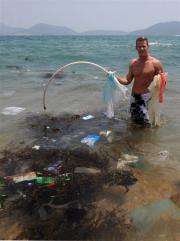
May 25, 2009 by Guy Newey Doug Woodring, an entrepreneur and conservationist who lives in Hong Kong

Enlarge

Doug Woodring, an entrepreneur and conservationist, shows rubbish on a beach on the south side of Hong Kong which has been left uncleaned. The United Nations Environment Programme says around 13,000 pieces of plastic litter are found in every square kilometre of sea.

A group of conservationists and scientists is due to set sail for an obscure corner of the Pacific Ocean in the coming months to explore a vast swirl of waste known as the "Plastic Vortex."

The giant gloop -- which some scientists estimate is twice the size of Texas -- has been gradually building over the last 60 years as Asia and the United States tossed their unwanted goods into the ocean.

Everything from flip-flops to have been slowly broken down by the sun's rays into small particles, and ocean tides have meant much of it has settled in a spiralling pattern just below the between Hawaii and the mainland United States.

After only coming to scientific attention in recent years, little remains known about the vortex, also known as the "Eastern Garbage Patch," so the expedition hopes to find out if the plastic can be fished out of the sea -- and what can be done with it.

Jim Dufour, a senior engineer at Scripps Institution of Oceanography in California, who is advising the trip, said establishing the extent of the problem was vital for the future health of the oceans.

"Importance is an understatement, it's imperative. It will take many years to understand and fix the problem," he told AFP.

The United Nations Environment Programme says around 13,000 pieces of plastic litter are found in every square kilometre of sea, but the problem is worst in five ocean gyres, or spiralling ocean currents, the worst of which is in the North Pacific.

The plastic has become so small most of it cannot be seen by satellite pictures, but the volume means the poisonous soup is being unknowingly vacuumed up by marine life and birds, and much of it is heavy with toxic chemicals, organisers of the trip say.

"That means the little piece of plastic the fish eats is actually a little toxic bomb," said Doug Woodring, an entrepreneur and conservationist who lives in Hong Kong and will lead the expedition.

As a result, a lot of the toxins could be getting into the human food chain.

Woodring said the location of the swirl -- more than 500 nautical miles from the west coast of the United States -- meant it remains a mystery for scientists.

"It is like going to outer space," he told AFP.

The 50-day voyage will head from San Francisco to Hawaii and back, passing through the vortex twice.

It will be led by a 150-foot-tall (45-metre-tall) ship, the "Kaisei" -- which means Ocean Planet in Japanese. Accompanying will be a fishing trawler, which will be trying out techniques to catch the waste without destroying too much marine life.

"You have to have netting that is small enough to catch a lot but big enough to let plankton go through it," said Woodring.

Ocean scientists and a documentary crew will be on the trip, which also hopes to examine whether the waste can be recycled or even used to create fuel.

The mission -- which is still looking for funding to meet its two million US dollar budget -- has received the backing of the United Nations Environment Programme and sponsorship from water company Brita.

But the swirl's location in international waters meant it was difficult to get any government support to clean it up.

"There is no jurisdiction, no government who is entirely responsible, so there has been no push to clean it up. The world doesn't know it is out there," said Woodring.

Several other trips have either made or planned journeys to the , but Dufour says this will be the most scientific-focused venture.

"It will be the first scientific endeavour studying sea surface pollutants, impact to organisms at intermediate depths, bottom sediments, and the impacts to organisms caused by the leaching of chemical constituents in discarded plastic," he said.

But for everyone involved in the project, the phenomenon only highlights the wider issue of reducing waste.

"The real fix is back on land. We need to provide the means, globally, to care for our disposable waste," said Dufour.

(c) 2009 AFP


print this article email this article download pdf blog this article bookmark this article     Stumble it Digg this share on Facebook retweet share on Reddit add to delicious
Rate this story - 4.6 /5 (65 votes)

Rank Filter

Move the slider to adjust rank threshold, so that you can hide some of the comments.


Display comments: newest first

  • Sirussinder - May 25, 2009
    • Rank: 1.9 / 5 (11)
    Who cares, nature will adapt.

    Progress, lots of kids and money is all that matters!!

    Be happy and consume!
  • Velanarris - May 25, 2009
    • Rank: 3.2 / 5 (16)
    Why are they going there and not cleaning it up? Just clean it up. A group of boats with a large net system can corral this junk where it can be extracted and brought back to land to be dealt with appropriately. If anything it's a resource pool. All that recyclable material is just sitting there.

    Stop talking about it and fix it. I'm so sick of this environmentalist foolishness. I do more for the environment than these groups.
  • derricka - May 25, 2009
    • Rank: 4.3 / 5 (11)
    Re: Velanarris
    Just clean it up? Did you actually read this article?
    This is an area twice the size of Texas, and the stuff is drifting.
    As for the "environmentalist foolishness", only a real fool would shoot the messenger. This is an international problem.
  • jonnyboy - May 25, 2009
    • Rank: 2.3 / 5 (12)
    Re:derricka
    Did you actually read this article and think about what they are doing and not doing? Velanarris did!

    This Junket that they want to spend two million dollars on so that they can cruise from California to Hawaii and back is absurd. Give me the two million and I will rent a trawler and go clean up the worst of it while at the same time seeing what works and what doesn't.

    And I won't be cruising on to Hawaii for a vacation either!!!!
  • earls - May 25, 2009
    • Rank: 4 / 5 (4)
    "which will be trying out techniques to catch the waste without destroying too much marine life."
  • zevkirsh - May 25, 2009
    • Rank: 1.2 / 5 (11)
    there is no point in exploring this mess of garbage. we know what to do, we must stop producing and throwing out so much plastic. we dont need to go to the garbage dump to understand that we created it and should continue to enlarge it. this is just more nonsense research.

    furthermore, we know full well that bacteria and more uv radiation will continue to break down the plastic over a time span. could be ten years, ten thousand years, or ten million. but we know that will happen , and we also know there is no feasible and economic means to clean up the mess we made. if there were plastic eating microbes out there that could clean up the mess faster, theyd already be doing it, so theres no point in thinking we can engineer them.
  • Baxterz - May 25, 2009
    • Rank: 4.6 / 5 (10)
    Assuming you could find a way to responsibly capture the trash, a massive trawler of some sort powered by one or two of these things would be ideal:

    Portable generator that turns trash into electricity

    http://www.physor...820.html

    *They are "going there and not cleaning it up" because it isn't just a simple matter of scooping out old bottles and plastic bags and then dumping them -- Where exactly do you propose to dump a pile of garbage 2X the size of Texas? How do you capture it without killing off a mother lode of sea creatures? How do you ship it to a dumping ground, assuming one can be found, once it has been captured? These (and other questions you could come up with if you bothered to think it through for 5 minutes) are some of the logistical problems they need to figure out.


    * Bacteria and UV radiation will break down the trash to sizes which are perfect for killing plankton, which cannot digest plastics. Dead plankton spells trouble for everyone.

    *Anybody who says a mess twice the size of Texas can be cleaned up for $2 million or less is either (a) being disingenuous (b)willfully ignorant of just exactly how big Texas is, or (c) not actually interested in seeing anyone take action of any sort to clean up the mess.

    Good heavens! Who could have imagined that a great site like Physorg would end up hosting so many trolls?
  • SamNoSpam - May 25, 2009
    • Rank: 4 / 5 (5)
    Anyone who thinks this is some sort of pleasure cruise has never been on a working oceanographic vessel.

    I have and it's a lot of hard work, some of it quite dangerous -- a single misstep when deploying an instrument and one can easily be lost overboard.

    I've had the honor of knowing a great number of oceanographers in my time and virtually every one is a dedicated scientist interested in nothing other than making the planet a better place for all.

    Disclosure: I work for the University of California, San Diego, of which Scripps Institution of Oceanography is a part. I am, however, not acquainted with the scientist in question and am currently not working in oceanography.
  • Velanarris - May 25, 2009
    • Rank: 3.4 / 5 (14)
    The english language is lost on some of you.

    "Occupies an area twice the size of texas" does not mean "it's enough trash to cover texas twice!"

    If I put a plastic bottle at each corner of a 1 sq mile plot the plastics I've strewn about could be considered to be "occupying an area the size of a square mile". The reflectivity of a pile of trash that immense would be detectable via satellite. Since the trash "heap" is not detectable via satellite, it must be spread more thinly than the article leads one to believe.

    Now, I'm sure it's a lot of trash, but, last I checked greenpeace had a fleet of boats. The whale wars guy has a few ships. The UN has a Navy. Not that hard to rent a container ship when the oil companies will want the credit for loaning them for such purposes and go out there with a dredger.

    And like I said, the majority of the trash out there is recyclable. It'd be a good thing to generate that many jobs. Who cares if it's an international problem? I don't, I see it as a resource, like oil, coal, gems, gold, etc. Go get it and repurpose it. After all, this solution would satify both ecos, economists and ecologists.

    Anyone saying otherwise is trying to profiteer off continuing the problem, not in finding the solution.
  • rwinners - May 25, 2009
    • Rank: 5 / 5 (4)
    Math says that there is one "bit" of plastic for every 70 or so square feet of ocean surface. If it exists at multiple depths, it is even more dispersed. This will be a very, very hard mess to clean up.
  • Pratyeka - May 25, 2009
    • Rank: 3 / 5 (6)
    Note to humans: make plastic magnetic, will help in separating it from ocean.
  • Soylent - May 26, 2009
    • Rank: 5 / 5 (4)
    The problem with cleaning it up is that there's way too little garbage spread out over a way too large area to make anything economically useful out of it.

    Most of the plastic is in the form of microscopic plastic fragments with a mean mass of 5.1 mg per square metre.
  • Jeffhans1 - May 26, 2009
    • Rank: 1.8 / 5 (5)
    http://www.nytime...bes.html
    We shouldn't jump to the conclusion that this is all man made waste or that it is needs to be cleaned. The earth is full of lifeforms that eat nearly anything possible to continue their lifecycle. Study it take samples and keep them under every imaginable condition and see if there are changes to the plastic content. I also like how no one seems to have noticed that the plastic bottles that we were told would be around unchanged for tens of thousands of years, have been transformed into a soup of plastic chemicals by natural ocean processes in far less then the 10k years we were presented with.
  • RAL - May 26, 2009
    • Rank: 3 / 5 (6)
    I want to see a budget showing how it costs 2 million dollars to get a boat 500 miles off the West Coast of the United States. Even assuming this is in some way important. I'm also a little skeptical about the "every lil piece is a toxic bomb" statement -- they don't really know what it is but it is all toxic bombs. If that were true there would be millions of dead fish in the area, but nobody mentions that. And apparently there are plenty of plankton since they are worried about that getting caught in their nets -- so apparently the plankton has been immunized against the "toxic bombs", right?
  • Egnite - May 26, 2009
    • Rank: 2.8 / 5 (4)
    http://www.natura...802.html

    Aye no worries eh, I'm sure fish will evolve to eat toxic plastic soup. Isn't the sun only breaking it up into smaller peices and not necesarrily degrading it? This toxic soup could be around for 10k years I expect, growing in size as our retarded (or greedy?) goverments allow the use of toxic materials for everyday uses. Shame they couldn't ban plastic as easily as they can drugs or speeding!

    From a AGW view, couldn't this plastic soup be insulating and helping warm up the ocean? Wonder if they account for that in thier climate models...
  • Soylent - May 26, 2009
    • Rank: 2.4 / 5 (8)
    From a AGW view, couldn't this plastic soup be insulating and helping warm up the ocean?


    No, but your skull might be insulating and overheating your brain.
  • bluehigh - May 26, 2009
    • Rank: 1.4 / 5 (8)
    what a load of trash. (ha ha)

    Its a case of who really cares.

    Get righteous if you want and make subjective uninformed comments (also into the trash) but in the end ...

    ... the vast majority dont care.

    So what? The ocean is an outlet for our sewerage and a place for inedible and stuffed up genetic throwbacks (except if your from a desperate water edge community).
  • wawadave - May 26, 2009
    • Rank: 2.3 / 5 (6)
    Just one more sign we are killing the earth and all as e know it will end.
  • phillydrifter - May 26, 2009
    • Rank: 3.2 / 5 (9)
    I'm so sick of people like Velanarris who, at a glance of any news article on the internet, automatically knows how to best solve the problem.

    You do more than these environmentalists do, which is why you leave not a single clue of how you do it. Good job.

    It's not their job to clean it up. It's their job to find out how drastically or minimally it could affect the water/the area/the planet.

    You want it cleaned up so bad, why don't YOU go clean it up?

    For the record, I'm abhorred by the way our country has gone from the pilgrims who made use of absolutely everything and generated very little waste, to a nation of consumers where everything sold is in a container which is immediately torn open and discarded upon purchase. I constantly berate my mother to stop buying water by the case, we have tap water (which is actually subject to much more strict regulations than any bottled water company is) which she just throws the bottles out after use, she doesn't even re-use them.
  • Velanarris - May 26, 2009
    • Rank: 3.4 / 5 (8)
    I'm so sick of people like Velanarris who, at a glance of any news article on the internet, automatically knows how to best solve the problem.

    You do more than these environmentalists do, which is why you leave not a single clue of how you do it. Good job.
    Yes, I don't toss trash around, I maintain a garden, I don't randomly slay animals I don't like jsut because I don't like them. And above all I practice what I preach.
    It's not their job to clean it up. It's their job to find out how drastically or minimally it could affect the water/the area/the planet.
    Well if they want to tell me what to do, they should be leading by example. You want me to be a "sheppard of the earth" you sure as hell better be doing the job.

    You want it cleaned up so bad, why don't YOU go clean it up?
    I honestly don't care if it's cleaned up. I want people to stop talking about it and DO something.
    For the record, I'm abhorred by the way our country has gone from the pilgrims who made use of absolutely everything and generated very little waste
    If you believe that, you're utterly insane.
  • nkalanaga - May 26, 2009
    • Rank: 4.8 / 5 (4)
    Since plastic is made from oil, and most can be turned back into oil, it would be practical to recycle it. Most biomass can also be used for oil, including algae and plankton, so simply skim the top tens of meters of the area clean and process it ALL into new raw materials. Removing all of the near-surface life from an area "twice the size of Texas" would seem less dangerous than ultimately poisoning the entire ocean by allowing the contaminated life to be eaten by species passing through.
  • mfritz0 - May 27, 2009
    • Rank: 3 / 5 (3)
    First thing to do design an efficient collector that will sort the plactic from the fish. Second design device that is portable to convert plastic into fuel,(diesel preferred). Third design designated craft to roboticly skim designated areas. Forth establish world wide repair crew to fetch or repair non working robotic units and put them back to work. You don't need to recycle all the plastic, but it should all be removed.
  • Velanarris - May 27, 2009
    • Rank: 2.3 / 5 (6)
    Since plastic is made from oil, and most can be turned back into oil, it would be practical to recycle it. Most biomass can also be used for oil, including algae and plankton, so simply skim the top tens of meters of the area clean and process it ALL into new raw materials. Removing all of the near-surface life from an area "twice the size of Texas" would seem less dangerous than ultimately poisoning the entire ocean by allowing the contaminated life to be eaten by species passing through.

    Truth is, the deep ocean is rather devoid of life.
  • nkalanaga - May 27, 2009
    • Rank: 2.5 / 5 (2)
    Possibly, but much of the shallow life is migratory, and would be exposed to contamination even if they didn't live in the area year round. Besides, if it sank, the chemosynthetic life on the bottom, that already eats oil, could eat it. The problem is that it doesn't sink!
  • Velanarris - May 28, 2009
    • Rank: 4.7 / 5 (3)
    Possibly, but much of the shallow life is migratory, and would be exposed to contamination even if they didn't live in the area year round. Besides, if it sank, the chemosynthetic life on the bottom, that already eats oil, could eat it. The problem is that it doesn't sink!

    Agreed, it must be cleaned up. My disagreement is in how dangerous the clean up process will be to existing life in the area. I'm betting there isn't much, except for the trash island effect.
  • nkalanaga - May 28, 2009
    • Rank: 5 / 5 (1)
    In the immediate area, probably not much, you're right. If it's thick enough to clean up, it's probably already killed much of the larger marine life! The plankton and other small stuff will move back in on its own, or can be be planted after the cleanup, so that shouldn't be an issue. I'd say the cleanup would cause fewer long-term problems than leaving it.
  • Velanarris - May 29, 2009
    • Rank: 2.6 / 5 (5)
    In the immediate area, probably not much, you're right. If it's thick enough to clean up, it's probably already killed much of the larger marine life! The plankton and other small stuff will move back in on its own, or can be be planted after the cleanup, so that shouldn't be an issue. I'd say the cleanup would cause fewer long-term problems than leaving it.

    Well, Like I said, and BrianH incorrectly disagrees with, the deep ocean is pretty barren when it comes to macrolife, and there's not much we can do to the microlife as long as we're removing the junk and not letting it slowly poison everything.
  • wwaldenn - May 30, 2009
    • Rank: 3 / 5 (1)
    Even if we did clean it, we would still have to enforce other countries (including our own) to stop littering into the ocean. Which seems like a much harder problem.


  • Velanarris - May 30, 2009
    • Rank: 4.3 / 5 (3)
    Even if we did clean it, we would still have to enforce other countries (including our own) to stop littering into the ocean. Which seems like a much harder problem.

    Not if we jsut open our foreign trade to all countries equally and begin sanctioning for failure to follow anti-pollution accords. If we made that change, not only would it satisfy economists and revitalize US trade and manufacturing, it would also serve to bring technology to areas that need it, food to the hungry, but it would also assist us in re-entering world diplomacy with a far stronger stance.
  • fcnotpdaaj - May 31, 2009
    • Rank: 2.6 / 5 (5)
    Well if the crazed liberal environmentalist havent blown it with global warming, spent so much money, they could do something like clean this mess up. But they rather talk about global warming, reducing human population, etc and etc.
  • docknowledge - May 31, 2009
    • Rank: 3.7 / 5 (3)
    One fine day, 300 years from now, all the anti-environment people will live on one planet, and all the others will have moved somewhere else.

    One planet will be teeming with life, the air and water will be pure. On the other, there will be never-ending debates about which industry is most responsible for cleaning the choking pollution, and which faction of the GOP made the stupidest mistakes, and they'll say (somewhat like my mother who died of lung cancer caused by smoking) "We'd rather live fewer, but more productive years."

    In that future happy solar system, you "productive" people will have only yourselves to blame for your miserable existence.
  • zevkirsh - May 31, 2009
    • Rank: 3.7 / 5 (3)
    my take away is that the plastic is slowly breaking down. it sucks now, but in 100 years itll more or less be gone unless we keep adding to it. logical conclusion, spend these research dollars on stopping plastic or making plastic substitutes, not on visiting a garbage patch.
  • Fazer - May 31, 2009
    • Rank: 5 / 5 (1)
    It sounds to me like the plastic is not toxic. Toxic chemicals from other sources stick to the surfaces of the plastic fragments:

    http://news.bbc.c...6441.stm

    If a cleanup project is what you want, maybe the plastic trash is a blessing in disguise. It represents an opportunity to clean up toxins that would otherwise be difficult to separate from seawater.
  • Fazer - May 31, 2009
    • Rank: 5 / 5 (2)
    Here is another reference if anyone is interested:

    http://search.jap...2x1.html

    "Chemicals like PCBs and DDE are very hydrophobic. That means they have a very high affinity for oily materials. Basically, plastics are solid oil. Therefore, plastic pellets accumulate hydrophobic pollutants with a concentration factor that's almost 1 million times (compared to the overall concentration of the chemicals in seawater)."
  • jonnyboy - May 31, 2009
    • Rank: 1 / 5 (1)
    Assuming you could find a way to responsibly capture the trash, a massive trawler of some sort powered by one or two of these things would be ideal:

    Portable generator that turns trash into electricity
    http://www.physor...820.html

    *They are "going there and not cleaning it up" because it isn't just a simple matter of scooping out old bottles and plastic bags and then dumping them -- Where exactly do you propose to dump a pile of garbage 2X the size of Texas? How do you capture it without killing off a mother lode of sea creatures? How do you ship it to a dumping ground, assuming one can be found, once it has been captured? These (and other questions you could come up with if you bothered to think it through for 5 minutes) are some of the logistical problems they need to figure out.

    * Bacteria and UV radiation will break down the trash to sizes which are perfect for killing plankton, which cannot digest plastics. Dead plankton spells trouble for everyone.

    *Anybody who says a mess twice the size of Texas can be cleaned up for $2 million or less is either (a) being disingenuous (b)willfully ignorant of just exactly how big Texas is, or (c) not actually interested in seeing anyone take action of any sort to clean up the mess.

    Good heavens! Who could have imagined that a great site like Physorg would end up hosting so many trolls?


    Well, if YOU would stop hanging around here there would be one less troll!!
  • bmcghie - Jun 01, 2009
    • Rank: 5 / 5 (1)
    Sooner or later, the chemotrophs will find a way to eat this stuff. It's our job/mission to ensure that a) we survive long enough to see it happen and b) they don't eat all the rest of our civilization. :)

    In the mean time? Go for a run to boost your immune system and cardiovascular system, to better deal with this air/water/you name it pollution. Heh heh.
  • DozerIAm - Jun 01, 2009
    • Rank: not rated yet
    There is not much that can be done. Countries cannot be "forced" to not litter. Certainly, regulations regarding "trash disposal at sea" can be possibly tightened, but I suspect they are already sufficiently tight, just ignored.

    In a "we can fix it" world, one could imagine it being fixed by adding a material to these gyres that would attach to the plastic, making it:

    * heavier so it would sink to the bottom where it wouldn't interfere with photoplankton

    * stick to other plastic things so eventually we could come by and pick up a giant floating ball of plastic

    * more UV sensitive so it would break up faster/smaller

    * magnetic (ferrous more accurately) so trawlers could come by with magnetic booms and pick it up (this was someone else's idea, I liked the whimsical nature of it)

    Also, since these things are gyres, so they aren't going anywhere - they spin more or less on an axis. If these scientists need to do periodic tests, I suggest they drop a buoy there with the necessary instrumentation. It'll stay in the gyre and probably cost less than 2 million a season.

May 25, 2009 all stories

Comments: 37

4.6 /5 (65 votes)
  • Stumble this up

  • Digg this

  • share this

  • hide
  • Related Stories


  • hide
  • Relevant PhysicsForums posts

  • The Origin of the term 'fossil' fuels
    created Nov 05, 2009
  • co2
    created Nov 03, 2009
  • Early Earths Sulfidic Ocean Conditions
    created Oct 30, 2009
  • vegetation
    created Oct 29, 2009
  • climate change
    created Oct 29, 2009
  • Global warming question
    created Oct 28, 2009
  • More from Physics Forums - Earth

Other News

Seattle team wins $900,000 in Space Elevator Games (AP)

Seattle team wins $900,000 in Space Elevator Games

Space & Earth / Space Exploration

created 21 hours ago | popularity 5 / 5 (8) | comments 4

(AP) -- A Seattle team has collected a $900,000 prize in a NASA-backed competition to develop the concept of an elevator to space - an idea spurred by science fiction novels.


Russian rocket to launch from French Guiana in 2010

Space & Earth / Space Exploration

created 21 hours ago | popularity 5 / 5 (3) | comments 0

A Russian rocket will next year for the first time blast off from a European launch pad in South America, officials said Saturday, as the first rockets headed for the site on board a ship.


Success in 'space elevator' competition (AP)

Success in 'space elevator' competition (Update 3)

Space & Earth / Space Exploration

created Nov 05, 2009 | popularity 4.3 / 5 (33) | comments 50

(AP) -- A robot powered by a ground-based laser beam climbed a long cable dangling from a helicopter on Wednesday to qualify for prize money in a $2 million competition to test the potential reality of the ...


Space hotel taking bookings for 2012 opening

Space hotel taking bookings for 2012 opening

Space & Earth / Space Exploration

created Nov 05, 2009 | popularity 4.3 / 5 (19) | comments 11

(PhysOrg.com) -- The first orbiting space hotel is on track to open for its first customers in 2012, but hurry, as bookings are filling fast.


'Dropouts' pinpoint earliest galaxies

'Dropouts' pinpoint earliest galaxies

Space & Earth / Astronomy

created Nov 06, 2009 | popularity 4.1 / 5 (9) | comments 11

Astronomers, conducting the broadest survey to date of galaxies from about 800 million years after the Big Bang, have found 22 early galaxies and confirmed the age of one by its characteristic hydrogen signature ...