Project Whirlwind comes home
May 25, 2009 Tom Rosko
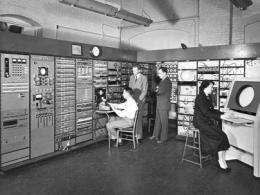
Stephen Dodd, Jay Forrester, Robert Everett, and Ramona Ferenz at Whirlwind I test control in the Barta Building, 1950. Photo / The MITRE Corporation
(PhysOrg.com) -- The Project Whirlwind Computer collection -- a compilation of pioneering digital computing research conducted at MIT in the 1940s and 1950s -- has been transferred back to the Institute from the MITRE Corporation, and its contents are being opened to the public for the first time.
The research project, which included the creation of "Whirlwind I" -- the first digital computer at MIT and the fastest of its time -- began at the Institute and had been moved to Lincoln Lab and then later to MITRE. Materials in the collection were previously unavailable to researchers, but with its transfer to MIT, the collection is now accessible to the public. Key documents from the Whirlwind collection have also been digitized and will soon be made available online.
Whirlwind I was completed in 1951, the same year that Project Whirlwind was detached from the Servomechanisms Lab to become the MIT Digital Computer Laboratory. Unclassified research projects using the computer were managed by the Digital Computer Lab staff on the MIT campus, where Whirlwind I occupied 3,300 square feet within the two-story Barta Building (N42).
The precursor to modern-day computers, Whirlwind's fingerprints are evident in today's software and hardware. Parallel digit processing, random-access and magnetic core memory made the initial launch of commercial computers, and interactive visual computer displays, possible. Its groundbreaking design also laid the foundation for simulation and real-time technology. In operation until 1959, Whirlwind formed the basis for the U.S. Air Force's Semi-Automatic Ground Environment (SAGE) air defense system.
The project materials have been transferred to the MIT Institute Archives and Special Collections. Documents on the project will soon be available through the MIT Libraries' web site at: libraries.mit.edu/archives/whirlwind . There will also be a reunion of the Project Whirlwind team at the Meridien Hotel (formerly the Hotel at MIT) on Tuesday, June 30.
Provided by Massachusetts Institute of Technology (news : web)
-
New project sets sights on future of computing
Apr 11, 2005 |
not rated yet |
0
-
Nokia, MIT to research on mobile tech
Oct 27, 2005 |
not rated yet |
0
-
International game laboratory created
Oct 10, 2006 |
not rated yet |
0
-
MIT develops lecture search engine to aid students
Nov 08, 2007 |
not rated yet |
0
-
African students get web link to MIT labs
Mar 22, 2005 |
not rated yet |
0
-
Engineers build first sub-10-nm carbon nanotube transistor
Feb 01, 2012 |
4.9 / 5 (33) |
30
-
Something old, something new: Evolution and the structural divergence of duplicate genes
Jan 31, 2012 |
4.6 / 5 (7) |
1
-
The hidden nanoworld of ice crystals: Revealing the dynamic behavior of quasi-liquid layers
Jan 30, 2012 |
5 / 5 (4) |
1
-
Stock market network reveals investor clustering
Jan 27, 2012 |
3.9 / 5 (23) |
8
-
Of microchemistry and molecules: Electronic microfluidic device synthesizes biocompatible probes
Jan 26, 2012 |
5 / 5 (2) |
0
-
How to calculate total compressibility in liquid porous solid system
1 hour ago
-
Need help reading 3-D
21 hours ago
-
A way to send and receive wireless data
Feb 11, 2012
-
Calling function with no input argument
Feb 10, 2012
-
Force free body diagram problem on gym equipment
Feb 10, 2012
-
Empirical data regarding shower heads and water
Feb 10, 2012
- More from Physics Forums - General Engineering
More news stories
Google might launch Drive for cloud storage soon
(PhysOrg.com) -- Google's next big move, according to the Wall Street Journal, is a cloud storage service called Drive. Hardly first to the plate, Google is simply catching up to introducing its cloud reposi ...
Iran blocks email, restricts net access: reports
Iran has further restricted access to the Internet and blocked popular email services for the past few days, in a move a top lawmaker said could "cost the regime dearly," media reports said on Sunday.
3 hours ago |
5 / 5 (1) |
3
Love a click away in Indonesia's Twitter Republic
He was a geeky kid from Yogyakarta, she a glamorous city girl in Jakarta. In a country with one of the world's most vibrant social networking scenes they fell in love on Twitter.
11 hours ago |
4 / 5 (1) |
0
Walney offshore wind farm is world's biggest (for now)
(PhysOrg.com) -- The Walney wind farm on the Irish Sea--characterized by high tides, waves and windy weather--officially opened this week. The farm is treated in the press as a very big deal as the Walney ...
Navy to begin tests on electromagnetic railgun prototype launcher
The Office of Naval Research (ONR)'s Electromagnetic (EM) Railgun program will take an important step forward in the coming weeks when the first industry railgun prototype launcher is tested at a facility ...
Feb 06, 2012 |
4.5 / 5 (17) |
94
|
Scientists discover molecular secrets of 2,000-year-old Chinese herbal remedy
For roughly two thousand years, Chinese herbalists have treated Malaria using a root extract, commonly known as Chang Shan, from a type of hydrangea that grows in Tibet and Nepal. More recent studies suggest that halofuginone, ...
New method to examine batteries -- MRI from the inside
There is an ever-increasing need for advanced batteries for portable electronics, such as phones, cameras, and music players, but also to power electric vehicles and to facilitate the distribution and storage of energy derived ...
Lab study raises questions over nano-particle impact
Tests involving chickens have raised questions about the impact on health from engineered nano-particles, the ultra-fine grains commonly used in drugs and processed foods, scientists said on Sunday.
Injured boomers beware: Know when to see doctor
(AP) -- It happened to nurse Jane Byron years after an in-line skating fall, business owner Haralee Weintraub while doing "men's" push-ups, and avid cyclist Gene Wilberg while lifting a heavy box.
A mitosis mystery solved: How chromosomes align perfectly in a dividing cell
Although the process of mitotic cell division has been studied intensely for more than 50 years, Whitehead Institute researchers have only now solved the mystery of how cells correctly align their chromosomes during symmetric ...
Starve a virus, feed a cure? Findings show how some cells protect themselves against HIV
A protein that protects some of our immune cells from the most common and virulent form of HIV works by starving the virus of the molecular building blocks that it needs to replicate, according to research published online ...