Brain-behavior disconnect in cocaine addiction
May 25, 2009
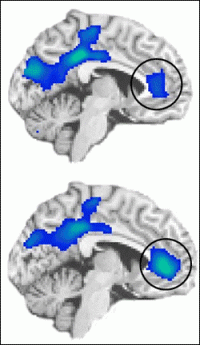
During an emotionally salient task, fMRI scans of cocaine-addicted individuals (bottom) showed stronger deactivation in the anterior cingulate cortex compared with scans of healthy controls (top). This deactivation suggests that this region may have been trying to "tune out" emotional stimuli, such as craving.
(PhysOrg.com) -- Parts of the brain involved in monitoring behaviors and emotions show different levels of activity in cocaine users relative to non-drug users, even when both groups perform equally well on a psychological test. These results — from a brain-imaging study conducted at the U.S. Department of Energy's Brookhaven National Laboratory and published online the week of May 25, 2009, by the Proceedings of the National Academy of Sciences — suggest that such impairments may underlie addictive vulnerability, and that treatments aimed at improving these functions could help addicted individuals resist drugs.
"Many studies have found decreased brain activity in drug-addicted individuals relative to healthy control subjects during psychological tests," said lead author Rita Goldstein, a psychologist at Brookhaven Lab. "But it's never been clear if these differences were due to varying levels of interest or ability between the two groups. This is the first study to look at two groups matched for performance and interest — and we still see dramatic differences in the brain regions that play a very significant role in the ability to monitor behavior and regulate emotion, which are both important to resisting drug use.
"Whether these brain differences are an underlying cause or a consequence of addiction, the brain regions involved should be considered targets for new kinds of treatments aimed at improving function and self-regulatory control," Goldstein said.
The researchers studied 17 active cocaine users and 17 demographically matched healthy control subjects. Both groups were trained to push one of four colored buttons corresponding to the color of type used to present words that were either related to drug use (e.g., crack, addict) or neutral household terms. Subjects were given monetary rewards for fast, accurate performance — up to 50 cents for each correct answer on some tests, for a maximum of $75.
After training, both groups performed equally well on this same test while lying in a magnetic resonance imaging (MRI) scanner, with performance improving when they knew they'd be earning the highest monetary reward. During the tests, the scientists used functional MRI (fMRI) to indirectly measure the amount of oxygen being used by specific regions of the brain, as an indicator of brain activity in those regions.
There were three main differences between the cocaine-addicted subjects and the healthy controls:
- The cocaine users had reduced activity in a portion of the anterior cingulate cortex that usually becomes more active (compared to a passive baseline) when monitoring behavior. Activity levels were lowest during the least "interesting," or salient, version of the test — when there was no monetary reward and the words shown were neutral household terms. Within the cocaine-user group, activity levels were lowest in the people who had used cocaine most frequently in the 30 days prior to the test.
- The cocaine users also had reduced activity in another part of the anterior cingulate cortex that usually becomes less active (compared to a passive baseline) when someone is successfully suppressing emotional feelings. Within the cocaine-user group, activity levels during the high-salience version of the test — when each fast, correct answer was rewarded with 50 cents and the words presented were drug-related — were lowest in the people who were most successful in suppressing the task-induced craving. In healthy controls, who did not report craving, activation in this region was not significantly different from baseline.
- The functions within the behavior-monitoring and emotion-monitoring brain regions were interconnected in the healthy control subjects but not in the addicted individuals. In all, these group differences in brain function and interconnectivity were quite robust and all the more meaningful in that there were no differences between the groups in performance on or interest ratings for the task.
"Our results show that activity in this region indeed went down in the drug-using group, suggesting they were actively trying to suppress craving. Indeed subjects who reported the highest levels of task-induced craving were the least able to suppress activity in this particular brain region.
"This could be because these drug users were still being distracted by background 'noise' stimuli, like memories of having taken drugs or anticipation of further use," Goldstein said.
"This work gives us some clues as to what happens when drug users are unable to suppress craving — and how that might work together with a decreased ability to monitor behavior, even during neutral, non-emotional situations, to make some people more vulnerable to taking drugs," Goldstein said.
The findings point to the importance of improving activity in the behavior-monitoring brain region, possibly by using behavioral and pharmacological approaches to increase motivation and top-down monitoring. Treatments aimed at strengthening activity in the emotion-monitoring brain region may further help addicted individuals regain self-control, especially during hard to suppress highly emotional situations (e.g., during craving). Treatments aimed at strengthening the interconnectivity between these brain regions may decrease impulsivity.
-
Altered Perception of Reward in Human Cocaine Addiction
Oct 16, 2006 |
not rated yet |
0
-
Drug-related preference in cocaine addiction extends to images
Nov 17, 2008 |
not rated yet |
0
-
Cocaine cravings are studied
Jun 15, 2006 |
not rated yet |
0
-
Recent Drug Use Masks Cocaine Abusers' Cognitive Impairment
Mar 03, 2009 |
not rated yet |
0
-
Methamphetamine Enters Brain Quickly and Lingers
Oct 13, 2008 |
not rated yet |
0
-
Engineers build first sub-10-nm carbon nanotube transistor
Feb 01, 2012 |
4.9 / 5 (33) |
30
-
Something old, something new: Evolution and the structural divergence of duplicate genes
Jan 31, 2012 |
4.6 / 5 (7) |
1
-
The hidden nanoworld of ice crystals: Revealing the dynamic behavior of quasi-liquid layers
Jan 30, 2012 |
5 / 5 (4) |
1
-
Stock market network reveals investor clustering
Jan 27, 2012 |
3.9 / 5 (23) |
8
-
Of microchemistry and molecules: Electronic microfluidic device synthesizes biocompatible probes
Jan 26, 2012 |
5 / 5 (2) |
0
-
Is Everyday Technology Killing Us?
Feb 08, 2012
-
Exercise and weight loss
Feb 08, 2012
-
Why do we have head aches? Our brains can't feel anything.
Feb 07, 2012
-
"The end of diseases" by David Agus, interview from Daily Show with Jon Stewart
Feb 04, 2012
-
Oncolytic adenovirus
Feb 04, 2012
-
Nutrition label stuffs and diets
Feb 02, 2012
- More from Physics Forums - Medical Sciences
More news stories
Starve a virus, feed a cure? Findings show how some cells protect themselves against HIV
A protein that protects some of our immune cells from the most common and virulent form of HIV works by starving the virus of the molecular building blocks that it needs to replicate, according to research published online ...
10 hours ago |
5 / 5 (2) |
0
|
Overeating may double risk of memory loss
New research suggests that consuming between 2,100 and 6,000 calories per day may double the risk of memory loss, or mild cognitive impairment (MCI), among people age 70 and older. The study was released today and will be ...
Medicine & Health / Neuroscience
7 hours ago |
5 / 5 (2) |
0
|
Injured boomers beware: Know when to see doctor
(AP) -- It happened to nurse Jane Byron years after an in-line skating fall, business owner Haralee Weintraub while doing "men's" push-ups, and avid cyclist Gene Wilberg while lifting a heavy box.
12 hours ago |
5 / 5 (1) |
0
Declining health-care productivity in England: Who says so?
Reports that the National Health Service in England has been declining in productivity in the last decade appear to have been accepted as fact. However, a Viewpoint published Online First by The Lancet disputes this. The Vi ...
5 hours ago |
not rated yet |
0
FDA-approved drug rapidly clears amyloid from the brain, reverses Alzheimer's symptoms in mice
Neuroscientists at Case Western Reserve University School of Medicine have made a dramatic breakthrough in their efforts to find a cure for Alzheimer's disease. The researchers' findings, published in the journal Science, show t ...
Medicine & Health / Neuroscience
Feb 09, 2012 |
4.9 / 5 (58) |
17
|
Scientists discover molecular secrets of 2,000-year-old Chinese herbal remedy
For roughly two thousand years, Chinese herbalists have treated Malaria using a root extract, commonly known as Chang Shan, from a type of hydrangea that grows in Tibet and Nepal. More recent studies suggest that halofuginone, ...
New method to examine batteries -- MRI from the inside
There is an ever-increasing need for advanced batteries for portable electronics, such as phones, cameras, and music players, but also to power electric vehicles and to facilitate the distribution and storage of energy derived ...
Google might launch Drive for cloud storage soon
(PhysOrg.com) -- Google's next big move, according to the Wall Street Journal, is a cloud storage service called Drive. Hardly first to the plate, Google is simply catching up to introducing its cloud reposi ...
A mitosis mystery solved: How chromosomes align perfectly in a dividing cell
Although the process of mitotic cell division has been studied intensely for more than 50 years, Whitehead Institute researchers have only now solved the mystery of how cells correctly align their chromosomes during symmetric ...
Lab study raises questions over nano-particle impact
Tests involving chickens have raised questions about the impact on health from engineered nano-particles, the ultra-fine grains commonly used in drugs and processed foods, scientists said on Sunday.
Researchers find extensive RNA editing in human transcriptome
In a new study published online in Nature Biotechnology, researchers from BGI, the world's largest genomics organization, reported the evidence of extensive RNA editing in a human cell line by analysis of RNA-seq data, demons ...
May 25, 2009
Rank: not rated yet
Does this extend to alcohol or other dependencies?
May 26, 2009
Rank: not rated yet
Most people associate drugs with low classes and crime but in fact most of the drug use is in the middle classes, especially coke as they can afford it. Crack is different altogether.
I use MJ on a daily basis (love the 4-5 J's a week is HEAVY user spiel, I smoke that a day) and love a sniff and yet I am a geeky accountant with a great childhood.
I even consider myself a connoisseur as I wont smoke anything and really go for the top. Addicted?, yes for sure. Would I stop?, not so sure.
Its hard to explain what we get from the use, but most people I know who are users are generally intelligent and the drugs are an addition to a boring day-in-day-out stuff, it just makes everything seem that much more interesting.
Now the crunch! Did drugs make us bored with everything? Or are we users because we are bored and seek some brain stimuli? Jobs destroy creativity and freedom of spirit so i guess its just our way of getting out of the system, even for an hour or 2.
May 26, 2009
Rank: not rated yet
iknow,
Just wanted to step in here to point out that you are not, in fact, addicted to cannabis. There are a plethora of studies that have disproven any chemical addiction by THC. What you have is a habit, which cannabis is known to form in users. Addictions begin with habits, but in the case of cannabis is impossible due to no chemical dependence on the intoxicating substance.
Also, not all jobs destroy creativity and freedom of spirit; consider photography, writing, pottery, glass-blowing, painting, etc. Sure, many jobs present the employee with repetitive daily tasks and no room for mental stimulation, but isn't that really just another method by which to utilize one's imagination? Repetition is a known method to meditation, as well as relaxation of the mind in general. This is why in repetitive tasks (driving is a good example), our minds are free to wander and thereby exhibit "creativity and freedom of spirit" as you termed it.