Astronauts to blast off to expanded space station
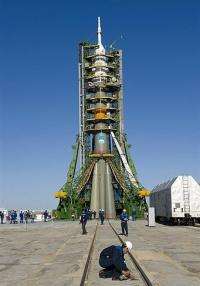
May 26, 2009 by Benoit Finck Russian "Soyuz TMA-15" rocket

Enlarge

This handout photo from the European Space Agency (ESA) shows Russian "Soyuz TMA-15" rocket sitting on its launching pad at the Russian leased Baikonur cosmodrome, in Kazakhstan, on May 25, 2009. A Belgian, a Canadian and a Russian blast off for the International Space Station on Wednesday as Russia steps up its rocket launches to support a doubling of the station's crew.

A Belgian, a Canadian and a Russian blast off for the International Space Station on Wednesday as Russia steps up its rocket launches to support a doubling of the station's crew.

The astronauts will lift off aboard a at 4:34 pm (1034 GMT) from Russia's historic Baikonur cosmodrome on the Kazakh steppe.

They will hurtle into low Earth orbit and then make a gradual ascent to the station over two days, docking on Friday.

The voyage marks a doubling of the station's permanent crew from three to six and with it a rise in the frequency of manned flights aboard the Soyuz, a Soviet-designed rocket that originated in the late 1960s.

Belgian Frank de Winne, Canadian Robert Thirsk and Russian Roman Romanenko will join Russian Gennady Padalka, US astronaut Michael Barratt and Japan's Koichi Wakata aboard the station.

The station, which orbits 350 kilometres (220 miles) above Earth, has become a sophisticated platform for scientific experiments after the installation of a European laboratory last year and the arrival of a hi-tech Japanese lab, Kibo, which is currently being completed.

A huge new was installed earlier this year to give more power.

The station is also intended to test the effects of long-term space travel on humans, with a view to more ambitious travel to destinations such as Mars.

Amid a dizzying array of new technology, one feature new arrivals will have to get used to is a recycling facility installed this month that enables astronauts to drink their recycled urine.

In one study to be carried out on the station Thirsk, 55, will take medication usually prescribed to geriatric patients to counter the effects of in space.

However Romanenko, who is following in the footsteps of an astronaut father, stressed plans to expand the station's dining table at a news conference earlier this month.

"Lunch is a ritual process in orbit," he said at Russia's cosmonaut training centre, Star City.

"With our arrival we will for the first time be six. So we will need to engineer another table," he said.

At the same news conference Thirsk promised to contribute Canadian specialities including Caribou meat to the station's menu.

However no paying "tourists" -- who have contributed extra revenue for Russia in recent years -- will be present on Wednesday's flight.

Russia is stepping up the number of Soyuz launches from two in previous years to four this year to meet the demands of the ISS and has said there may be no tourists for some time.

The Soyuz is set to become the sole means of reaching the ISS for a few years as the United States is due to take its somewhat troubled shuttles out of commission in 2010.

The current mission will be the first time astronauts from all five of the partners in the ISS -- Canada, the European Space Agency (ESA), Japan, Russia and the United States -- are in orbit together.

Even as the six-person ISS crew put the finishing touches on their orbiting home, international space agencies are looking toward the next step in space exploration: travel to Mars.

(c) 2009 AFP


print this article email this article download pdf blog this article bookmark this article     Stumble it Digg this share on Facebook retweet share on Reddit add to delicious
Rate this story - 5 /5 (4 votes)

Rank Filter

Move the slider to adjust rank threshold, so that you can hide some of the comments.


Display comments: newest first

  • KBK - May 26, 2009
    • Rank: not rated yet
    Hope the Canadian brought some good Hydro.

May 26, 2009 all stories

Comments: 1

5 /5 (4 votes)
  • Stumble this up

  • Digg this

  • share this

  • hide
  • Related Stories

  • New dinner table top priority as ISS expands
    created May 07, 2009 | popularity not rated yet | comments 0
  • Russian ship with tourist docks with space station
    created Mar 28, 2009 | popularity not rated yet | comments 0
  • ISS crew prepares for repositioning
    created Mar 13, 2007 | popularity not rated yet | comments 0
  • Russian ship with tourist docks with space station: reports
    created Mar 28, 2009 | popularity not rated yet | comments 0
  • Roscosmos Calls For Launch Swaps And Bigger ISS Crew
    created Mar 15, 2006 | popularity not rated yet | comments 0


  • hide
  • Relevant PhysicsForums posts

  • The shape of our solar system's orbits.
    created Nov 07, 2009
  • Above or Below the Line of Nodes
    created Nov 07, 2009
  • Supernova vs. Nova?
    created Nov 07, 2009
  • Supernova's Gamma Rays and Comets
    created Nov 06, 2009
  • More from Physics Forums - General Astronomy

Other News

Deep creep means milder, more frequent earthquakes along Southern California's San Jacinto fault

Deep creep means milder, more frequent earthquakes along Southern California's San Jacinto fault

Space & Earth / Earth Sciences

created 12 hours ago | popularity 4.7 / 5 (3) | comments 0

With an average of four mini-earthquakes per day, Southern California's San Jacinto fault constantly adjusts to make it a less likely candidate for a major earthquake than its quiet neighbor to the east, the ...


Success in 'space elevator' competition (AP)

Success in 'space elevator' competition (Update 3)

Space & Earth / Space Exploration

created Nov 05, 2009 | popularity 4.3 / 5 (33) | comments 50

(AP) -- A robot powered by a ground-based laser beam climbed a long cable dangling from a helicopter on Wednesday to qualify for prize money in a $2 million competition to test the potential reality of the ...


In a Galaxy Far, Far Away...

In a Galaxy Far, Far Away...

Space & Earth / Astronomy

created Nov 06, 2009 | popularity 4.8 / 5 (5) | comments 16

(PhysOrg.com) -- Astronomers have published the discovery of the farthest known object in the cosmos: a star that exploded when the universe was only 630 million years old -- only 4.6% of its current age. ...


'Dropouts' pinpoint earliest galaxies

'Dropouts' pinpoint earliest galaxies

Space & Earth / Astronomy

created Nov 06, 2009 | popularity 4.2 / 5 (10) | comments 13

Astronomers, conducting the broadest survey to date of galaxies from about 800 million years after the Big Bang, have found 22 early galaxies and confirmed the age of one by its characteristic hydrogen signature ...


Space hotel taking bookings for 2012 opening

Space hotel taking bookings for 2012 opening

Space & Earth / Space Exploration

created Nov 05, 2009 | popularity 4.4 / 5 (21) | comments 11

(PhysOrg.com) -- The first orbiting space hotel is on track to open for its first customers in 2012, but hurry, as bookings are filling fast.