New extinct lemur species discovered in Madagascar
May 26, 2009 New extinct lemur species discovered in Madagascar

Enlarge

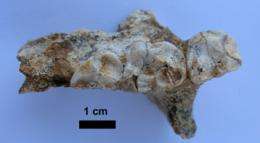
P.kelyus maxilla fragment, removed from its matrix. © D. Gommery- MAPPM & CNRS

A third species of Palaeopropithecus, an extinct group of large lemurs, has just been uncovered in the northwest of Madagascar by a Franco-Madagascan team.

Baptised Palaeopropithecus kelyus, this new specimen is smaller than the two species of these 'large sloth lemurs' already known and its diet made up of harder-textured foodstuffs. This discovery supports the idea of a richer in recent prehistory (late Pleistocene and beginning of the Holocene). The results, currently available online, will be published in the Comptes Rendus de l'Académie des Sciences Palevol, July-August 2009.

Madagascar, where natural environments show a high level of endemism, is one of the last great biodiversity sanctuaries in the world. The island is home to a special group of primates, the lemurs. There are presently 15 genera and 71 species of these small mammals on Madagascar.

The genus Palaeopropithecus is a group of subfossil giant . Up until now, two species had been described: P. ingens (in 1898) and P. maximus (in 1903). Palaeopropithecus have very specific adaptations, notably for locomotion, as they moved from branch to branch using all four limbs, with their head downwards, in a similar way to today's South American sloths.

Recent discoveries by the MAPPM on sites in northwest Madagascar have established the existence of a third species of Palaeopropithecus, which has been baptised P. kelyus. Scientists have suspected the existence of this species for more than 20 years. P. kelyus, whose weight is estimated around 35 kg, is smaller than the two known Palaeopropithecus species, but is very large in comparison with the largest living lemur, the Indri, which weighs only 10 kg.

The other main difference of this new species is that its teeth are smaller. Its dental characteristics could be described from the P. kelyus subfossil maxilla fragment, showing a crista obliqua, a parastyle and a highly developed mesostyle. This morphology is reminiscent of the present day Propithecus genus. While other Palaeopropithecus must have fed on leaves and fruit, the differences in the teeth of P. kelyus suggest that this animal could chew much tougher foods (notably seeds) compared with the other two known species. P. kelyus was found in an area of northwest Madagascar (Boeny region, Mahajanga province) with the particularity of being situated between large bays and rivers. This topography could have isolated P. kelyus from the other two species of Palaeopropithecus, one of which lived more in the south or centre, and the other in the north of Madagascar.

In the 'evolution laboratory' that represents, the discovery of this third Palaeopropithecus contributes to our understanding of the subfossil fauna . More broadly, such work also includes the study of the island's human population.

More information: D.Gommery et al., C.R. Palevol, vol 8 (5), July-August 2009 © 2009 Académie des sciences / Elsevier Masson (DOI : 10.1016/j.crpv.2009.02.001) http://www.em-consulte.com/revue/palevo/s200/4901

Provided by CNRS, France


print this article email this article download pdf blog this article bookmark this article     Stumble it Digg this share on Facebook retweet share on Reddit add to delicious
Rate this story - 4.5 /5 (2 votes)


May 26, 2009 all stories

Comments: 0

4.5 /5 (2 votes)
  • Stumble this up

  • Digg this

  • share this

  • hide
  • Related Stories

  • Ancient DNA Confirms Single Origin of Malagasy Primates
    created May 27, 2005 | popularity not rated yet | comments 0
  • New population of highly threatened greater bamboo lemur found in Madagascar
    created Jul 22, 2008 | popularity not rated yet | comments 0
  • New Lemur species named for Field Museum scientist
    created Aug 10, 2005 | popularity not rated yet | comments 0
  • Museum specimens aid conservation effort in Madagascar
    created Apr 16, 2009 | popularity not rated yet | comments 0
  • Lemur's evolutionary history may shed light on our own
    created Feb 25, 2008 | popularity not rated yet | comments 0


  • hide
  • Relevant PhysicsForums posts

  • Human Leukocyte Antigen (HLA) typing
    created 6 hours ago
  • Breeding program
    created Nov 20, 2009
  • How does a concentration gradient provide energy?
    created Nov 20, 2009
  • Eyesight and Neural Damage from Electronics
    created Nov 19, 2009
  • More from Physics Forums - Biology

Other News

Museum: Galileo's fingers, tooth are found (AP)

Museum: Galileo's fingers, tooth are found

Other Sciences / Archaeology & Fossils

created 17 hours ago | popularity not rated yet | comments 5

(AP) -- Two fingers and a tooth removed from Galileo Galilei's corpse in a Florentine basilica in the 18th century and given up for lost have been found again and will soon be put on display, an Italian museum ...


Measure to change U. of Neb. stem-cell rule fails (AP)

Measure to change U. of Neb. stem-cell rule fails (Update 2)

Other Sciences / Other

created 17 hours ago | popularity 5 / 5 (1) | comments 0

(AP) -- The University of Nebraska's governing board on Friday voted not to place tighter restrictions on embryonic stem cell research than those outlined under federal guidelines, which were expanded after ...


Researcher: Faint writing seen on Shroud of Turin (AP)

Researcher: Faint writing seen on Shroud of Turin (Update)

Other Sciences / Archaeology & Fossils

created Nov 20, 2009 | popularity 1.9 / 5 (23) | comments 23

(AP) -- A Vatican researcher has rekindled the age-old debate over the Shroud of Turin, saying that faint writing on the linen proves it was the burial cloth of Jesus. Experts say the historian may be reading ...


Three of a kind

Three of a kind: Revealing language’s universal essence

Other Sciences / Social Sciences

created Nov 20, 2009 | popularity 3.8 / 5 (10) | comments 6

(PhysOrg.com) -- On the surface, English, Japanese, and Kinande, a member of the Bantu family of languages spoken in the Democratic Republic of Congo, have little in common. It is not just that the vocabularies ...


Maya

New insights into the life of the Maya

Other Sciences / Archaeology & Fossils

created Nov 16, 2009 | popularity 4.6 / 5 (15) | comments 7

(PhysOrg.com) -- Ancient artifacts are almost always concerned with rich and powerful religious and political leaders, but new excavations of an ancient Maya site have unearthed a pyramid decorated with murals ...