Before God particle, scientists must learn soul of new machine
May 26, 2009 By Kathleen Tibbetts, SMU Before God particle, scientists must learn soul of new machine

Enlarge

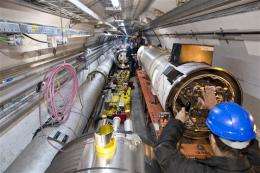
Work progressing in the LHC tunnel. Photo courtesy of CERN.

After a huge success in first testing, followed by a very public meltdown last September, the Large Hadron Collider may be ready for action again as early as June.

But before the science can proceed, the world's scientists must come to terms with the complex organism they have created, says one project manager.

"We will have to understand the detector first," says Ryszard Stroynowski, chair and professor of physics at SMU.

Stroynowski is U.S. Coordinator for the Liquid Argon Calorimeter, the literal and experimental heart of ATLAS, the largest in the LHC array.

The first priority for operation of the ATLAS detector is "to get all those billions of elements to work together in synch again," Stroynowski says. "We want to see during the summer whether the circulating beam will induce any noise in the system."

Stroynowski leads an SMU delegation that includes Fredrick Olness, professor of physics, and Robert Kehoe and Jingbo Ye, assistant professors of physics, all in Dedman College. Kehoe is currently at CERN for his research.

The SMU team is focusing on three projects in parallel:

• improvements of the graphic and software interfaces for control and monitoring of the detector and of the quality of its data
• preparation of the software packages to analyze the data
• design and prototyping of the modifications of the readout electronics that will be needed for future upgrades of the experiment to much higher-intensity beams — a six-year research and development project led by Jingbo Ye in SMU's Physics Electronics Lab.

The LHC is considered the world's largest physics experiment. The particle accelerator is a 27-kilometer circular tunnel that lies 100 meters underground near Geneva on the French-Swiss border. It uses a magnetic field to propel high-energy protons into each other.

A mechanical failure in September 2008 damaged 53 of the super-sized magnets that power and focus the accelerator's beams. The final replacement magnet was lowered into place April 30. Repairs in the tunnel now focus on connecting the magnets together and installing new safety and monitoring systems to prevent similar incidents from happening again.

In addition, the 37 damaged magnets that were replaced by spares will be refurbished to serve as spares themselves. Sixteen magnets sustained only minimal damage and were repaired and reinstalled.

The earlier malfunction has resulted in a frustrating wait — one that has had a "rather demoralizing" effect on the students and postdoctoral fellows whose time at the LHC may come and go during downtime, Stroynowski says. Yet the importance of protecting the vast high-energy array from future trauma can't be overstated, and "the goal is worth the wait, as the payoff may be enormous," he says.

Scientists and technicians at the European Organization for Nuclear Research — called by its acronym, CERN — in Geneva have maintained an aggressive rehabilitation schedule. The ATLAS detector itself was closed on May 5, marking an end to checks and re-checks of the electronics, cables and other connections. Repairs to the accelerator's underground ring are scheduled to be completed at the end of May.

Beams will start in June, initially at a relatively low 450 gigaelectron volts (GeV) per beam to ensure the integrity of the new parts and connections. Scientists will raise the energy over a couple of days to 2 teraelectron volts (TeV) per beam, and finally to the LHC's target operational level of 5 TeV per beam.

The ATLAS team will start taking shifts in July and expects to have useful data starting in October 2009, Stroynowski says. The will then run continuously for 11 months.

Stroynowski says he doesn't expect any major discoveries by this time next year, but that he hopes "significant results" will come early in 2011.

The LHC's proton collisions release even smaller pieces of matter, and the particle detector helps measure the tracks they leave. The huge, international project is directed at finding the "Higgs boson," a subatomic "God particle" that physicists believe could help explain the origin of our Universe.

The theory behind the Higgs boson holds that all particles had no mass just after the "Big Bang." As the Universe cooled and the temperature fell below a critical value, an invisible force field composed of subatomic particles called the "Higgs boson" developed throughout the cosmos. Particles that interact with the field gain mass and particles that never interact have no mass. But the theory remains unproven because no one has ever seen the Higgs boson at work.

More information: For more information and useful links see the original story at SMU website.

Provided by Southern Methodist University (news : web)


print this article email this article download pdf blog this article bookmark this article     Stumble it Digg this share on Facebook retweet share on Reddit add to delicious    
Rate this story - 4.3 /5 (18 votes)

Rank Filter

Move the slider to adjust rank threshold, so that you can hide some of the comments.


Display comments: newest first

  • DGBEACH - May 26, 2009
    • Rank: 1.3 / 5 (4)
    The huge, international project is directed at finding the "Higgs boson," a subatomic "God particle" that physicists believe could help explain the origin of our Universe.
    OK guys...so does God exist, or not?
  • iamcrazy - May 27, 2009
    • Rank: 1.8 / 5 (5)
    science proved god wrong along time ago.
  • Lazlor - May 27, 2009
    • Rank: 3.7 / 5 (3)
    Which god?
  • iamcrazy - May 27, 2009
    • Rank: 4.7 / 5 (3)
    the one that says its the real one
  • Torbjorn_Larsson_OM - May 27, 2009
    • Rank: 5 / 5 (2)
    I doubt that technically the Higgs field is invisible any more than gravitation is unobservable despite that we haven't seen an actual graviton interaction.


    @ DGBEACH:


    Prayer studies has tested that the particular god of the "God particle" exist or not - it doesn't.


    As for gods in general, apparently not. But which sane person expected after the enlightenment that religious ideas had any bearing on reality? [No True Scotsmen need to answer that. :-o But seriously, it is a little bit of social insanity to persist in magical thinking at this time.]

  • finitesolutions - May 27, 2009
    • Rank: 1 / 5 (3)
    This means that religion is a fantasy or worse a biological malfunction ( more harsh: mental ilness ). Religious people are pretty much functional human beings that do not want to change their belief system. They are traped into their believes. Why people choose suicide behavior contradicts the evolution theories.
  • Nevertheless - May 27, 2009
    • Rank: 4.7 / 5 (3)
    The jury is still out, people. There is no proof, and hense no science on the existence of a creator now. What is the truth? 0 or 1, plus or minus--we don't know. Thus there are people who affirm the truth of each side of the question.

    It's doubtful that the situation will remain this way in the foreseeable future. RK pegs the singularity at 2045. The people/machines living then will-be-like-gods. We should expect that there is very little if anything that they will not be able to affirm as true/false. We only need to be patient (and not suicide).
  • brant - May 27, 2009
    • Rank: 5 / 5 (3)
    Religion, politics and money are devices to ensure compliance.
  • Torbjorn_Larsson_OM - May 28, 2009
    • Rank: 5 / 5 (1)
    "There is no proof, and hense no science on the existence of a creator now."

    "Proof" is for formal math.

    Instead there are testable empirical hypotheses. For example, that all systems are matter systems (action-reaction systems). Last I did the math (binomial test yes/no) this is validated beyond reasonable doubt.

    So sorry, no gods.

    Especially not a creator, which assumes he was created more complex than the system he created. Obviously the infinite regress of needed creators quickly spins into a singularity, so it doesn't even make formal sense as a "proof".

    But more seriously, natural systems are always found to start out simple before complexity emerges by way of many observed mechanisms, so "a creator" hypothesis is easily falsified by testing. [Read Dawkins "The God Delusion" for a weaker but more specific version of this simple observation.]
  • DGBEACH - May 28, 2009
    • Rank: 5 / 5 (1)
    ALL good answers, I suppose, but the chicken-or-egg question still remains to be answered...do all things have a beginning? I ask this because, to me, accepting that the universe just "always was" seems like a bit of a leap of faith in itself (not based upon provable facts).

    All our math tells us that the universe is expanding from a central (starting) point, which would infer a beginning, and that is really what "God" was supposed to have done- started the whole thing going...I'm truly torn.

    Can someone explain to me how the universe, expanding outwards as it is, could have always existed?

  • Alizee - May 28, 2009
    • Rank: 1 / 5 (2)
    ..do all things have a beginning..
    Time has no beginning. In adition, things could have more futures and pasts in Aether wave theory. In AWT space-time is forming nested recursive foam, we are living at some membrane, but such membrane is branching into many others both in the past, both in the future perspective - well, like membranes in foam. Quantum uncertainty is manifestation of many time arrows at future, microwave photons and CMB polarization is manifestation of many time arrows at past.
    ..how the universe, expanding outwards as it is, could have always existed..
    The assumption space-time is eternal doesn't implies eternity of observable matter in it. AWT considers, Universe is an infinite system of nested density fluctuations of energy and matter and we are one of these fluctuations. Such system appears the more dense, the farther we are looking through it by the same way, like during observation through fog, which can be interpreted as a space-time expansion. The landscape under haze appears quite foggy at distance, but when we come into remote place, we would see, it's quite transparent, whereas the original place would appear under haze instead. I do believe, universe expansion is mostly an illusion of the same origin. Every remote observer at the Universe boundary would see us by the same way, like we could see him right now.

    This model has some observational support, because remote gallaxies in ultradepth Hubble field appear quite simmilar to gallaxies at proximity, it means Universe is basically Uniform.
  • DGBEACH - May 28, 2009
    • Rank: not rated yet
    Alizee- I am not convinced of the coexistence of multiple time-lines...it sounds too far fetched. Time is only a measurement of relative intervals, not something tangible or detectable, thus it cannot be affected by anything- it just is...IMHO

    And perhaps your opinion will change, regarding the Universe's uniformity, once Hubble's new equipment comes on-line...the equipment WAS flawed.
  • Slotin - May 28, 2009
    • Rank: 1 / 5 (2)
    From certain perspective the existence of multiple time-line manifest itself at all places, where single space-time events causes the different responses at different places. For example the gravitational lensing, the formation of multiple event horizons at the case of rotating black holes or quantum uncertainty phenomena are all manifestations of Lorentz invariance violation, tachyons, hidden dimensions and multiple time arrows. Of course, from more general perspective these effects are all just some manifestation of some sufficiently general space-time curvature, whereas the general time arrow remains unafected. The trick is, the influence of such general time arrow becomes weaker, the more distant is your perspective from everyday perspective. I can live in very general hyperspace-time, into which our Universe is embedded, but such abstract hypertime is uselless with respect of measurement of time intervals inside of our Universe. The general problem of AWT laymans is, they're thinking in very general concept, which have nearly no tangible influence to our observable reality. You would dissolve into radiation, if you would travel for your abstract general time outside of our Universe.

    So you can use whatever interpretation you like, but you shouldn't mix it with another, or you can get inconsistent conclusions. An illustrative example of the way of thinking presented above: the observer outside of gravitational lense observes the relativistic aberration from flat space-time, so he would see path of light curved and he can believe in variable light speed theory without problem.

    Whereas the observer inside of gravitational lense would always see the path of light straight, because he would be deformed in (nearly) the same way, like surrounding space-time. This is a relativistic view.

    Both these perspectives are perfectly interchangable each other, but they shouldn't never mixed, or you get into inconsistent results from trivial geometry reasons and your theory becomes singular. But in real situation, you're always affected by gravitational lense, but not quite, so your view would suffer by quantum uncertainty.

    It's quite difficult not to consider various inconsistent postulates and assumptions at the same moment, the only safety policy here is to consider as few postulates and assumptions, as possible, i.e. an Occam's razor principle.
  • Slotin - May 28, 2009
    • Rank: 1 / 5 (1)
    ..time is only a measurement of relative intervals, not something tangible or detectable..
    Not quite at the moment, when we can measure or predict the number of time dimensions of space-time in reproducible way, for example. For example the flat density gradient forming the local space/time at the water surface has a single time dimension - but the brane between pair of bubbles has a two surfaces, i.e. a pair of time dimensions. For example, we can say, antiparticles are living at the opposite side of our space-time, or we can say, they're living in inverse/reciprocal time arrow. Antiparticle usually decay, where comon particles are condensing and vice-versa, they feel antigravity, and so on... As such they're rather rare, but tangible evidence of second time dimension.
  • norcaltoker - May 29, 2009
    • Rank: 5 / 5 (2)
    Addressing the "big-bang" event.. To state that the universe is expanding from a certain "point" at a certain "time" is inaccurate. Because, according to the theory, prior to the event there would have been neither time or space. Both of which are just measurements of mono-universal dimensions, and are therefore meaningless comparisons.

    **fingers crossed for CERN
  • Posquant - May 30, 2009
    • Rank: 1 / 5 (1)
    The Higgs-Boson is an event, not a particle. They'll never find it this way. But they may help create it.
  • james11 - May 30, 2009
    • Rank: 1 / 5 (2)
    Off the subject but when u die do u just cease to be or is there any possibility at all that there is more after?
  • james11 - May 30, 2009
    • Rank: 1 / 5 (2)
    Also...with the crazy amount of planets out there cant help to think could there be a chaotic planet with life that evolves in harder/different conditions making them much smarter and stronger and gaining exotic abilities cuz that would be sweeeeeet
  • dhughes - May 30, 2009
    • Rank: 5 / 5 (2)
    The Higgs-Boson is an event, not a particle. They'll never find it this way. But they may help create it.


    From what I understand it's a field (Higgs field) and a particle (Higgs boson).


    From CERN:

    "As the Universe cooled and the temperature fell below a critical value, an invisible force field called the 'Higgs field' was formed together with the associated 'Higgs boson'. The field prevails throughout the cosmos: any particles that interact with it are given a mass via the Higgs boson. The more they interact, the heavier they become, whereas particles that never interact are left with no mass at all."


    http://public.web...-en.html
  • Au-Pu - May 31, 2009
    • Rank: 1 / 5 (3)
    To DGBEACH May 28.
    Our observations show the universe expanding, yes
    But from a central point, NO.
    We see the universe expanding in all directions away from us.
    If your view were to hold that would place us at the epicentre of the big bang.
    No one believes that to be true.
    All of space expands at the same rate
    Therefore the further the gap between two points the greater the rate of expansion between them
    The universe is vastly larger than we can observe
    We are merely in the centre of our observable sphere because the boundary we observe is where the rate of expansion exceeds the speed of light.
    Beyond that boundary space continues to expand relative to us at speeds greater than the speed of light
    Personally I am not comfortable with the big bang theory.
    It smacks too much of the anthropomorphism of science (astrophysics/cosmology), and with 80% ormore of the matter needed to support it we may need to look at other theories.
  • Au-Pu - May 31, 2009
    • Rank: 1 / 5 (1)
    Apologise for error in previous submission final part of last sentence should read "with 80% or more of the matter needed to support it missing, we may need to look to other theories."
  • DGBEACH - May 31, 2009
    • Rank: 1 / 5 (1)
    Our observations show the universe expanding, yes
    But from a central point, NO.
    We see the universe expanding in all directions away from us.
    If your view were to hold that would place us at the epicentre of the big bang.
    No one believes that to be true.

    nor do I
    with 80% or more of the matter needed to support it missing, we may need to look to other theories

    Isn't it possible that we just cannot see the missing matter because it is just too far away?
    "The universe is vastly larger than we can observe"


  • Mercury_01 - May 31, 2009
    • Rank: not rated yet
    there is no center of the universe. it is a closed system. Every point is the center.
  • DGBEACH - Jun 01, 2009
    • Rank: not rated yet
    there is no center of the universe. it is a closed system. Every point is the center.


    EVERYTHING has a center, regardless of its shape or size. That's ridiculous! You are just calling EVERYTHING the center.
  • definitude - Jun 02, 2009
    • Rank: not rated yet
    A resolute science is analogous to GOD. As for the abstract notion of a non-centered Universe, there is no empirical evidence of expansion. We are running off of theory here folks. Just because we have a best guess does not mean that many good ideas cannot be explored. The beauty of science is the unequivocal discovery process that keeps everyone in the race.

    Keep trying and the truth will set you free.
  • Nevertheless - Jun 02, 2009
    • Rank: not rated yet
    james11: "Off the subject but when u die do u just cease to be or is there any possibility at all that there is more after?"

    Strictly speaking your query is not off the subject, since "God" is part of the title of this article.

    Not only is there a "possibility," but a likelihood or depending upon one's point of view (and prior and post prejudice), a definite possibility that there "is more after."

    See, e.g.:

    http://www.ndespace.com/

    or

    http://www.nderf....NDEs.htm
  • scsc75 - Jun 02, 2009
    • Rank: not rated yet
    Not a religious bone in my body but to deny the existence of God (I prefer the term Creator force) is bizarre to me personally. Funny enough this is in fact what the concept of the "original sin" is actually all about and if you can work out why and then how this directly relates to something akin to the possibility of a "God Particle" then well done.
  • Mercury_01 - Jun 03, 2009
    • Rank: 1 / 5 (1)
    there is no center of the universe. it is a closed system. Every point is the center.


    EVERYTHING has a center, regardless of its shape or size. That's ridiculous! You are just calling EVERYTHING the center.


    You do not understand the basic tenets of a non- euclidean closed system, which I and a lot of others believe we are in. Let this bake your noodle: If you get in a rocketship and travel in a perfectly straight line, you will eventually come back to the same place you began. (barring any irregularities in the actual shape of the universe)
  • Mercury_01 - Jun 03, 2009
    • Rank: not rated yet
    DGBEACH:

    Keep in mind that the universe insnt expanding into anything, because outside the boundaries of our physical universe, there is no space time. (excepting the possibility of other universes) It is virtually impossible to visualize the nature of closed space time, but think of it this way. we live on the surface of a sphere, which for all intensive purposes is two dimensional- lat and long. Now add another spatial dimension, and you can see how we live on the "surface" of 3d space. Now add time to the equation and our universe would look quite different than you think it would if it could be viewed from the outside. out of space, out of time!
  • DGBEACH - Jun 04, 2009
    • Rank: 1 / 5 (1)
    You do not understand the basic tenets of a non- euclidean closed system, which I and a lot of others..... BELIEVE...... we are in. Let this bake your noodle: If you get in a rocketship and travel in a perfectly straight line, you will eventually come back to the same place you began. (barring any irregularities in the actual shape of the universe)


    I've obviously heard this one before...my father used to explain it to me as a bedtime story when I was a kid. I just find it a little hypocritical on your parts (you and your "others) that you would readily "believe" in this, and yet ridicule those which might believe in some kind of God as an alternate explanation- the two of which have just as much proof of actually being true.
    As I said before, I am torn, because I just wish there was indisputable proof of one or the other...all theories aside! (ie. Footprint of God OR a picture of your closed space time). I'll admit this however...both theories make for great looking posters! :)
  • DGBEACH - Jun 04, 2009
    • Rank: not rated yet
    [This is from a more recent article]

    Lee Smolin, author of the bestselling science book The Trouble with Physics and a founding member and research physicist at the Perimeter Institute for Theoretical Physics in Waterloo, Canada, writes exclusively in the June issue of Physics World explaining why theories of cosmology that suggest that our universe is just one of many - the so-called multiverse - and thus perpetuate the notion that time does not exist are flawed.

    Smolin explains how theories describing a myriad of possible universes, with less or more dimensions and different kinds of particles and forces, have become increasingly popular in the last few years. However, through his work with the Brazilian philosopher Roberto Mangabeira Unger, Smolin believes that, despite there being good reasons for the conclusion that we live in a timeless multiverse, those theories, and the concomitant assumption that time is not a fundamental concept, are "profoundly mistaken".

    Smolin points out why a timeless multiverse means that our laws of physics are no longer determinable from experiment and how the connection between fundamental laws, which are unique and applicable universally from first principles, and effective laws, which hold based on what we can actually observe, becomes unclear.

    Smolin suggests a new set of principles that he hopes will begin a fresh adventure in science where we have to reconceive the notion of law to apply to a single universe that happens just once. These principles begin with the assertion that there is only one universe; that all that is real is real in a moment, as part of a succession of moments; and that everything that is real in a moment is a process of change leading to the next or future moments. As he explains, "If there is just one universe, there is no reason for a separation into laws and initial conditions, as we want a law to explain just one history of the one universe."

    If we embrace the idea that there is only one universe and that time is a fundamental property of nature, then this opens up the possibility that the laws of physics evolve with time. As Smolin writes, "The notion of transcending our time-bound experiences in order to discover truths that hold timelessly is an unrealizable fantasy. When science succeeds, we do nothing of the sort; what we physicists really do is discover laws that hold in the universe we experience within time. This, I would claim, should be enough; anything beyond that is more a religious urge for transcendence than science."
  • Mercury_01 - Jun 04, 2009
    • Rank: 1 / 5 (1)
    DGBEACH Its not a matter of belief, its a matter of mathematics, and who the hell ever said I was ridiculing you? I know God, and there isn't anything about science that goes against true spirituality. Anyone who says otherwise will soon have major issues. I recommend a book titled "the science of God", and I would also recommend a little humility in the face of these most profound questions. There are no absolutes, and there should definitely not be any room for absolutes proclaimed by humans in the name of God.

May 26, 2009 all stories

Comments: 32

4.3 /5 (18 votes)
  • Stumble this up

  • Digg this

  • share this

  • hide
  • Related Stories

  • Michigan integral to world's largest physics experiment
    created Sep 05, 2008 | popularity not rated yet | comments 0
  • A front-row seat at this summer's physics extravaganza
    created Jul 02, 2008 | popularity not rated yet | comments 0
  • High-energy physics at the highest level
    created Mar 27, 2006 | popularity not rated yet | comments 0
  • Large Hadron Collider set to unveil a new world of particle physics
    created Aug 19, 2008 | popularity not rated yet | comments 0
  • Better track leads to new particles
    created Dec 07, 2006 | popularity not rated yet | comments 0


  • hide
  • Relevant PhysicsForums posts

  • Entropy vs. video game controllers
    created 2 hours ago
  • Electron oscillating in vacuum
    created 2 hours ago
  • Swings
    created 2 hours ago
  • Bicycling on the Moon
    created 3 hours ago
  • Where'd the energy come from?
    created 4 hours ago
  • Need help understanding negative pressure
    created 5 hours ago
  • More from Physics Forums - General Physics

Other News

Stars Fueled by Dark Matter Could Hold Secrets to the Universe

Stars Fueled by Dark Matter Could Hold Secrets to the Universe

Physics / General Physics

created Nov 03, 2009 | popularity 4.5 / 5 (50) | comments 40

(PhysOrg.com) -- The first stars in the universe may have been very different from the stars we see today, yet they may hold clues to understanding some of the mysterious features of the universe. These "dark ...


Second Law of Thermodynamics May Explain Economic Evolution

Second Law of Thermodynamics May Explain Economic Evolution

Physics / General Physics

created Nov 02, 2009 | popularity 4.3 / 5 (29) | comments 28

(PhysOrg.com) -- Terms such as the "invisible hand," laissez-faire policy, and free-market principles suggest that economic growth and decline in capitalist societies seem to be somehow self-regulated. Now, ...


High-performance plasmas may make reliable, efficient fusion power a reality

High-performance plasmas may make reliable, efficient fusion power a reality

Physics / Plasma Physics

created Nov 02, 2009 | popularity 4.7 / 5 (37) | comments 31

In the quest to produce nuclear fusion energy, researchers from the DIII-D National Fusion Facility have recently confirmed long-standing theoretical predictions that performance, efficiency and reliability ...


'Teapot effect' solved

Solving Teapot Effect

Physics / General Physics

created Nov 02, 2009 | popularity 4.9 / 5 (11) | comments 10

(PhysOrg.com) -- A team of scientists from France have worked out why teapots dribble at low flow rates, and how to stop them. The effect is called the "teapot effect", and solving it could finally put an ...


Laser accelerated protons to the highest energies so far

Researchers use trident laser to accelerate protons to record energies

Physics / General Physics

created Nov 02, 2009 | popularity 4.6 / 5 (5) | comments 10

An international team of physicists at Los Alamos National Laboratory has succeeded in using intense laser light to accelerate protons to energies never before achieved. Using this technique, scientists can ...