Getting to the root of science in a nutty way
May 26, 2009
Getting to the root of science in a nutty way

Enlarge

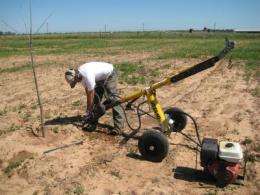
Dr. Leo Lombardini, a Texas AgriLife Research horticultural scientist, bored a hole at a 45-degree angle about 20" from the trunk of 20 pecan trees. He will insert a camera several times a year to study root growth. Credit: Photo courtesy of Texas AgriLife Research

Dr. Leo Lombardini has gone underground to get the most top secret information in his field.

Lombardini is watching roots grow in his experimental orchards, and it is sort of - he's a pecan researcher.

His study is part of a national specialty crop research project funded by the U.S. Department of Agriculture. Lombardini, a Texas AgriLife Research horticultural scientist, will focus on pecans while researchers at other universities focus on almonds, and walnuts. The overall goal is to discover ways to produce a higher quality, more nutritious nut in the most efficient, sustainable way.

"There have been very little root research efforts," said Lombardini who is teamed on the project with Dr. Astrid Volder, Texas A&M University assistant professor of horticultural sciences. "And there has been nothing that looks directly at the root. As far as we know, this is the first research to look at roots in the real setting."

To do that, Lombardini bored a hole at a 45-degree angle about 20 inches from the trunk of 20 trees in a 400-tree orchard planted in February. Each hole was fitted with a six-foot clear plastic tube into which a camera will be inserted at various times in the growing year.

"Pecan trees are planted bare root, that is with not much root system," Lombardini said. "The camera turns to capture a panoramic-type view. So we will be able to watch as these roots grow and see how they respond to various conditions over time."

A pecan tree spends its first five or six years growing into a mature tree capable of producing nuts. Spring is typically a period of growth for the , but it is not currently known whether first-year roots grow much in the first few months of planting. Lombardini hopes the initial shots from the camera in June will give an indication of first-year root growth.

"If we can see when various roots of a tree die or what happens to roots in a drought, for example, we then might know better how to schedule tree maintenance or apply nitrogen at the best time for the best results," Lombardini explained.

Lombardini plans to photograph the roots at least twice a year. A similar study in Las Cruces, N.M., will replicate his work, and the two can be compared.

The federal grant will provide $100,000 over three years for Lombardini's study.

Source: Texas A&M AgriLife Communications


Rank 5 /5 (1 vote)
Related Stories
Relevant PhysicsForums posts
  • Factors affecting beet root cell membrane
    created17 hours ago
  • Stem cell question.
    createdFeb 10, 2012
  • Protease cleavage
    createdFeb 10, 2012
  • Pertubance in a model
    createdFeb 10, 2012
  • Cancer drugs and Alzheimer's, Oh my!
    createdFeb 09, 2012
  • Squishing cells
    createdFeb 09, 2012
  • More from Physics Forums - Biology

More news stories

A mitosis mystery solved: How chromosomes align perfectly in a dividing cell

Although the process of mitotic cell division has been studied intensely for more than 50 years, Whitehead Institute researchers have only now solved the mystery of how cells correctly align their chromosomes during symmetric ...

Biology / Cell & Microbiology

created 13 hours ago | popularity 4.4 / 5 (20) | comments 0 | with audio podcast

Researchers find extensive RNA editing in human transcriptome

In a new study published online in Nature Biotechnology, researchers from BGI, the world's largest genomics organization, reported the evidence of extensive RNA editing in a human cell line by analysis of RNA-seq data, demons ...

Biology / Biotechnology

created 13 hours ago | popularity 5 / 5 (4) | comments 0 | with audio podcast

The proteins ensuring genome protection

Researchers from the University of Geneva (UNIGE), Switzerland, have discovered the crucial role of two proteins in developing a cell 'anti-enzyme shield'. This protection system, which operates at the level of molecular ...

Biology / Cell & Microbiology

created 13 hours ago | popularity 5 / 5 (3) | comments 0 | with audio podcast

Entire genome of extinct human decoded from fossil

(PhysOrg.com) -- In 2010, Svante Pääbo and his colleagues presented a draft version of the genome from a small fragment of a human finger bone discovered in Denisova Cave in southern Siberia. The ...

Biology / Biotechnology

created Feb 07, 2012 | popularity 4.7 / 5 (60) | comments 51 | with audio podcast

Why are there so few fish in the Earth's oceans?

(PhysOrg.com) -- A Stony Brook University researcher has found that, contrary to popular belief, there are not plenty of fish in the sea.

Biology / Plants & Animals

created Feb 08, 2012 | popularity 4.3 / 5 (19) | comments 27 | with audio podcast


Scientists discover molecular secrets of 2,000-year-old Chinese herbal remedy

For roughly two thousand years, Chinese herbalists have treated Malaria using a root extract, commonly known as Chang Shan, from a type of hydrangea that grows in Tibet and Nepal. More recent studies suggest that halofuginone, ...

New method to examine batteries -- MRI from the inside

There is an ever-increasing need for advanced batteries for portable electronics, such as phones, cameras, and music players, but also to power electric vehicles and to facilitate the distribution and storage of energy derived ...

Google might launch Drive for cloud storage soon

(PhysOrg.com) -- Google's next big move, according to the Wall Street Journal, is a cloud storage service called Drive. Hardly first to the plate, Google is simply catching up to introducing its cloud reposi ...

Lab study raises questions over nano-particle impact

Tests involving chickens have raised questions about the impact on health from engineered nano-particles, the ultra-fine grains commonly used in drugs and processed foods, scientists said on Sunday.

Starve a virus, feed a cure? Findings show how some cells protect themselves against HIV

A protein that protects some of our immune cells from the most common and virulent form of HIV works by starving the virus of the molecular building blocks that it needs to replicate, according to research published online ...

Iran blocks email, restricts net access: reports

Iran has further restricted access to the Internet and blocked popular email services for the past few days, in a move a top lawmaker said could "cost the regime dearly," media reports said on Sunday.