Astronauts blast off to double space station crew
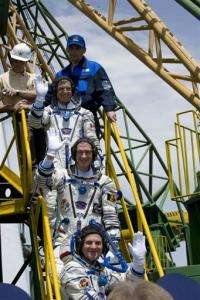
May 27, 2009 by Benoit Finck The astronauts will hurtle into low Earth orbit and then make a gradual ascent to the station

Enlarge

The Soyuz TMA-15 crew members (from top) Canadian astronaut Robert Thirsk, European Space Agency (ESA) astronaut Frank De Winne of Belgium and Russian cosmonaut Roman Romanenko during a farewell ceremony before boarding the Soyuz spacecraft in Baikonur. The three astronauts blasted off for the International Space Station in a landmark mission that will double its crew to six for the first time.

Three astronauts, from Canada, Belgium and Russia, blasted off Wednesday for the International Space Station in a landmark mission that will double its crew to six for the first time.

Belgian Frank De Winne, Canadian Robert Thirsk and Russian Roman Romanenko lifted off from the aboard a .

"We feel okay. The flight is normal... I can see the sun," Romanenko told Russia's space agency chief, Anatoly Perminov, by radio from the rocket as it hurtled into space on the start of its two day journey to the orbiting station.

When they dock with the ISS, the trio will join the current three-person crew who will remain on the station for several more months rather than heading back home as was the case previously.

This will raise the station's permanent crew to six for the first time, allowing the astronauts to make full use of the capacities of the ISS, which orbits 350 kilometres (220 miles) above Earth.

"It's a very good example that shows the whole world that when countries want to work together for the good of their children we can do incredible things," said De Winne at a news conference in Baikonur ahead of his departure.

"It would be impossible for one country to maintain six people aboard the space station. But thanks to the international cooperation, not just aboard the ISS but between all the space organizations, it will be possible."

The three will be joining Russian Gennady Padalka, US astronaut Michael Barratt and Japan's Koichi Wakata aboard the station.

De Winne will take over from Padalka as commander of the ISS when the crew is rotated in October, the first time a West European has been given this responsibility. The Belgian will then return to earth in November.

In a mission marked by a sequence of firsts, Friday's docking will also mark the first time all the partners in the station -- the United States, Russia, Europe, Japan and Canada -- will be represented at the same time on board.

De Winne is only the second European astronaut to undertake a full six-month mission to space after the German Thomas Reiter in 2006. Italian Paolo Nespoli is due to carry out a similar mission from November 2010.

The European (ESA) now receives 8.3 percent of the experiment time aboard the ISS, meaning that it can send an astronaut to the station for a six-month mission every two years.

The station has become a sophisticated platform for scientific experiments after the installation of a European laboratory last year and the arrival of a hi-tech Japanese lab, Kibo, which is currently being completed.

A huge new solar array was installed earlier this year to give more power.

Amid a dizzying array of new technology, one feature new arrivals will have to get used to is a facility installed this month that enables to drink their recycled urine.

In one study to be carried out on the station, Thirsk, 55, will take medication usually prescribed to geriatric patients to counter the effects of bone loss in space.

The voyage also marks a rise in the frequency of manned flights aboard the Soyuz, a Soviet-designed rocket that originated in the late 1960s.

Russia is stepping up the number of Soyuz launches from two in previous years to four this year to meet the demands of the ISS.

The Soyuz is also set to become the sole means of reaching the for several years when the United States takes its space shuttles out of commission in 2010.

(c) 2009 AFP


print this article email this article download pdf blog this article bookmark this article     Stumble it Digg this share on Facebook retweet share on Reddit add to delicious
Rate this story - 5 /5 (2 votes)


May 27, 2009 all stories

Comments: 0

5 /5 (2 votes)
  • Stumble this up

  • Digg this

  • share this

  • hide
  • Related Stories

  • Astronauts to blast off to expanded space station
    created May 26, 2009 | popularity not rated yet | comments 0
  • New dinner table top priority as ISS expands
    created May 07, 2009 | popularity not rated yet | comments 0
  • Station, Shuttle Mission Crew Announced
    created May 16, 2005 | popularity not rated yet | comments 0
  • Roscosmos Calls For Launch Swaps And Bigger ISS Crew
    created Mar 15, 2006 | popularity not rated yet | comments 0
  • Astronaut wouldn't refuse return to space
    created Jan 18, 2007 | popularity not rated yet | comments 0


  • hide
  • Relevant PhysicsForums posts

  • The shape of our solar system's orbits.
    created Nov 07, 2009
  • Above or Below the Line of Nodes
    created Nov 07, 2009
  • Supernova vs. Nova?
    created Nov 07, 2009
  • Supernova's Gamma Rays and Comets
    created Nov 06, 2009
  • More from Physics Forums - General Astronomy

Other News

Antarctica glacier retreat creates new carbon dioxide store

Antarctica glacier retreat creates new carbon dioxide store

Space & Earth / Earth Sciences

created 2 hours ago | popularity 5 / 5 (1) | comments 1

Large blooms of tiny marine plants called phytoplankton are flourishing in areas of open water left exposed by the recent and rapid melting of ice shelves and glaciers around the Antarctic Peninsula. This ...


Deep creep means milder, more frequent earthquakes along Southern California's San Jacinto fault

Deep creep means milder, more frequent earthquakes along Southern California's San Jacinto fault

Space & Earth / Earth Sciences

created Nov 08, 2009 | popularity 4.5 / 5 (4) | comments 0

With an average of four mini-earthquakes per day, Southern California's San Jacinto fault constantly adjusts to make it a less likely candidate for a major earthquake than its quiet neighbor to the east, the ...


Success in 'space elevator' competition (AP)

Success in 'space elevator' competition (Update 3)

Space & Earth / Space Exploration

created Nov 05, 2009 | popularity 4.3 / 5 (33) | comments 53

(AP) -- A robot powered by a ground-based laser beam climbed a long cable dangling from a helicopter on Wednesday to qualify for prize money in a $2 million competition to test the potential reality of the ...


In a Galaxy Far, Far Away...

In a Galaxy Far, Far Away...

Space & Earth / Astronomy

created Nov 06, 2009 | popularity 4.8 / 5 (5) | comments 15

(PhysOrg.com) -- Astronomers have published the discovery of the farthest known object in the cosmos: a star that exploded when the universe was only 630 million years old -- only 4.6% of its current age. ...


'Dropouts' pinpoint earliest galaxies

'Dropouts' pinpoint earliest galaxies

Space & Earth / Astronomy

created Nov 06, 2009 | popularity 4.2 / 5 (10) | comments 13

Astronomers, conducting the broadest survey to date of galaxies from about 800 million years after the Big Bang, have found 22 early galaxies and confirmed the age of one by its characteristic hydrogen signature ...