New rotors could help develop nanoscale generators
May 27, 2009 New rotors could help develop nanoscale generators

The research focused on rotating magnetic fields which play an important part in machines such as electric motors

(PhysOrg.com) -- Scientists at the University of Liverpool have developed a molecular structure that could help create current-generating machines at the nanoscale.

In collaboration with the Chinese Academy of Sciences in Beijing, scientists have investigated the rotation of molecules on a fixed surface to understand how they may help in the development of future rotor-based machinery at nanoscale level.

The research focused on rotating magnetic fields, which play an important part in machines like electric motors and generators. The difficulty for technology at the atomic scale is to replicate this property with rotors the size of small . A number of rotating molecules have already been identified, but so far molecules have not been used to create rotating magnetic fields.

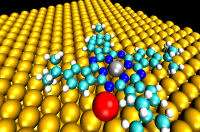
The researchers used a gold metal surface to anchor phtalocyanine molecules, which have a metallic centre, in a large array. The anchor point, a single gold atom on top of the attached to a of the molecule, allowed the molecules to rotate just off-centre.

Professor Werner Hofer, from the University's School of Chemistry, explains: "The difficulty in creating molecular rotors is that molecules need a fixed anchor point and will often react with the surface you want to fix them to. A gold surface interacts very weakly with molecules; it moreover provides regular anchor points to attach single molecules, which then line up in large and well ordered arrays."

"The centre atoms, which are metallic, spin around the atoms creating an off-axis rotation. The beauty of phtalocyanines is that the centre can be functionalised with any metal atom; the research could then lead to the development of rotating magnetic fields at a very small scale."

Scientists believe that this could be the first step towards the fabrication of machines for the generation of currents at small scale.

The research is published in .

Source: University of Liverpool (news : web)


Rate this story - 3 /5 (1 vote)


May 27, 2009 all stories

Comments: 0

3 /5 (1 vote)

  • hide
  • Related Stories

  • Chemistry research could produce faster computers
    created Jul 11, 2006 | popularity not rated yet | comments 0
  • Remotely Controlled Nanomachines
    created Jul 03, 2007 | popularity not rated yet | comments 0
  • Molecules that suck
    created Nov 21, 2005 | popularity not rated yet | comments 0
  • Single-Molecule Magnets Open New Door for Information Technology
    created Mar 09, 2009 | popularity not rated yet | comments 0
  • Theorist helps develop first single molecule transistor
    created Jun 07, 2005 | popularity not rated yet | comments 0


  • hide
  • Relevant PhysicsForums posts

  • Interception angle
    created 2 hours ago
  • Pressure created by clamping base and cover
    created 2 hours ago
  • How to find static friction
    created 8 hours ago
  • Calculating decible increases
    created 15 hours ago
  • More from Physics Forums - General Physics

Other News

Nanoscale Structures with Superior Mechanical Properties Developed

Nanoscale Structures with Superior Mechanical Properties Developed

Nanotechnology / Nanomaterials

created 17 hours ago | popularity 4.6 / 5 (9) | comments 1 | with audio podcast

(PhysOrg.com) -- Researchers at the California Institute of Technology have developed a way to make some notoriously brittle materials ductile -- yet stronger than ever -- simply by reducing their size.


Spray-on liquid glass

Spray-on liquid glass is about to revolutionize almost everything

Nanotechnology / Nanomaterials

created Feb 02, 2010 | popularity 4.7 / 5 (240) | comments 93 | with audio podcast report

(PhysOrg.com) -- Spray-on liquid glass is transparent, non-toxic, and can protect virtually any surface against almost any damage from hazards such as water, UV radiation, dirt, heat, and bacterial infections. ...


IBM Scientists Demonstrate World's Fastest Graphene Transistor

IBM Scientists Demonstrate World's Fastest Graphene Transistor

Nanotechnology / Nanophysics

created Feb 05, 2010 | popularity 4.9 / 5 (38) | comments 25 | with audio podcast

(PhysOrg.com) -- In a just-published paper in the magazine Science, IBM researchers demonstrated a radio-frequency graphene transistor with the highest cut-off frequency achieved so far for any graphene device ...


Conductive eTextiles: Stanford finds a new use for cloth

Conductive eTextiles: Researchers move from making batteries from paper to making batteries from cloth

Nanotechnology / Nanomaterials

created Feb 05, 2010 | popularity 4.3 / 5 (7) | comments 4 | with audio podcast

(PhysOrg.com) -- Stanford researchers have moved from making batteries from paper to making batteries from cloth. Your-T-shirt could become a lighted, moving display.


Carbon Based Chips May One Day Replace Silicon Transistors

Carbon Based Chips May One Day Replace Silicon Transistors

Nanotechnology / Nanomaterials

created Feb 03, 2010 | popularity 4.7 / 5 (18) | comments 3 | with audio podcast weblog

(PhysOrg.com) -- IBM researchers are hopeful that, over the next decade, silicon-based transistors will be replaced by carbon-based transistors. IBM has already laid out the ground work for carbon-based transistors.