World first: Japanese scientists create transgenic monkeys
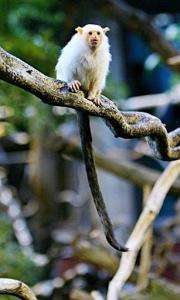
May 27, 2009 by Richard Ingham A marmoset at a zoo

Enlarge

A marmoset at a zoo. In a controversial achievement, Japanese scientists announced on Wednesday they had created the world's first transgenic primates, breeding monkeys with a gene that made the animals' skin glow a fluorescent green.

In a controversial achievement, Japanese scientists announced on Wednesday they had created the world's first transgenic primates, breeding monkeys with a gene that made the animals' skin glow a fluorescent green.

The exploit opens up exciting prospects for medical researchers, they said.

It could eventually lead to lab monkeys that replicate some of humanity's most devastating diseases, providing a new model for exploring how these disorders are caused and how they may be cured.

"Great advances in pre-clinical research can be expected using these models," the team said.

But other voices warned of a potential ethics storm, brewed by fears that technology used on our closest animal relatives could be turned to create genetically-engineered humans.

In a study published in the British , a team led by Erika Sasaki of the Central Institute for Experimental Animals at Keio University reported on experiments on common marmosets (Callithrix jacchus), a small monkey native to Brazil.

They introduced a foreign gene, tucked inside a virus, into marmoset embryos that were then nurtured in a bath of sucrose.

The gene codes for (GFP), a substance that was originally isolated from a jellyfish and is now commonly used as a biotech marker. An animal tagged with GFP glows green when exposed to ultraviolet light, proving that a key has been switched on.

The transgenic embryos were then implanted in the uterus of seven surrogate mother marmosets.

Three of recipients miscarried. The other four gave birth to five offspring, all of which carried the GFP gene.

In two of these five, the GFP gene had been incorporated into the reproductive cells. A second generation of marmosets was then derived from one of the two.

The work is important, because medical researchers have hankered for an that is closer to the human anatomy than rodents.

Mice and rats, genetically engineered to have the symptoms of certain human diseases, are the mainstay of pre-clinical lab work, in which scientists test their theories before trying out any outcome on human volunteers.

But many disorders, especially neurological diseases such as Alzheimer's and Parkinson's, are so complex that they cannot be reproduced meaningfully in rodents because their biology is different.

Hopes for a non-human primate model have until now been dashed by the failure to insert a gene into a monkey's sperm and eggs -- the "germline" that ensures that the inserted DNA is passed on to future generations rather than lost.

The first genetically-modified monkey was born in 2000. Known as ANDi (the initials of "Inserted DNA," spelt backwards), the rhesus carried the GFP gene but not in its reproductive cells.

The latest exploit thus opens up hopes of eventually breeding colonies of transgenic primates with inherited traits that closely replicate human disease.

"This is the first case ever established in the world that an introduced gene was successfully inherited (by) the next generation in primates," the researchers said in a press relase.

Future plans include creating transgenic marmosets that replicate human diseases such as Parkinson's and amyotrophic lateral sclerosis.

In a commentary also published by Nature, Gerald Schatten and Shoukhrat Mitalipov, primate research specialists in the US, praised the achievement as "undoubtedly a milestone" but sounded caution.

They said marmosets were not as useful as baboons or rhesus monkeys in replicating some diseases, notably HIV and tuberculosis.

Another question was the random insertion of a foreign gene in the monkey's genetic code. This may have caused some of the miscarriages and, if previous research is a guide, could unleash cancer.

Scientists also have to address legitimate public concern about animal welfare and the need for "realistic policies" to prevent genetically-engineered babies, they warned.

"There are many unanswered questions," Helen Wallace, of GeneWatch UK, a British NGO that monitors the ethics of gene research, told AFP.

"It's a big step from making a fluorescent green marmoset to making a marmoset that replicates a human disease, it's a much more complicated thing to do.

"There's also a very important ethical debate, firstly about the animals themselves and secondly about what this might lead to in the future, whether it might be ethically justified to genetically engineer humans."

(c) 2009 AFP


print this article email this article download pdf blog this article bookmark this article     Stumble it Digg this share on Facebook retweet share on Reddit add to delicious
Rate this story - 4.6 /5 (9 votes)

Rank Filter

Move the slider to adjust rank threshold, so that you can hide some of the comments.


Display comments: newest first

  • moj85 - May 27, 2009
    • Rank: 2 / 5 (4)
    no pictures no proof
  • KBK - May 27, 2009
    • Rank: 1 / 5 (2)
    .....and 12,000 year old Sumerian cuneiform tablets detail the creation of man, from similar experiments..over 400,000 years ago.

    Look it up if you feel I'm full of it. The deeper you get into the research, the more overwhelming the evidence gets.

    Remember, have fun! It will open quite a few mental doors....
  • Amy_Steri - May 28, 2009
    • Rank: 5 / 5 (1)
    Fast forward..."Take your stinking paws off me you damned glow in the dark ape!"
  • neuromancerz - May 28, 2009
    • Rank: not rated yet
    .....and 12,000 year old Sumerian cuneiform tablets detail the creation of man, from similar experiments..over 400,000 years ago.
    Look it up if you feel I'm full of it.


    Provide links/references with claims if you want to be taken seriously??
  • itistoday - May 28, 2009
    • Rank: not rated yet
    Genetically modified humans are coming, and they are part of a natural evolution. You might as well face that fact now and get it out of your system, it'll be easier than resisting, as resistance is futile, and dare I say, counterproductive. ;-)
  • bmcghie - May 28, 2009
    • Rank: not rated yet
    It will be quite the shitstorm when they attempt to gengineer monkeys with disease characteristics. I mean, how would you like to have it a foregone conclusion that you'll wind up with pancreatic cancer at age 2? Ah well, if we start thinking about it now, we'll have it sorted for when we actually get it started years down the road.
  • Quantum_Conundrum - Jun 02, 2009
    • Rank: not rated yet
    Another question was the random insertion of a foreign gene in the monkey's genetic code. This may have caused some of the miscarriages and, if previous research is a guide, could unleash cancer.
    ===

    You fools.

    God said to let everything reproduce after it's own kind.

    What the heck do you expect? Of course there were going to be miscarriages. You took a foriegn strand of DNA and injected it into an organism. That's just as hostile an act as injecting a pandemic flu virus.

    These idiots took DNA from a tri-sexual invertebrate sea creature and injected it into a primate using....*drum roll please*...A VIRUS!

    Does anyone here realize the potential consequences of this sort of research if somebody does something like injecting the reproductive DNA of a jellyfish into a terrestrial animal?

    The consequences would be UNTHINKABLE and this sort of research simply should NOT be allowed.

    I know of other cases involving similar genetics tricks, I think there is one involving some hound puppies which glow orange or whatever. But there were also a case of goats that can make spider silk or something like that. But those were injected after birth, if I remember right.

    This is essentially genetically a "new" organism created by corrupting a pre-existing species in a highly un-natural way.
  • itistoday - Jun 03, 2009
    • Rank: not rated yet
    @Quantum_Conundrum, If "God" didn't want this to happen it wouldn't happen.

    Don't bring in talk of God or "the natural way" into this, that's all subjective baloney. Instead, if you feel this is wrong, just say that, don't go around stating that your subjective world-view is somehow objectively correct.

    If anything, all of these genetically modified organisms are natural. It depends on what you mean by natural of course, but if natural means existing in nature, then of course they are! We, and everything else, is all a part of nature whether we believe that or not.

May 27, 2009 all stories

Comments: 8

4.6 /5 (9 votes)
  • Stumble this up

  • Digg this

  • share this

  • hide
  • Related Stories


  • hide
  • Relevant PhysicsForums posts

Other News

Prized mushroom collection returns to China

Biology / Plants & Animals

created 16 hours ago | popularity 5 / 5 (1) | comments 0

(AP) -- A Chinese scholar persecuted during the Cultural Revolution for smuggling a rare collection of mushrooms out of China before World War II was honored Saturday when the collection was returned more than 70 years later.


Sea lions killed, but Columbia salmon toll rises (AP)

Sea lions killed, but Columbia salmon toll rises

Biology / Ecology

created 16 hours ago | popularity not rated yet | comments 1

(AP) -- Killing or removing 25 California sea lions over the past two years has not reduced the toll on salmon at the base of Bonneville Dam in the Columbia River.


Laser etching safe alternative for labeling grapefruit

Laser etching safe alternative for labeling grapefruit

Biology / Other

created Nov 03, 2009 | popularity 4.4 / 5 (14) | comments 8

Laser labeling of fruit and vegetables is a new, patented technology in which a low-energy carbon dioxide laser beam is used to label, or "etch" information on produce, thereby eliminating the need for common ...


Wolves, moose and biodiversity: An unexpected connection

Wolves, moose and biodiversity: An unexpected connection

Biology / Ecology

created Nov 02, 2009 | popularity 4.8 / 5 (6) | comments 4

Moose eat plants; wolves kill moose. What difference does this classic predator-prey interaction make to biodiversity?


Caught in the act: Butterfly mate preference shows how 1 species can become 2

Caught in the act: Scientists find butterflies splitting into two species

Biology / Plants & Animals

created Nov 05, 2009 | popularity 4.5 / 5 (8) | comments 2

(PhysOrg.com) -- Breaking up may actually not be hard to do, say scientists who've found a population of tropical butterflies that may be on its way to a split into two distinct species.