Biologists: Greening Arctic not likely to offset permafrost carbon release
May 27, 2009
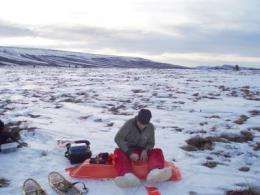
In this photo from February 2006, research team member Christian Trucco makes a wintertime measurement of ecosystem carbon flux in Eight Mile Lake near Denali National Park in Alaska. The black suitcase contains an infrared gas analyzer to measure carbon dioxide exchange between tundra and the air. When the small clear chambers are placed on the snow/tundra surface, the carbon dioxide in the chamber increases slowly over 10 minutes because of microbial release of carbon dioxide from decomposing soil organic matter. Even during the winter when the plants are not active, there is a slow release of carbon by microbes that is significant once it is added up over the long winter period. Credit: Emily Tissier/University of Florida
As the frozen soil in the Arctic thaws, bacteria will break down organic matter, releasing long-stored carbon into the warming atmosphere.
At the same time, plants will proliferate, nurtured by balmier temperatures, more nutrients from decomposing soil and the increasing abundance of the greenhouse gas they depend on for growth.
These connected but contrasting changes have raised a question for scientists who study the causes and consequences of global climate change: Will the shrubs and incipient forests spreading across the Arctic compensate for the permafrost's rising release of carbon, blunting its impact on a warming planet? Or, with twice as much carbon locked up in the permafrost as now present in the atmosphere, will the lush growth become overwhelmed -- like a kitchen sponge put down to stem a water main break?
Researchers led by a University of Florida ecologist may have an answer. In a paper set to appear May 28 in the journal Nature, the team reports experimental results suggesting tundra plant growth may keep up with rising carbon dioxide initially.
But if thawing continues in a warmer world, the permafrost will spew carbon for decades, and the plants will become overwhelmed -- unable to sop up the excess carbon despite even the most vigorous growth.
"At first, with the plants offsetting the carbon dioxide, it will appear that everything is fine, but actually this conceals the initial destabilization of permafrost carbon," said Ted Schuur, a UF associate professor of ecology and lead author of the paper. "But it doesn't last, because there is so much carbon in the permafrost that eventually the plants can't keep up."
Schuur noted most of the 13 million square kilometers, or roughly 5 million square miles, of permafrost in Alaska, Canada, Siberia and parts of Europe remain frozen. However, thawing already occurring around its southern edges is expected to expand this century.
Should that occur, this study suggests the permafrost could lose in the range of 1 gigaton of carbon, or 1 billion tons, per year - about the same order of magnitude as being added by current deforestation of the tropics, another large biospheric source, Schuur said.
While burning fossil fuels contributes considerably more carbon, about 8.5 gigatons annually, that process can at least in theory be controlled - whereas once the permafrost thaw begins, it sets up a self-reinforcing loop far from human activity and potentially difficult to stop.
That highlights the urgent need to address human-caused emissions now, Schuur said.
"It is not an option to be putting insulation on top of the tundra," he said. "If we address our own emissions, either by reducing deforestation or controlling emissions from fossil fuels, that's the key to minimizing the changes in the permafrost carbon pool."
Researchers from UF used hand-built, automated chambers to trap and measure carbon dioxide losses in Alaska year-round from 2004 through 2006. Thawing at the research sites near Denali National Park, in central Alaska, varies considerably, with some plots much more extensively thawed than others.
The researchers determined how long each spot had been thawing using long-term data from permafrost-monitoring instruments combined with historical aerial photographs. With a total of 18 of the automated chambers, they measured the release and uptake of carbon between the tundra and the atmosphere. This resulted in a measurement of net ecosystem carbon exchange - the total carbon each spot lost, or gained, due to thawing permafrost.
The results were clear.
Tundra sites that had thawed for the past 15 years gained net carbon, as increasingly verdant plant growth was greater than the permafrost's carbon losses. However, radiocarbon dating of carbon dioxide showed that old carbon from the permafrost was already being released in higher amounts due to thaw - signifying that all was not well with the permafrost carbon even in that time period. The site that began thawing decades before gained net carbon emission to the atmosphere, revealing that more thaw caused significantly more old carbon loss -- despite greening of the vegetation, including more shrubs.
Said Jason Vogel, a UF postdoctoral associate and author of the paper: "The plants are still growing faster in the extensively thawed area, but that's not enough to keep up with the greater microbial activity releasing old carbon from deeper in the soil."
As a result, even as the Arctic greens, its escalating old carbon loss "could make permafrost a large biospheric carbon source in a warmer world," according to the paper.
-
Bad sign for global warming: Thawing permafrost holds vast carbon pool
Sep 03, 2008 |
not rated yet |
0
-
Thawing permafrost likely to boost global warming
Sep 01, 2008 |
not rated yet |
0
-
Global warming could accelerate from thawing Siberian permafrost
Jun 16, 2006 |
not rated yet |
0
-
Permafrost carbon content double the old estimates
Sep 12, 2008 |
not rated yet |
0
-
Arctic soil reveals climate change clues
Oct 08, 2008 |
not rated yet |
0
-
Engineers build first sub-10-nm carbon nanotube transistor
Feb 01, 2012 |
4.9 / 5 (33) |
30
-
Something old, something new: Evolution and the structural divergence of duplicate genes
Jan 31, 2012 |
4.6 / 5 (7) |
1
-
The hidden nanoworld of ice crystals: Revealing the dynamic behavior of quasi-liquid layers
Jan 30, 2012 |
5 / 5 (4) |
1
-
Stock market network reveals investor clustering
Jan 27, 2012 |
3.9 / 5 (23) |
8
-
Of microchemistry and molecules: Electronic microfluidic device synthesizes biocompatible probes
Jan 26, 2012 |
5 / 5 (2) |
0
-
Do some geologists actually act a lot like Randy Marsh?
Feb 11, 2012
-
Discrepancy between oxygen and carbon-dioxide levels
Feb 09, 2012
-
where gems are found in the world
Feb 09, 2012
-
Wind Waves in Reservoir ~ Wind run-up and Wind set-up
Feb 08, 2012
-
Balance of oxygen in the atmosphere
Feb 01, 2012
-
The case for a methanol-based economy
Jan 30, 2012
- More from Physics Forums - Earth
More news stories
Latin America mining boom clashes with conservation
Latin America is experiencing a mining boom as prices rise fuelled by a hike in global demand, but the region is also being hit by a wave of violent protests, strikes and rallies by environmentalists.
21 hours ago |
5 / 5 (1) |
1
Salvage workers begin pumping fuel from Italian shipwreck
Salvage workers Sunday began pumping fuel from the shipwrecked Italian cruise liner Costa Concordia, a day ahead of schedule, officials said.
13 hours ago |
5 / 5 (2) |
0
Political leaders play key role in how worried Americans are by climate change: study
More than extreme weather events and the work of scientists, it is national political leaders who influence how much Americans worry about the threat of climate change, new research finds.
Feb 06, 2012 |
5 / 5 (8) |
75
NASA budget will axe Mars deal with Europe: scientists
US President Barack Obama's budget proposal to be submitted next week for 2013 will cut NASA's budget by 20 percent and eliminate a major partnership with Europe on Mars exploration, scientists said Thursday.
Space & Earth / Space Exploration
Feb 10, 2012 |
5 / 5 (4) |
58
Humans may have helped the decline of African rainforests 3000 years ago
(PhysOrg.com) -- Large areas of rainforests in Central Africa mysteriously disappeared over three thousand years ago, to be replaced by savannas. The prevailing theory has been that the cause was a change ...
Scientists discover molecular secrets of 2,000-year-old Chinese herbal remedy
For roughly two thousand years, Chinese herbalists have treated Malaria using a root extract, commonly known as Chang Shan, from a type of hydrangea that grows in Tibet and Nepal. More recent studies suggest that halofuginone, ...
New method to examine batteries -- MRI from the inside
There is an ever-increasing need for advanced batteries for portable electronics, such as phones, cameras, and music players, but also to power electric vehicles and to facilitate the distribution and storage of energy derived ...
Google might launch Drive for cloud storage soon
(PhysOrg.com) -- Google's next big move, according to the Wall Street Journal, is a cloud storage service called Drive. Hardly first to the plate, Google is simply catching up to introducing its cloud reposi ...
A mitosis mystery solved: How chromosomes align perfectly in a dividing cell
Although the process of mitotic cell division has been studied intensely for more than 50 years, Whitehead Institute researchers have only now solved the mystery of how cells correctly align their chromosomes during symmetric ...
Lab study raises questions over nano-particle impact
Tests involving chickens have raised questions about the impact on health from engineered nano-particles, the ultra-fine grains commonly used in drugs and processed foods, scientists said on Sunday.
Starve a virus, feed a cure? Findings show how some cells protect themselves against HIV
A protein that protects some of our immune cells from the most common and virulent form of HIV works by starving the virus of the molecular building blocks that it needs to replicate, according to research published online ...