XMM-Newton takes astronomers to a black hole's edge
May 27, 2009 XMM-Newton takes astronomers to a black hole's edge

Enlarge

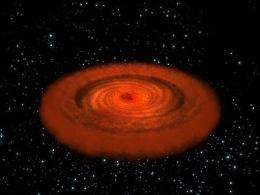
Illustration of a supermassive black hole at the centre of a galaxy. Using new data from ESA’s XMM-Newton spaceborne observatory, astronomers have probed closer than ever to a supermassive black hole lying deep at the core of a distant active galaxy. The black hole at the centre of the galaxy - known as 1H0707-495 - was thought to be partially obscured from view by intervening clouds of gas and dust, but the current observations have revealed the innermost depths of the galaxy. Credits: ESA (Image by C. Carreau)

(PhysOrg.com) -- Using new data from ESA's XMM-Newton spaceborne observatory, astronomers have probed closer than ever to a supermassive black hole lying deep at the core of a distant active galaxy.

The galaxy - known as 1H0707-495 - was observed during four 48-hr-long orbits of XMM-Newton around Earth, starting in January 2008. The black hole at its centre was thought to be partially obscured from view by intervening clouds of gas and dust, but these current observations have revealed the innermost depths of the galaxy.

"We can now start to map out the region immediately around the black hole," says Andrew Fabian, at the University of Cambridge, who headed the observations and analysis.

X-rays are produced as matter swirls into a . The X-rays illuminate and are reflected from the matter before its eventual accretion. Iron atoms in the flow imprint characteristic iron lines on the reflected light. The iron lines are distorted in a number of characteristic ways: they are affected by the speed of the orbiting iron atoms, the energy required for the X-rays to escape the black hole's , and the spin of the black hole. All these features show that the astronomers are tracking matter to within twice the radius of the black hole itself.
XMM-Newton
Enlarge

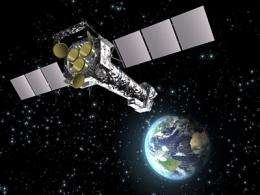
An artist's impression of XMM-Newton. Credits: ESA (Image by C. Carreau)

detected two bright features of iron emission in the reflected X-rays that had never been seen together in an active galaxy. These bright features are known as the iron L and K lines, and they can be so bright only if there is a high abundance of iron. Seeing both in this galaxy suggests that the core is much richer in iron than the rest of the galaxy.

The direct X-ray emission varies in brightness with time. During the observation, the iron L line was bright enough for its variations to be followed.

A painstaking of the data revealed a time lag of 30 seconds between changes in the X-ray light observed directly, and those seen in its reflection from the disc. This delay in the echo enabled the size of the reflecting region to be measured, which leads to an estimate of the mass of the black hole at about 3 to 5 million solar masses.

The observations of the iron lines also reveal that the black hole is spinning very rapidly and eating matter so quickly that it verges on the theoretical limit of its eating ability, swallowing the equivalent of two Earths per hour.

The team are continuing to track the galaxy using their new technique. There is a lot for them to study. Far from being a steady process, like water slipping down a plughole, a feeding black hole is a messy eater. "Accretion is a very messy process because of the magnetic fields that are involved," says Fabian.

Their new technique will enable the astronomers to map out the process in all its glorious complexity, taking them to previously unseen regions at the very edges of this and other supermassive black holes.

More information: 'The detection of Broad Iron K and L line emission in the Narrow-Line Seyfert 1 Galaxy 1H0707-495 using XMM-Newton', by A. Fabian et al. will be published in Nature tomorrow.

Source: European Space Agency (news : web)


print this article email this article download pdf blog this article bookmark this article     Stumble it Digg this share on Facebook retweet share on Reddit add to delicious
Rate this story - 4.9 /5 (9 votes)

Rank Filter

Move the slider to adjust rank threshold, so that you can hide some of the comments.


Display comments: newest first

  • omatumr - May 27, 2009
    • Rank: 3 / 5 (4)
    THERE ARE NO CELESTIAL BLACK HOLES

    Repulsive interactions [1] between ordinary neutrons prevent the collapse of neutron stars into stellar black holes.

    However, it is possible that neutrons themselves are the mini-black holes [2] that will be produced in high-energy experiments at CERN's Large Hadron Collider.

    With kind regards,
    Oliver K. Manuel
    http://www.omatumr.com

    [1] O. Manuel, E. Miller, and A. Katragada, "Neutron repulsion confirmed as energy source", Journal of Fusion Energy 20, 197-201 (2003). http://tinyurl.com/38un57

    [2] G. G. Coyne and D. D. Cheng, " A scenario for strong gravity in particle physics: An alternative mechanism for black holes to appear at accelerator experiments," http://arxiv.org/...1667.pdf
  • LuckyBrandon - May 27, 2009
    • Rank: 5 / 5 (2)
    omatumr-i was reading through your paper (flipped through it admittedly)...not a bad paper at all.

    So, just so you can defend your statement before people start dinging you for saying there's no black holes, I thought I'd start it with a legit question :)

    Is your theory that n-n interactions are occurring and that is what is causing the "matter jets" from the currently referred to phenomonom of "black holes"?
    If so, are you also theorizing that normal space-time and matter, if you will, is composed of n-p interactions that are attracting each other (thereby making mass)?

    What is your take on what the cause is of extreme gravity wells in those locations? Maybe outling n-p ring attracting all the other n's and p's to it, then all the n-n combos falling into the ring (i say ring here meaning the outer edge of the accretion disk here) and as a result. repulsing away from each other at high velocity?

    Like I said, I only thumbed through your paper and did not read it thoroughly, although providing i have time, i will....

    Now, wheres my buddy velanarris at...i expect he'll chime in any moment....
  • omatumr - May 28, 2009
    • Rank: 2.3 / 5 (3)
    Lucky,

    I tried to post a response but it disappeared.

    Rest mass data for the 3,000 different types of atoms that comprise the visible universe form the basis for my statement that neutron-neutron interactions are repulsive and prevent the formation of celestial black holes.

    See the data here: http://tinyurl.com/2otxps

    With kind regards,
    Oliver K. Manuel
  • omatumr - May 28, 2009
    • Rank: 2.3 / 5 (3)
    omatumr-i was reading through your paper (flipped through it admittedly)...not a bad paper at all.


    Lucky,

    If you want to have a discussion, rank my posting higher than 1/5 so other readers can see it.

    Thanks,
    Oliver
  • LuckyBrandon - May 28, 2009
    • Rank: 3.7 / 5 (3)
    there ya go :)
  • omatumr - May 28, 2009
    • Rank: 2.3 / 5 (3)
    there ya go :)


    Thanks, Lucky.

    Would you also be willing to use your real name and give us your research profile?

    I am Oliver K. Manuel, Emeritus Professor of Nuclear and Space Studies at the University of Missouri. I started my research career in 1960. My research mentors were Professor Paul Kuzuo Kuroda and John H. Reynolds. Professor Kuroda was a citizen of Japan during World War II when I was a child. My work was greatly influenced by his life at the Imperial University of Tokyo during that period.

    See: http://tinyurl.com/ojsqkv

    With kind regards,
    Oliver K. Manuel
  • LuckyBrandon - May 28, 2009
    • Rank: 3 / 5 (2)
    I am actually in a completely different field than this. This just happens to interest me more than my field does :)
  • Bonkers - May 28, 2009
    • Rank: 5 / 5 (3)
    Interesting comments for once, Professor Manuel passes muster as far as i'm concerned.
    There is another line of theory that suggests there is a fundamental limit to energy density, seems reasonable to me, so that black holes are not infinitely dense, but lots smaller than their event horizons. If true this would remove troublesome singularities, without changing any (?) observables.
  • omatumr - May 28, 2009
    • Rank: 1 / 5 (2)
    THE REST OF THE STORY

    Interesting comments for once, Professor Manuel passes muster as far as i'm concerned.


    THE REST OF THE STORY

    Interesting comments for once, Professor Manuel passes muster as far as I'm concerned.


    Bonkers,

    Thanks for your vote of confidence. Please rank my posting favorably so it will be visible to other readers.

    The new theoretical paper by G. G. Coyne and D. D. Cheng [1] on gravitational forces in atomic particles also passes muster because it agrees with a.) precise, space-age measurements [2] and b.) fundamental properties of the universe [3]:

    1. The equivalency of mass and energy (E = mc2). Matter is energy stored from the creation of neutrons as primordial, mini-black holes.

    2. The three fundamental particles (neutrons, protons and electrons) are explained because a free neutron outside the nucleus spontaneously decays to a proton and an electron [ neutron --> proton electron anti-neutrino ].

    3. The Sun and the cosmos are powered and sustained by competition between long-range, attractive forces of gravity and short-range, repulsive interactions between neutrons [3]. Interstellar space is filled with Hydrogen coming from stars as a by-product of these processes [3].

    4. High quality data from precise measurements of abundances and rest masses of atoms in the solar system [2] indicate that:

    ( a ) The Hydrogen (H) that pours from the surface of the Sun is a product of neutron-decay [2]. About 50,000 billion metric ton of Hydrogen is released from the Sun each year in the solar wind.

    ( b ) H is accelerated upward from the solar core, acting as a carrier gas that maintains mass separation in the Sun and covers the solar surface with lightweight elements like H and He [2].

    ( c ) The interior of the Sun consists mostly of Iron (Fe), Oxygen (O), Nickel (Ni), Silicon (Si), and Sulfur (S) - the same elements that comprise the bulk matrix material of rocky planets and ordinary meteorites [2].

    Oliver K. Manuel

    [1] G. G. Coyne and D. D. Cheng, " A scenario for strong gravity in particle physics: An alternative mechanism for black holes to appear at accelerator experiments," http://arxiv.org/...1667.pdf

    [2] O. Manuel, S. A. Kamat and Michael Mozina, "The Sun is a plasma diffuser that sorts atoms by mass," http://arxiv.org/...609509v3

    [3] " O. Manuel, M. Mozina and H. Ratcliffe, "The nuclear cycle that powers the stars: Fusion, gravitational collapse and dissociation," http://arxiv.org/...511379v1


May 27, 2009 all stories

Comments: 9

4.9 /5 (9 votes)
  • Stumble this up

  • Digg this

  • share this

  • hide
  • Related Stories

  • Spin of Supermassive Black Holes Measured for First Time
    created May 30, 2007 | popularity not rated yet | comments 0
  • Scientists Nudge Closer to the Edge of a Black Hole
    created Oct 06, 2006 | popularity not rated yet | comments 0
  • No matter their size black holes 'feed' in the same way
    created Dec 06, 2006 | popularity not rated yet | comments 0
  • Cosmic engines surprise XMM-Newton
    created Apr 07, 2008 | popularity not rated yet | comments 0
  • An Intriguing, Glowing Galaxy
    created May 14, 2009 | popularity not rated yet | comments 0


  • hide
  • Relevant PhysicsForums posts

  • Sideral question
    created 17 hours ago
  • Doppler shifted blackbody spectrum
    created 19 hours ago
  • Earth v. Moon
    created 22 hours ago
  • help me with coordinates and orbits
    created 22 hours ago
  • basic 'our universe' question..
    created Nov 20, 2009
  • deriving keplers law
    created Nov 19, 2009
  • More from Physics Forums - General Astronomy

Other News

Astronauts finish another spacewalk, still no baby (AP)

Astronauts finish another spacewalk, still no baby

Space & Earth / Space Exploration

created 8 hours ago | popularity 3 / 5 (2) | comments 0

(AP) -- A spacewalking astronaut put aside the impending birth of his daughter and blazed through his first-ever venture outside the International Space Station on Saturday.


Unseasonably hot and dry weather combined with strong winds to fan scores of blazes in the country's southeastern states

Australia issues 'catastrophic' alerts as fires rage

Space & Earth / Environment

created 14 hours ago | popularity 4.5 / 5 (2) | comments 0

Australia has issued "catastrophic" alerts after record-breaking temperatures and wild lightning storms sparked more than 100 fires across the country, officials said Saturday.


Commuters wait on the platform shrouded by fog in London

Climate change not man-made, say majority of Britons: poll

Space & Earth / Environment

created Nov 15, 2009 | popularity 3.3 / 5 (15) | comments 46

Less than half of Britons believes that human activity is to blame for global warming, according to a poll carried out for The Times newspaper and published on Saturday.


Mysteriously warm times in Antarctica

Mysteriously warm times in Antarctica

Space & Earth / Earth Sciences

created Nov 18, 2009 | popularity 4.2 / 5 (21) | comments 28

(PhysOrg.com) -- A new study of Antarctica's past climate reveals that temperatures during the warm periods between ice ages (interglacials) may have been higher than previously thought. The latest analysis ...


UN: Fight climate change with free condoms (AP)

UN: Fight climate change with free condoms

Space & Earth / Environment

created Nov 18, 2009 | popularity 3.1 / 5 (11) | comments 24

(AP) -- The battle against global warming could be helped if the world slowed population growth by making free condoms and family planning advice more widely available, the U.N. Population Fund said Wednesday.