Triage technology with a Star Trek twist
Triage technology comes with a Star Trek twist, at the U.S. Department of Homeland Security's Science & Technology Directorate (DHS S&T).
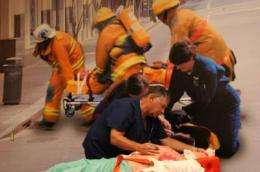
Determining who needs medical care at the scene of a disaster is still pretty old-fashioned: emergency responders bent over a victim, checking body temperature, heart rate, and muscle movement. Up close and personal, the entire process can take 3-5 minutes per person.
"Human nature is to pay attention to those who are screaming and bleeding, but someone with a less obvious internal injury may be the real top priority," said Greg Price, Director of S&T's Tech Solutions, whose office is managing a new DHS S&T project. "In the case of large-scale triage, it is not always the squeaky wheel that needs the grease," he says.
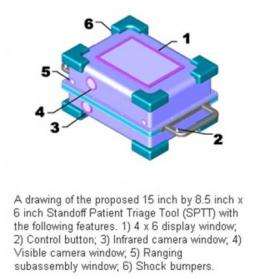
In partnership with the Technical Support Working Group (TSWG), Boeing and Washington University's School of Medicine in St. Louis, S&T's Tech Solutions group is developing the Standoff Patient Triage Tool (SPTT), a device that classic Star Trek fans will recognize for its resemblance to the medical diagnostic tool known as the tricorder.
Because time is the most precious resource in a crisis, every second shaved can be a life-saver. With this in mind, S&T wants to make a revolutionary leap forward in triage. Why not 30 seconds per person? And why not from a distance?
"We thought, 'Wow, wouldn't it be great if a responder, fully clothed in an emergency suit, could have a technology to take vital signs quickly from 5 to 40 feet away?'" said Price.
Like the tricorder, SPTT takes key physiological readings necessary to any diagnosis —pulse, body temperature, and respiration. It's triage at twenty paces.
The magic behind SPTT is a technology known as Laser Doppler Vibrometry, which has been used in aircraft and automotive components, acoustic speakers, radar technology, and landmine detection. When connected to a camera, the vibrometer can measure the velocity and displacement of vibrating objects. An algorithm then converts those data points into measurements emergency medical responders can use in their rapid assessment of a patient's critical medical conditions.
With the help of Washington University, researchers have found that best place to capture strong readings vital signs is on the carotid artery, although strong signals have been obtained from the head, chest, abdomen, even a foot. Researchers are also testing whether readings could be taken when someone is lying in an awkward position, or wearing multiple layers of clothing. So far, the results are encouraging.
Despite its promise, the SPTT is not quite as a sophisticated as StarTrek's tricorder, which was able to comprehensively diagnose obscure diseases. The standoff patient triage tool is a quantum leap forward for medical response, but science fiction remains on the big screen for the moment. The goal is to develop a handheld unit about the size of a legal notebook and as a thick as a ream of paper. Achieving this will require hardening of the unit, and further testing of optical stabilization technology to make sure the unit can function despite a responder's arm and hand movements. Transition and commercialization could occur sometime mid to late 2010.
The final frontier for the SPTT, of course, is the first responders themselves. S&T's Tech Solutions wants to put working prototypes in the hands of medical teams this fall for extensive field tests. From there, everyone is hoping for warp speed ahead.
Source: US Department of Homeland Security - Science and Technology


