Researchers set alarm for incoming space storms
May 27, 2009 Researchers set alarm for incoming space storms

Enlarge

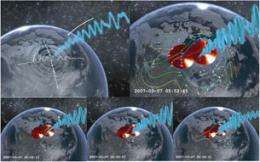
Magnetic disturbances help predict the arrival of a space storm.

(PhysOrg.com) -- A team of researchers at the University of Alberta in Edmonton has broken new ground in outer space by pinpointing the impact epicentre of an Earthbound space storm as it crashes into the atmosphere and giving an advance warning that it's on the way.

The studies, using data from the NASA THEMIS mission, reveal that magnetic blast waves can be used to pinpoint and predict the location at the edge of space where space storms dissipate their energy. The technique can be considered as the seismology of space, the epicentre marking the location where the energy equivalent to 50 gigawatts of power, or the output of 10 of the world's largest power stations, is dumped into the atmosphere.

Physicists Jonathan Rae and Ian Mann are leading the U of A research team that has found the epicenter of impact. Their team is using ground stations spread across northern Canada and the five satellites of the THEMIS project to pick up magnetic disturbances as the storm crashes into the atmosphere. With information from the "space seismology" the researchers look for the eye of the storm, hundreds of thousands of kilometres above the Earth.

"We see the benevolent side of space storms in form of the northern lights," said Mann. "When electrically charged particles speed towards Earth and buffet the atmosphere, the result is often a dancing shimmering light over the polar region."

The U of A team has also determined that the magnetic tremors show that the space storm impact into the atmosphere has a unique epicentre. The eye of the storm is in deep space, far past the orbits of most communication satellites. Guided by the Earth's magnetic field, the magnetic tremors rocket through space towards the planet. These disturbances trigger magnetic sensors on the ground as they impact the atmosphere at the edge of space. The space storm's effects, and the most spectacular displays of the northern lights, follow a few minutes later. The Earth is protected from the most damaging direct effects of the radiation from these space storms by its atmosphere, but in space there is nowhere to hide. High-energy electrically charged particles released in space storms can disable spacecraft, interrupt radio communications and GPS navigation, and damage electric power grids.

Probing the eye of a space storm and recognizing the advance warning signs are crucial for researchers trying to understand space weather. Key questions about when and how space storms start are still challenging researchers on the team. Like forecasters on Earth who predict severe weather, the University of Alberta researchers are now using these magneto-seismic techniques to investigate methods to forecast space storms.

Provided by University of Alberta (news : web)


print this article email this article download pdf blog this article bookmark this article     Stumble it Digg this share on Facebook retweet share on Reddit add to delicious
Rate this story - 4.4 /5 (10 votes)


May 27, 2009 all stories

Comments: 0

4.4 /5 (10 votes)
  • Stumble this up

  • Digg this

  • share this

  • hide
  • Related Stories

  • University of Alberta space research to solve aurora mystery
    created Jan 10, 2007 | popularity not rated yet | comments 0
  • NASA Satellites Discover What Powers Northern Lights
    created Jul 24, 2008 | popularity not rated yet | comments 0
  • Spring is Aurora Season
    created Mar 04, 2008 | popularity not rated yet | comments 0
  • Scientists solve 30-year-old aurora borealis mystery
    created Jul 24, 2008 | popularity not rated yet | comments 0
  • Northern lights research enters final frontier
    created Jan 12, 2007 | popularity not rated yet | comments 0


  • hide
  • Relevant PhysicsForums posts

  • The shape of our solar system's orbits.
    created 8 hours ago
  • Above or Below the Line of Nodes
    created 12 hours ago
  • Supernova vs. Nova?
    created 18 hours ago
  • Supernova's Gamma Rays and Comets
    created Nov 06, 2009
  • More from Physics Forums - General Astronomy

Other News

Seattle team wins $900,000 in Space Elevator Games (AP)

Seattle team wins $900,000 in Space Elevator Games

Space & Earth / Space Exploration

created 21 hours ago | popularity 5 / 5 (8) | comments 4

(AP) -- A Seattle team has collected a $900,000 prize in a NASA-backed competition to develop the concept of an elevator to space - an idea spurred by science fiction novels.


Russian rocket to launch from French Guiana in 2010

Space & Earth / Space Exploration

created 21 hours ago | popularity 5 / 5 (3) | comments 0

A Russian rocket will next year for the first time blast off from a European launch pad in South America, officials said Saturday, as the first rockets headed for the site on board a ship.


Success in 'space elevator' competition (AP)

Success in 'space elevator' competition (Update 3)

Space & Earth / Space Exploration

created Nov 05, 2009 | popularity 4.3 / 5 (33) | comments 50

(AP) -- A robot powered by a ground-based laser beam climbed a long cable dangling from a helicopter on Wednesday to qualify for prize money in a $2 million competition to test the potential reality of the ...


Space hotel taking bookings for 2012 opening

Space hotel taking bookings for 2012 opening

Space & Earth / Space Exploration

created Nov 05, 2009 | popularity 4.3 / 5 (19) | comments 11

(PhysOrg.com) -- The first orbiting space hotel is on track to open for its first customers in 2012, but hurry, as bookings are filling fast.


'Dropouts' pinpoint earliest galaxies

'Dropouts' pinpoint earliest galaxies

Space & Earth / Astronomy

created Nov 06, 2009 | popularity 4.1 / 5 (9) | comments 11

Astronomers, conducting the broadest survey to date of galaxies from about 800 million years after the Big Bang, have found 22 early galaxies and confirmed the age of one by its characteristic hydrogen signature ...