Really virtual reality
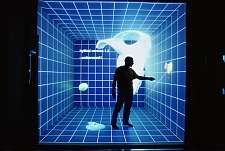
(PhysOrg.com) -- Far from being geeky and exotic, virtual reality could be the key to a new range of innovative products. European researchers and industrialists have come together to build a world-leading community ready to exploit that promise.
Made famous by the ‘holodeck’ in Star Trek: The Next Generation, virtual reality (VR) has long had the reputation of being slightly frivolous. Yet Europe’s VR industry is emerging as a world leader thanks to new efforts to coordinate developments on a continental scale.
“Virtual reality looks exotic to the general public,” says Angelos Amditis of the Institute of Communication and Computer Systems in Athens. “But for many of us this looks like a key technology that could really enable innovation and creation of new jobs, opportunities and products.”
In VR, the user can enter a virtual world and interact with it as if it were real. In the simpler VR systems, the user views a virtual scene on a normal computer screen. This is the method used by many kinds of computer games and the famous online Second Life simulation.
In more sophisticated ‘fully immersive’ systems, the user can move through a surrounding virtual environment, though not yet as realistically as portrayed in Star Trek.
VR is already in use in medicine, education, training and the energy, aeronautics and car industries, but until the last few years there was little sense of cohesion amongst those working in the field.
That began to change with INTUITION, an EU-funded Network of Excellence set up in 2004 to pull together Europe’s fragmented efforts in VR. “In the previous ten years we’d had a lot of new developments that made the wide use of such technologies more realistic and cost-effective,” says Amditis, who coordinated the network.
Industrial prototyping
As well as more than 60 formal partners, INTUITION attracted a further 80 associated organisations. It was, Amditis claims, the biggest Network of Excellence in the EU’s Sixth Framework Programme for research.
Practical services included an online knowledge base in VR, a ‘virtual lab’ where partners could use one another’s infrastructure, and an employment exchange and mobility scheme. All these things helped to build cooperation and a sense of community, Amditis says.
An annual workshop soon grew into a major conference and has now become one of the world’s biggest trade exhibitions for the VR industry.
In its four-year life, INTUITION fostered 16 internal projects and many external ones. “The idea was to increase cooperation by creating groups of two, three or four partners to develop a specific application,” Amditis explains.
One important application is in industrial prototyping. By building virtual prototypes rather than physical ones, the time to develop and commercialise a product can be greatly reduced, along with the costs.
Links with the European Space Agency have led to projects to do with prototyping, astronaut training and remote maintenance.
A remarkably simple project, developed by INRIA, showed how an illusion of texture in web pages could be created without any special equipment.
EuroVR takes over
The momentum built up by INTUITION, which finished last October, will be carried forward by a Brussels-based association called EuroVR, to be launched later this year. The association will be self-financed and will act as a voice for Europe’s VR industry, promoting cooperation and especially supporting SMEs.
“We already have more than 60 organisations interested in taking part,” says Amditis. “Half of them are from the original INTUITION consortium and the other half are outsiders. Even during the current economic crisis people are looking at VR with great interest.”
EuroVR will take over the knowledge base and other collaboration services from INTUITION and will run events and publish a journal.
An urgent priority will be to draft standards for VR applications. Lack of standards has kept costs high, held back investment and confined VR to niche products rather than a wider market. “We are reinventing the wheel again and again,” Amditis points out. “Standardised solutions mean less expensive solutions.”
Positive attitudes
He admits that understanding of VR can be poor, especially in senior management where Star Trek fantasies still shape sceptical attitudes to the technology. “But if you go into the research departments of companies you will see a lot of positive attitudes - they are really interested in VR. So we are looking for applications that are easy to install and use, to persuade people that this is something worth investing in.”
Despite these difficulties, Europe is emerging as a world leader in this field. Amditis estimates there are about 85 European businesses specialising in VR, competing in a growing world market.
European automakers have invested far more in VR than their US counterparts, he says, and this could help see them through the economic crisis by cutting costs and the time to market for their new products.
It will be some time before EuroVR’s members can meet on the holodeck, but in the mean time, as Amditis says, INTUITION has created a “virtual table which they can sit around to discuss and promote their ideas, their needs and their solutions.”
More information: www.intuition-eunetwork.org/
Provided by ICT Results


