New Solar Cycle Prediction: Fewer Sunspots, But Not Necessarily Less Activity
May 27, 2009 By Tony Phillips New Solar Cycle Prediction: Fewer Sunspots, But Not Necessarily Less Activity

Enlarge

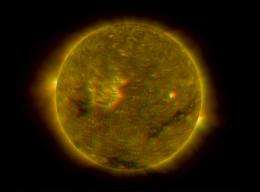
This is an image of the sun from NASA's twin STEREO satellites. Credit: NASA

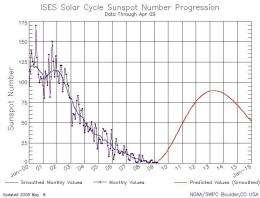
(PhysOrg.com) -- An international panel of experts has released a new prediction for the next solar cycle, stating that Solar Cycle 24 will peak in May 2013 with a below-average number of sunspots. Led by the National Oceanic and Atmospheric Administration (NOAA) and sponsored by NASA, the panel includes a dozen members from nine different government and academic institutions. Their forecast sets the stage for at least another year of mostly quiet conditions before solar activity resumes in earnest.

"If our prediction is correct, 24 will have a peak sunspot number of 90, the lowest of any cycle since 1928 when Solar Cycle 16 peaked at 78," says panel chairman Doug Biesecker of the NOAA Prediction Center, Boulder, Colo.

It is tempting to describe such a cycle as "weak" or "mild," but that could give the wrong impression. "Even a below-average cycle is capable of producing severe space weather," says Biesecker. "The great geomagnetic storm of 1859, for instance, occurred during a solar cycle of about the same size we’re predicting for 2013."
New Solar Cycle Prediction: Fewer Sunspots, But Not Necessarily Less Activity
Enlarge

This plot of sunspot numbers shows the measured peak of the last solar cycle (Solar Cycle 23) in blue and the predicted peak of the next solar cycle (24) in red. Credit: NOAA/Space Weather Prediction Center.

The 1859 storm -- named the "Carrington Event" after astronomer Richard Carrington who witnessed the instigating -- electrified transmission cables, set fires in telegraph offices, and produced Northern Lights so bright that people could read newspapers by their red and green glow. A recent report by the National Academy of Sciences found that if a similar storm occurred today, it could cause $1 to 2 trillion in damages to society’s high-tech infrastructure and require four to ten years for complete recovery. For comparison, caused $80 to 125 billion in damage.

The latest forecast revises a prediction issued in 2007, when a sharply divided panel believed solar minimum would come in March 2008 and would be followed by either a strong solar maximum in 2011 or a weak solar maximum in 2012. Competing models of the solar cycle produced different forecasts, and researchers were eager for the sun to reveal which was correct.

"It turns out that none of the models were really correct," says Dean Pesnell of the Goddard Space Flight Center, Greenbelt, Md. NASA’s lead representative on the panel. "The sun is behaving in an unexpected and very interesting way."
New Solar Cycle Prediction: Fewer Sunspots, But Not Necessarily Less Activity
Enlarge

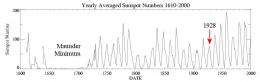
Yearly-averaged sunspot numbers from 1610 to 2000. Researchers believe upcoming Solar Cycle 24 will be similar to the cycle that peaked in 1928, marked in red. Credit: NASA/MSFC

Astronomers first noted the solar cycle in the mid-1800s. Graphs of sunspot numbers resemble a roller coaster, going up and down with an approximately 11-year period. Predicting the peaks and valleys has proven troublesome because cycles vary in length from 9 to 14 years. Some peaks are high, others low. The valleys are usually brief, lasting only a couple of years, but sometimes they stretch much longer. In the 17th century, the sun plunged into a 70-year period of spotless quiet known as the Maunder Minimum that still baffles scientists.

Right now, the solar cycle is in a valley--the deepest of the past century. In 2008 and 2009, the sun set Space Age records for low counts, weak solar wind, and low solar irradiance. The sun has gone more than two years without a significant solar flare.

"In our professional careers, we’ve never seen anything quite like it," says Pesnell. "Solar minimum has lasted far beyond what we predicted in 2007."

In recent months, however, the sun has begun to show signs of life. Small sunspots and "proto-sunspots" are popping up with increasing frequency. Enormous currents of plasma on the sun’s surface ("zonal flows") are gaining strength and slowly drifting toward the sun’s equator. Radio astronomers have detected a tiny but significant uptick in solar radio emissions. All these things are precursors of an awakening Solar Cycle 24 and form the basis for the panel’s new, almost unanimous forecast.

According to the forecast, the sun should remain generally calm for at least another year. From a research point of view, that’s good news because solar minimum has proven to be more interesting than anyone imagined. Low solar activity has a profound effect on Earth’s atmosphere, allowing it to cool and contract. Space junk accumulates in Earth orbit because there is less aerodynamic drag. The becalmed solar wind whips up fewer magnetic storms around Earth’s poles. Cosmic rays that are normally pushed back by solar wind instead intrude on the near-Earth environment. There are other side-effects, too, that can be studied only so long as the sun remains quiet.

Meanwhile, the sun pays little heed to human committees. There could be more surprises, panelists acknowledge, and more revisions to the forecast.

"Go ahead and mark your calendar for May 2013," says Pesnell. "But use a pencil."

Provided by Marshall Space Flight Center


Rate this story - 4.4 /5 (15 votes)

Rank Filter

Move the slider to adjust rank threshold, so that you can hide some of the comments.


Display comments: newest first

  • GrayMouser - May 27, 2009
    • Rank: not rated yet
    "It turns out that none of the models were really correct," says Dean Pesnell of the Goddard Space Flight Center, Greenbelt, Md. NASA%u2019s lead representative on the panel. "The sun is behaving in an unexpected and very interesting way."

    The only thing interesting about this is GSFC admitting their models were worthless. The rest is institutional "science".
  • fcnotpdaaj - May 28, 2009
    • Rank: 1 / 5 (1)
    Hummm so this year should be a cool one as well..... but wait Global Cooling, errr,, Global warming...., err... Climate change has nothing to do with the sun...
  • 3432682 - May 28, 2009
    • Rank: not rated yet
    Sister, daughter, sister, daughter....
  • Kooter - May 28, 2009
    • Rank: 1 / 5 (1)
    I'm just terribly impressed that they didn't explain that the sunspot number is 'the daily average number of sunspots' as so many recent artilces have done.

    As to climate change; they'll simply argue that once the solar minimum ends, we're really in for it. Once the sun starts heating the earth, why there'll be so much CO2 & CH4 in the atmosphere it'll practically catch on fire.

    In the immortal words of manbearpig's nemisis; 'I'm super cereal guys!'. (You could look it up, it'll give you a good chuckle.)
  • Alistair - May 29, 2009
    • Rank: 1 / 5 (1)
    Maybe its time to dust off last centuries papers hypothesising that the sunspot cycle is related to the suns orbit around the solar systems centre of gravity, the barycentre. Those papers predicted that this cycle and the next two would have sunspot numbers similar to those during the Maunder minimum with a return to 'normal' near 2050.

May 27, 2009 all stories

Comments: 5

4.4 /5 (15 votes)

  • hide
  • Related Stories

  • The Sun Loses its Spots
    created Jul 24, 2007 | popularity not rated yet | comments 0
  • Warning: Sunspot cycle beginning to rise
    created May 08, 2009 | popularity not rated yet | comments 0
  • Next solar storm cycle will likely start next March
    created Apr 27, 2007 | popularity not rated yet | comments 0
  • Sunspot is harbinger of new solar cycle, increasing risk for electrical systems
    created Jan 07, 2008 | popularity not rated yet | comments 0
  • What's Wrong with the Sun? (Nothing)
    created Jul 11, 2008 | popularity not rated yet | comments 0


  • hide
  • Relevant PhysicsForums posts

Other News

Rho Ophiuchus cloud

Professor: We have a 'moral obligation' to seed universe with life

Space & Earth / Astronomy

created 7 hours ago | popularity 3.5 / 5 (17) | comments 27 | with audio podcast report

(PhysOrg.com) -- Eventually, the day will come when life on Earth ends. Whether that’s tomorrow or five billion years from now, whether by nuclear war, climate change, or the Sun burning up its fuel, the last ...


Better weather forecasts with a map showing atmospheric vapour

Space & Earth / Space Exploration

created 1hour ago | popularity not rated yet | comments 0

Weather forecasts, satellite navigation in cars and the inspection of dikes or natural gas fields: these applications using satellite data would all be even more accurate if we knew more about the distribution of water vapour ...


UB geographers help map devastation in Haiti

Space & Earth / Earth Sciences

created 3 hours ago | popularity not rated yet | comments 0

In the wake of the earthquake in Haiti, University at Buffalo geography students are participating in a global effort to enhance the international response and recovery effort by helping to assess damage, using images hosted ...


Russian Soyuz TMA-17 rocket blasts off to the International Space Station

Russia wants to charge more for rides to space: report

Space & Earth / Space Exploration

created 10 hours ago | popularity 5 / 5 (1) | comments 2

Russia, which is set to hold a monopoly on flights to the international space station (ISS), wants to charge more for rides on its Soyuz rocket, the space agency head said Tuesday.


Astronauts inspect shuttle on way to space station (AP)

Astronauts inspect shuttle on way to space station

Space & Earth / Space Exploration

created 9 hours ago | popularity not rated yet | comments 0

(AP) -- Endeavour's astronauts inspected their ship early Tuesday for any launch damage as they raced toward a 200-mile-high rendezvous with the International Space Station.