New discovery could help feed millions (w/Video)
May 27, 2009
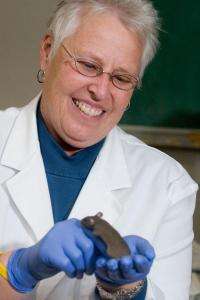
NAU's Loretta Mayer is working on research to speed up fertility in rats to decrease the number of rodents munching on crops intended for humans. Photo by Jerry Foreman, Northern Arizona University
When scientist Loretta Mayer set out to alleviate diseases associated with menopause, she didn't realize her work could lead to addressing world hunger and feeding hundreds of millions of people.
The Northern Arizona University researcher and her colleagues at NAU and the University of Arizona identified a nontoxic chemical technology that when applied to rodents, caused infertility in rats, which feast on crops intended for human consumption.
"This environmentally neutral approach, that has never been available before, will reduce the damage rice-field rats cause in countries that depend on rice as a main food supply," Mayer said.
This video is not supported by your browser at this time.
A team of NAU researchers is working to increase global food supplies by managing fertility among rice rats. Credit: Northern Arizona University
Rodents consume or damage up to 50 percent of pre-harvest rice crops. Due to the large-scale cultivation of rice worldwide, if rice production were to increase by 10 percent, "this would feed about 380 million people a year," Mayer said. "We can easily increase rice production by 10 percent by reducing rodent fertility in half."She said this noninvasive approach is more humane than poison, which takes several days to kill rodents and seeps into groundwater, harming other animals and possible food sources.
The sterilization technology derived from Mayer's research, done by Patricia Hoyer and and Glenn Sipes at UofA, investigated potential damage caused to ovarian follicles in women exposed to certain chemicals in industrial settings. Of particular interest was a chemical compound known as 4-vinylcyclohexene diepoxide, or VCD, typically used in manufacturing rubber tires, polyesters and plastics.
She found that low, nontoxic doses of VCD in mice sped the menopausal process and rendered them infertile. She dubbed this new animal model of accelerated menopause "mouseopause."
Mayer and her colleagues have developed a product called ContraPest that incorporates the chemical sterilization treatment into bait. The bait is put into strategically placed stations that lure rodents into cages too small to attract or affect other animals. "No rat or mice I know can resist a little hole," she said.
ContraPest is being tested in Indonesia -- the largest producer of rice in the world, and is currently being registered for rodent-population control in Australia.
"We are testing it in Indonesia, and then our next target site will be in the Philippines. From the Philippines we go to Vietnam," Mayer said.
Scientists adapt the product to different rodent species at SenesTech, the Flagstaff-based company that grew out of Mayer's work on the NAU campus. Named after the word senescence, meaning approaching an advanced age, the young company hopes to create a number of beneficial products.
Mayer and her team of researchers also are adapting the technology platform for population management of other animals. They are formulating a product, ChemSpay, for use in population management of wild animals such as deer, coyotes, foxes, raccoons, horses, buffalo and elk as well as cats and dogs.
"What we are doing right now is we are preparing the translation of this technology to dogs and cats. We have already completed six months of study in dogs. This could have a tremendous impact on reducing the number of animals in shelters," said Mayer noting that not only is the method a cost-effective way to avoid surgical spaying, there's a global impact to canine management most people don't realize.
"Dogs are huge vectors of disease throughout the world," she said. "In India, every two seconds someone is bitten by a dog. The tragedy is that every 30 minutes someone dies from rabies. If you continue to vaccinate against rabies, you won't be able to make a dent. You have to combine rabies vaccinations with fertility control."
She hopes to address rabies problems on the rise in West Africa, India and China.
Australia hopes to put the technology to use in managing its kangaroo, wallaby and camel populations. New Zealand, Spain and the United Kingdom also are in line to put ChemSpay to use.
She said luring students to the research team was easy. "We want them involved with hands-on research and field experience," she said. "The first question I ask interested students is if they have empty passport pages they are ready to fill."
Source: Northern Arizona University
-
Rice that 'Snaps, Crackles and Pops' with Protein
Jan 14, 2008 |
not rated yet |
0
-
'Rice camp' shows teens the grain is now
May 05, 2006 |
not rated yet |
0
-
Research required urgently to control planthopper pests
Jun 23, 2008 |
not rated yet |
0
-
Elevated arsenic levels reported in rice grown in South Central States
Mar 05, 2007 |
not rated yet |
0
-
Rice research pays off big
Dec 17, 2005 |
not rated yet |
0
-
Engineers build first sub-10-nm carbon nanotube transistor
Feb 01, 2012 |
4.9 / 5 (32) |
30
-
Something old, something new: Evolution and the structural divergence of duplicate genes
Jan 31, 2012 |
4.6 / 5 (7) |
1
-
The hidden nanoworld of ice crystals: Revealing the dynamic behavior of quasi-liquid layers
Jan 30, 2012 |
5 / 5 (4) |
1
-
Stock market network reveals investor clustering
Jan 27, 2012 |
3.9 / 5 (23) |
8
-
Of microchemistry and molecules: Electronic microfluidic device synthesizes biocompatible probes
Jan 26, 2012 |
5 / 5 (2) |
0
-
Stoichiometry
54 minutes ago
-
How to determine zinc in a plant.
Feb 11, 2012
-
Stoichiometry
Feb 10, 2012
-
Boiling and melting point of impure substances
Feb 10, 2012
-
Safe nitrogen compound to decompose a 500 deg C in a furnace?
Feb 09, 2012
-
[ask]electron inside drinking water
Feb 08, 2012
- More from Physics Forums - Chemistry
More news stories
Scientists discover molecular secrets of 2,000-year-old Chinese herbal remedy
For roughly two thousand years, Chinese herbalists have treated Malaria using a root extract, commonly known as Chang Shan, from a type of hydrangea that grows in Tibet and Nepal. More recent studies suggest that halofuginone, ...
2 hours ago |
5 / 5 (6) |
1
|
New method to examine batteries -- MRI from the inside
There is an ever-increasing need for advanced batteries for portable electronics, such as phones, cameras, and music players, but also to power electric vehicles and to facilitate the distribution and storage of energy derived ...
Chemistry / Analytical Chemistry
2 hours ago |
5 / 5 (2) |
0
|
Hydrogen from acidic water: Researchers develop potential low cost alternative to platinum for splitting water
A technique for creating a new molecule that structurally and chemically replicates the active part of the widely used industrial catalyst molybdenite has been developed by researchers with the Lawrence Berkeley ...
Feb 09, 2012 |
4.8 / 5 (16) |
21
|
Fool's gold may prove an unlikely alternative to overexploited catalytic materials
Catalytic materials, which lower the energy barriers for chemical reactions, are used in everything from the commercial production of chemicals to catalytic converters in car engines. However, with current catalytic materials ...
Feb 10, 2012 |
4.4 / 5 (8) |
8
|
Research provides octagonal window of opportunity for carbon capture
(PhysOrg.com) -- Filtering carbon dioxide, a greenhouse gas, from factory smokestacks is a necessary, but expensive part of many manufacturing processes. However, a collaborative research team from the National ...
Feb 08, 2012 |
5 / 5 (2) |
5
|
Lab study raises questions over nano-particle impact
Tests involving chickens have raised questions about the impact on health from engineered nano-particles, the ultra-fine grains commonly used in drugs and processed foods, scientists said on Sunday.
Google might launch Drive for cloud storage soon
(PhysOrg.com) -- Google's next big move, according to the Wall Street Journal, is a cloud storage service called Drive. Hardly first to the plate, Google is simply catching up to introducing its cloud reposi ...
A mitosis mystery solved: How chromosomes align perfectly in a dividing cell
Although the process of mitotic cell division has been studied intensely for more than 50 years, Whitehead Institute researchers have only now solved the mystery of how cells correctly align their chromosomes during symmetric ...
Starve a virus, feed a cure? Findings show how some cells protect themselves against HIV
A protein that protects some of our immune cells from the most common and virulent form of HIV works by starving the virus of the molecular building blocks that it needs to replicate, according to research published online ...
Researchers find extensive RNA editing in human transcriptome
In a new study published online in Nature Biotechnology, researchers from BGI, the world's largest genomics organization, reported the evidence of extensive RNA editing in a human cell line by analysis of RNA-seq data, demons ...
The proteins ensuring genome protection
Researchers from the University of Geneva (UNIGE), Switzerland, have discovered the crucial role of two proteins in developing a cell 'anti-enzyme shield'. This protection system, which operates at the level of molecular ...
May 27, 2009
Rank: 5 / 5 (3)
May 27, 2009
Rank: 5 / 5 (4)
Children of Men.
Let's not make that a reality!
May 27, 2009
Rank: 5 / 5 (5)
May 27, 2009
Rank: 4.2 / 5 (5)
So mice eat it, what happens to the animals who eat a lot of mice? Then the animal that eats those animals? I just hope the Eco system can take the cut in tasty mice for other animals and that this chemical doesn't reach us.
It comforting to know we're investigating other avenues of wiping ourselves out slowly.
May 27, 2009
Rank: 3 / 5 (2)
But yes we can't do without the large cities and food so we have to do something. Responsibly used this is a humane way to control the problem.
What is a little disturbing is they discovered a way to control fertility while researching ways to "alleviate diseases associated with menopause". Were they trying to speed up the test subjects to the menopause stage?
May 27, 2009
Rank: 5 / 5 (1)
Or you could read "The Douglas Convolution" by Edward Llewellyn where a contraceptive induces sterility.
May 27, 2009
Rank: 5 / 5 (3)
That raises some questions:
1) Are the metabolites of this drug biologically active? If so, what is their activity and do they accumulate in the body tissues or environment?
2) Does this drug require long term exposure? If so, can it migrate in to the food chain?
3) What other species does it affect and at what levels? We don't want a 50% reduction in mice to lead to the destruction of an endangered meal worm.
May 28, 2009
Rank: 5 / 5 (2)
2. Are VCD's effects passed through generations?
3. At very low levels, what are the effects? Is it a mutagen? Teratogen? Carcinogen?
4. Does VCD mimic the effects of any natural hormones?
May 28, 2009
Rank: 2.2 / 5 (5)
May 28, 2009
Rank: 3.3 / 5 (3)
May 28, 2009
Rank: 3.9 / 5 (7)
Don't you malthusians ever get tired of being wrong?
More food means less people working as subsistence farmers which leads to lower fertility rates because it means that basic education becomes affordable and if there's anything that hurts fertility rates it's access to education by women.
Your prefered mode of population reduction(the starvation of ~90% of humanity down to some completely imaginary notion of a carrying capacity based on artificially limiting technology to the bronze age) would lead directly to the deforestation of every square inch of the planet as hungry people fan out and farm anything that can possibly be farmed.
May 28, 2009
Rank: 3 / 5 (2)
May 28, 2009
Rank: 3.7 / 5 (3)
May 28, 2009
Rank: not rated yet
May 28, 2009
Rank: not rated yet
Just another form of genocide?
How about releasing genetically engineered rodents that would cause infertility to offsprings. Nope, that's too easy.
non-toxic ... hahaha, who are you kidding.
May 28, 2009
Rank: 1 / 5 (1)
Governments stand to lose more than they gain by eliminating populations, even rival ones, especially through the introduction of fertility reduction agents.
Eroding the potential tax base and work force isn't in the cards of any government.
May 28, 2009
Rank: 1 / 5 (1)
Interesting, when quoting scenarios, Sean W could only come up with situations dealing with Muslims committing terrorist attacks. Since he is in that line of thought, here's another scenario:
The U.S. or Israel decide, regardless of morality, that this stuff should be sprayed on a helpless Muslim population, such as against Iraqis or Palestinians. Considering these two countries recent track records, that seems more likely, now doesn't it?
May 28, 2009
Rank: 5 / 5 (1)
- 4-Vinylcyclohexene diepoxide is produced by epoxidation of 4-vinylcyclohexene with peroxyacetic acid (IARC, 1994) [source]
- Repeated dosing of rats with the ovotoxic chemical, 4-vinylcyclohexene diepoxide (VCD) destroys primordial and primary ovarian follicles via apoptosis (physiological cell death) by accelerating the normal rate of atresia. (Toxicology and Applied Pharmacology, 1999) [mechanism]
- 4-Vinylcyclohexene diepoxide can be absorbed through the skin of rodents. (IARC, 1994) [transdermal]
- induced squamous cell carcinomas of the skin in most males and females. Regarding internally induced neoplasia, both benign and malignant tumors of the ovaries were caused by dermal exposure of 4-VCHD in female mice (toxsci.oxfordjournals.org 2006) [skin carcinoma risk, et al]
- mutagenic in bacteria and caused gene conversion and mitotic crossing-over in Saccharomyces cerevisiae
(IARC, 1994) [potential for long-term pervasive impact]
- This product is not readily biodegradable in a biological wastewater treatment plant and it may be toxic (tedpella.com 1996) [doesn't self-destruct in a timely fashion]
All this suggests that if VCD becomes a common biocide (like DDT) in third world venues then we may be in for some interesting times. [VCD may then be redubbed 'Vaginal Conception Deactivated'. Artificial uterus-es anyone?]
May 29, 2009
Rank: 3 / 5 (2)
May 30, 2009
Rank: not rated yet
- mutagenic in bacteria and caused gene conversion and mitotic crossing-over in Saccharomyces cerevisiae
(IARC, 1994) [potential for long-term pervasive impact]
- This product is not readily biodegradable in a biological wastewater treatment plant and it may be toxic (tedpella.com 1996) [doesn't self-destruct in a timely fashion]
-From Escherplex
Whoa, you sure can talk some shit, Masked Man. That makes my head hurt. Lets have two steps back on this subject, huh? That's at least 4 major red flags on this compund. Who's going to have the go ahead on applying this stuff? The govts of Indonesia and India?
The most powerful and yet unacknowledged rule of human behavior is the rule of unintended consequences - they will usually be greater than the intended ones.
May 31, 2009
Rank: 5 / 5 (1)
Indeed we shouldn't. Effectively banning DDT for all uses, including combating malaria in the third world is one of the greatest humanitarian disasters in history. It has so far killed tens of millions and dragged down the economies of some of the poorest countries on Earth.
The racist component of this crime shouldn't be forgotten either; the west erradicated their malaria mosquitos with DDT and then pulled up the draw bridges when DDT was no longer needed.
Luckily cooler heads have prevailed and DDT is making a come-back. It is being actively supported by the WHO until better alternatives come along.
May 31, 2009
Rank: not rated yet
May 31, 2009
Rank: 1 / 5 (1)
May 31, 2009
Rank: not rated yet
I get it. Your plan is to kill off 90% of humanity so you can try to turn back technology to before the neolithic. Your thinking goes back to 19th century romanticism.
May 31, 2009
Rank: not rated yet
I would be interested in knowing how much of this compound is already in the environment - is there any of it left in the materials after manufacture?
Why I ask is that in products such as many plastics, there are small and possibly significant amounts of plasticizer which eventually leach out. For example, one of current concern is Bisphenol A, and while whether it is a problem of not is still being investigated, many people are concerned about plastics made with it (especially those used with babies) and researchers are concerned if its presence might be affecting their experiments (unrelated to the plasticizer).
May 31, 2009
Rank: not rated yet
Jun 01, 2009
Rank: not rated yet
To be honest, this is not about governments. Afterall, the government is composed of the country's constituency. Also, considering that Hitler had a form of government and so did other previous genocides, I fail to see your logic.
What this about is naive scientists giving "expert" opinions as to the possible side effects of such a chemical introduction into the wild. There are better ways to achieve the goals they are trying to achieve; some are far better.
Jun 01, 2009
Rank: not rated yet
Jun 04, 2009
Rank: not rated yet
This is certainly something we should be very careful about.
Jun 04, 2009
Rank: not rated yet
Where is he wrong? More food = more people. Or are you trying to say that more food = less people?
And where did you get this from?
Jun 05, 2009
Rank: not rated yet
He's saying more food = less farmers, less farmers= less large households operating as subsistence farming steads.