Portable device can detect viruses in minutes
May 27, 2009 Portable device can detect viruses in minutes

Enlarge

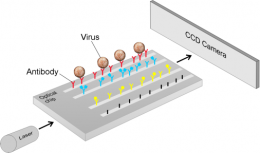
Schematic representation of the sensor: light from a laser is directed onto a wave-guide structure (chip) on which several measuring and reference channels are located. Different types of antibodies that are specific to certain micro-organisms (or types of micro-organism) are first immobilized onto each measuring channel. The liquid from the sample enters a particular channel on the chip via a micro-fluid system (not shown on the diagram above) that is connected to the measuring and reference channels on the chip. When a micro-organism, such as a virus that is present in the sample being analyzed, binds to the relevant antibody on the chip, the interference pattern of the light changes - this is recorded on a CCD camera. An accurate analysis of the change in the interference pattern also provides information about the quantity of virus particles that are specifically bound in a given channel on the chip, and this means the concentration of a micro-organism in a sample can be determined. The method is fast and simple, and yet very sensitive.

(PhysOrg.com) -- Imagine being able to detect in just a few minutes whether someone is infected with a virus. This has now become a reality, thanks to a new ultra-sensitive detector that has been developed by Ostendum, a spin-off company of the University of Twente, Netherlands.

The company has just completed the first prototype and expects to be able to introduce the first version of the onto the market in late 2010. Not only does the detector carry out measurements many times faster than do standard techniques, it is also portable, so it can be used anywhere. Ostendum’s Aurel Ymeti (R&D director), Alma Dudia (Senior Researcher) and Paul Nederkoorn (CEO) claim that if they had the right antibodies to the swine flu at their disposal, they would be able to highlight the presence of the virus within five minutes. In addition to viruses, the device is also able to pick up bacteria, proteins and DNA molecules.

Following the outbreak of swine flu, the issue of finding a means of detecting quickly and simply whether someone is infected with a virus is again very much on the agenda. It is important to be able to do so as soon as possible in order to prevent the virus from spreading further. However, the techniques that are currently available do not yield results for several hours or even days. Moreover, the tests cannot be carried out without a laboratory or trained personnel.
Portable device can detect viruses in minutes
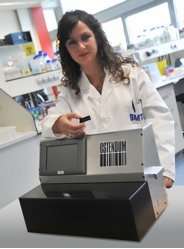
Researchers at Ostendum, a spin-off company of the University of Twente, have developed a portable device that can show in five minutes whether or not a person is infected with a particular virus. The system is able to detect not only viruses, but also specific bacteria, proteins and DNA molecules, an increased or reduced concentration of which in a person’s saliva may be an indication that they have one illness or another.

The only thing needed by the Ostendum detection method is a sample of saliva, blood or another body fluid from the person being tested and the availability of a specific receptor (i.e. a substance that binds with a specific micro-organism or biological substance). For example, in the case of a virus, a specific antibody served as a receptor on the chip and such antibody to that virus has to be available in order to be able to apply the underlying detection method.

Prototype

Ymeti demonstrated during his doctoral research in 2007 that the principle behind the detector worked. At the time, he used a fairly sizeable laboratory set-up. The Ostendum company was subsequently founded, in 2008, in order to develop the principle into a marketable product.

This week, the company completed the first prototype of the device, and it is presently working on two others. The three are undergoing practical tests, in a collaboration involving the Laboratorium Microbiologie Twente Achterhoek and the Zwanenberg Food Group. Ostendum will then make further improvements to the design of the device on the basis of the test results, and expects to have the first device ready for introduction to the marketplace in late 2010.

How it works

The device consists of two parts: a lab-on-a-chip-system and a portable detector. A lab-on-a-chip is a miniature laboratory the size of a chip. The chip contains tiny channels that are coated with receptors. The blood or saliva sample is transported to the channels with the help of a fluid system. Substances from the saliva or blood can then bind with the receptors on the chip. Light from a laser is guided through the channels. If any of the substances binds with the receptors in any of the channels, this will alter the phase of the light. Such a change will manifest itself in the interference pattern, and is a fingerprint of any viruses present, for example, or biomarkers. The method is highly sensitive: it is possible to measure the binding of a single particle.

Provided by University of Twente (news : web)


print this article email this article download pdf blog this article bookmark this article     Stumble it Digg this share on Facebook retweet share on Reddit add to delicious
Rate this story - not rated yet


May 27, 2009 all stories

Comments: 0

not rated yet
  • Stumble this up

  • Digg this

  • share this

  • hide
  • Related Stories

  • Silicon chip beams light through a liquid-core waveguide to detect one particle at a time
    created Jul 03, 2007 | popularity not rated yet | comments 0
  • Rapid Response to Avian Flu Threat
    created Jan 26, 2007 | popularity not rated yet | comments 0
  • Disease-detecting lab in the palm of your hand
    created Jul 01, 2008 | popularity not rated yet | comments 0
  • New lab-on-a-chip can detect heart and gum disease instantly
    created Jan 28, 2005 | popularity not rated yet | comments 0
  • Chips could speed up detection of livestock viruses
    created Mar 31, 2008 | popularity not rated yet | comments 0


  • hide
  • Relevant PhysicsForums posts

  • 23 Years in a Vegetative State....or not?
    created 17 hours ago
  • Has the H1N1 vaccine been scientifically proven to work?
    created Nov 24, 2009
  • nesfatin
    created Nov 22, 2009
  • Obsessive Compulsive Disorder
    created Nov 20, 2009
  • West's zone 2 starling resistor respiratory physiology
    created Nov 18, 2009
  • 50-0-50 rule
    created Nov 18, 2009
  • More from Physics Forums - Medical Sciences

Other News

Managing doctors' practices made easier with new software

Medicine & Health / Other

created 40 minutes ago | popularity not rated yet | comments 0

(PhysOrg.com) -- A McMaster University-led research team has developed an innovative software tool that gives family doctors up-to-date information on their patients in two seconds or less.


Stuffing the turkey and other Thanksgiving food-safety mistakes

Medicine & Health / Diseases

created 40 minutes ago | popularity not rated yet | comments 0

(PhysOrg.com) -- What would a Thanksgiving turkey be without its stuffing, and what better place for that stuffing than inside the turkey? Despite the tradition involved, a food-safety specialist in Penn State's College of ...


Brain's endocannabinoid signaling pathway kept in check by two enzymes

Medicine & Health / Research

created 2 hours ago | popularity 5 / 5 (2) | comments 0

(PhysOrg.com) -- A research team has shown that blocking the degradation of two naturally occurring cannabinoids in the endocannabinoid signaling pathway of the brain produces marijuana-like behavioral effects in mice, according ...


Implant-based cancer vaccine is first to eliminate tumors in mice

Implant-based cancer vaccine is first to eliminate tumors in mice

Medicine & Health / Cancer

created 4 hours ago | popularity 5 / 5 (8) | comments 2

(PhysOrg.com) -- A cancer vaccine carried into the body on a carefully engineered, fingernail-sized implant is the first to successfully eliminate tumors in mammals, scientists report this week in the journal ...


Engineers, doctors develop novel material that could help fight arterial disease

Medicine & Health / Research

created 1hour ago | popularity not rated yet | comments 0

A fortuitous discovery that grew out of a collaboration between UCLA engineers and physicians could potentially offer hope to the nearly 10 million Americans who suffer from peripheral arterial disease.