Silver nanoparticles show 'immense potential' in prevention of blood clots
May 27, 2009 Silver nanoparticles show 'immense potential' in prevention of blood clots

Enlarge

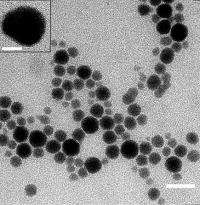
Silver nanoparticles (shown) could help prevent blood clots. Credit: The American Chemical Society

Scientists are reporting discovery of a potential new alternative to aspirin, ReoPro, and other anti-platelet agents used widely to prevent blood clots in coronary artery disease, heart attack and stroke. Their study, scheduled for the June 23 issue of ACS Nano, a monthly journal, involves particles of silver -- 1/50,000th the diameter of a human hair -- that are injected into the bloodstream.

Debabrata Dash and colleagues point out that patients urgently need new anti-thrombotic agents because traditionally prescribed medications too-often cause dangerous bleeding. At the same time, aging of the population, sedentary lifestyle and spiraling rates of certain diseases have increased the use of these drugs. Researchers are seeking treatments that more gently orchestrate activity of platelets, disk-shaped particles in the blood that form clots.

The scientists describe development and lab testing of that seem to keep platelets in an inactive state. Low levels of the nanosilver, injected into mice, reduced the ability of platelets to clump together by as much as 40 percent with no apparent harmful side effects.

The nanoparticles “hold immense potential to be promoted as an antiplatelet agent,” the researchers note. “Nanosilver appears to possess dual significant properties critically helpful to the health of mankind — antibacterial and antiplatelet — which together can have unique utilities, for example in coronary stents.”

More information: , Journal Article: “Characterization of Antiplatelet Properties of Silver Nanoparticles”

Provided by American Chemical Society (news : web)


print this article email this article download pdf blog this article bookmark this article     Stumble it Digg this share on Facebook retweet share on Reddit add to delicious
Rate this story - 5 /5 (7 votes)

Rank Filter

Move the slider to adjust rank threshold, so that you can hide some of the comments.


Display comments: newest first

  • KBK - May 27, 2009
    • Rank: 1 / 5 (1)
    Wow.......

    I guess those colloidal silver guys who took so much shit from the medical INDUSTRY..were actually on to something.

    Never would have guessed. This seems to be implying that the blood's PH is off subtly when someone has a clotting issue..as the body's blood PH is so tightly held to a mean. Otherwise..death.

    This means that one might want to look into Jim Humble's MMS.
  • sender - May 28, 2009
    • Rank: not rated yet
    pretty sure silver nanoparticles are effective poison against HIV
  • RETT - May 29, 2009
    • Rank: not rated yet
    This has absolutely nothing to do with colloidal silver, because that is a poison and the people involved with it have absolutely no scientific basis in studies for their claims. Just because a study has the word silver in it does not validate every piece of prior pseudoscience that employed the word.
  • QED - Jun 01, 2009
    • Rank: not rated yet
    The ACS has done medical research great disservice by promoting silver nanopartices (NPs) as anti-thrombotic agents.


    In fact, NPs in the blood stream have been shown to cause DNA damage in nunmerous experiments over the past few decades. NPs as a health hazard are consistent with recent theoretical arguments that show NPs conserve the collisional energy from surrounding solution moelcules by the emission of EM radiation instead of by an increase in temperature.


    Similar to conventional radiation sources, the NPs emit UV and higher energy radiation although at low power levels, the process called QED induced radiation. QED stands for quantum electrodynamics.


    Inadvertantly, the ACS has promoted the risk of cancer induced from DNA damage. See http://www.nanoqed.org at link "NP induced DNA damage".

May 27, 2009 all stories

Comments: 4

5 /5 (7 votes)
  • Stumble this up

  • Digg this

  • share this

  • hide
  • Related Stories


  • hide
  • Relevant PhysicsForums posts

  • Human Leukocyte Antigen (HLA) typing
    created 2 hours ago
  • Breeding program
    created Nov 20, 2009
  • How does a concentration gradient provide energy?
    created Nov 20, 2009
  • Eyesight and Neural Damage from Electronics
    created Nov 19, 2009
  • More from Physics Forums - Biology

Other News

Using superconducting probes to get a picture of what it's like inside CNTs

Nanotechnology / Nanophysics

created Nov 20, 2009 | popularity 4.9 / 5 (7) | comments 0

(PhysOrg.com) -- "Carbon nanotubes are exciting for fundamental physics, and for potential technological applications," Nadya Mason tells PhysOrg.com. "However, we are generally limited in the way that we can study them. ...


Nanoparticles used in common household items caused genetic damage in mice

Nanotechnology / Bio & Medicine

created Nov 16, 2009 | popularity 4.7 / 5 (22) | comments 11

Titanium dioxide (TiO2) nanoparticles, found in everything from cosmetics to sunscreen to paint to vitamins, caused systemic genetic damage in mice, according to a comprehensive study conducted by researchers at UCLA's Jonsson ...


Nanotube defects equal better energy and storage systems

Nanotube defects equal better energy and storage systems

Nanotechnology / Nanomaterials

created Nov 19, 2009 | popularity 4.4 / 5 (9) | comments 2

(PhysOrg.com) -- Most people would like to be able to charge their cell phones and other personal electronics quickly and not too often. A recent discovery made by UC San Diego engineers could lead to carbon ...


When It Comes to Drug Delivery, Size Matters

Nanotechnology / Bio & Medicine

created Nov 20, 2009 | popularity 5 / 5 (1) | comments 0

(PhysOrg.com) -- One of the great promises of nanotechnologies lies in its ability to create drug-containing nanoparticles decorated with targeting molecules that recognize and bind to cancer cells, providing drug delivery ...


Scientists synthesize graphene-like material: Polymer with honeycomb structure

Scientists synthesize graphene-like material: Polymer with honeycomb structure

Nanotechnology / Nanomaterials

created Nov 19, 2009 | popularity 4.5 / 5 (6) | comments 1

Two-dimensional carbon layers, so-called graphenes, are regarded as a possible substitute for silicon in the semiconductor industry. The electronic properties of these layers can be varied by "building in" ...