New 'microcapsules' put more medication into the bloodstream to treat disease
May 27, 2009 New 'microcapsules' put more medication into the bloodstream to treat disease

Enlarge

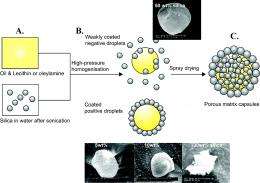
Scientists report that new "microcapsules" could help the stomach absorb certain medicines. Credit: The American Chemical Society

Scientists are reporting a potential solution to a problem that limits the human body’s ability to absorb and use medications for heart disease, Type-2 diabetes, cancer and other conditions. It is a “nano-hybrid microcapsule” that enables the stomach to absorb more of these so-called “poorly-soluble” medicines. Their study is scheduled for the June 1 issue of ACS’ Molecular Pharmaceutics.

Finding ways to improve the stomach’s uptake of poorly soluble medicines has been one of the major challenges facing pharmaceutical companies. Estimates suggest, for instance, that 40 percent of potential new drugs fall into this category. In the new study, Clive Prestidge and colleagues note that one solution has been to include detergent-like substances in pills and capsules. However, that approach involves safety concerns, since the detergent can irritate the stomach lining, making it unsuitable for drugs that must be taken month after month.

The scientists describe development of a first-of-its-kind microcapsule made from lipid oils and nanoparticles 1/50,000th the width of a human hair. Although acting like conventional detergents, they seem unlikely to irritate the stomach. In test tube experiments, microcapsule versions of the arthritis drug, indomethacin, dissolved up to five times faster than a regular version of the drug. Lab rats given the new microcapsule version absorbed almost twice as much of the drug.

More information: Molecular Pharmaceutics, “Dry Hybrid Lipid-Silica Microcapsules Engineered from Submicron Lipid Droplets and Nanoparticles as a Novel Delivery System for Poorly Soluble Drugs”


Provided by American Chemical Society (news : web)


print this article email this article download pdf blog this article bookmark this article     Stumble it Digg this share on Facebook retweet share on Reddit add to delicious
Rate this story - 5 /5 (2 votes)


May 27, 2009 all stories

Comments: 0

5 /5 (2 votes)
  • Stumble this up

  • Digg this

  • share this

  • hide
  • Related Stories


  • hide
  • Relevant PhysicsForums posts

  • Putting every element in a box
    created 14 hours ago
  • a question in Lewis structure???
    created 22 hours ago
  • Paint Technology
    created Nov 24, 2009
  • About pH, Metallic electrodes
    created Nov 24, 2009
  • More from Physics Forums - Chemistry

Other News

Blocking biofilms: Alzheimer's research sheds light on potential treatments for urinary tract infections

Chemistry / Biochemistry

created 19 hours ago | popularity 5 / 5 (1) | comments 0

(PhysOrg.com) -- Research into Alzheimer's disease seems an unlikely approach to yield a better way to fight urinary tract infections (UTIs), but that's what scientists at Washington University School of Medicine in St. Louis ...


Chemists get custom-designed microscopic particles to self-assemble in liquid crystal

Chemists get custom-designed microscopic particles to self-assemble in liquid crystal

Chemistry / Materials Science

created 20 hours ago | popularity 5 / 5 (5) | comments 0

(PhysOrg.com) -- The scientists anticipate their "LithoParticles" will have significant applications in photonics, optical communications and other areas.


Sandia CR5

Machine Converts CO2 into Gasoline, Diesel, and Jet Fuel

Chemistry / Biochemistry

created Nov 23, 2009 | popularity 4.6 / 5 (30) | comments 19

(PhysOrg.com) -- Researchers at Sandia National Laboratories have built a machine that uses the sun's energy to convert carbon dioxide waste from power plants into transportation fuels such as gasoline, diesel, ...


New hydrogen-storage method discovered

New hydrogen-storage method discovered

Chemistry / Materials Science

created Nov 22, 2009 | popularity 4.3 / 5 (42) | comments 15

Scientists at the Carnegie Institution have found for the first time that high pressure can be used to make a unique hydrogen-storage material. The discovery paves the way for an entirely new way to approach ...


Study shows flavanol antioxidant content of US chocolate and cocoa-containing products

Chemistry / Other

created 21 hours ago | popularity 1 / 5 (2) | comments 0

A recent study confirms that the antioxidants and other plant-based nutrients in chocolate and cocoa products are highly associated with the amount of non-fat cocoa-derived ingredients in the product. The study expands on ...