'Surprising link' leads toward a new antibiotic
May 28, 2009 by Suzanne Morrison 'Surprising link' leads toward a new antibiotic

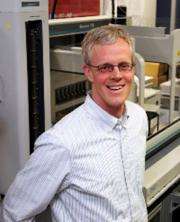
Eric Brown, professor and chair of the Deparment of Biochemistry and Biomedical Sciences in the DeGroote School of Medicine, is lead author of a study that may lead to a new antibiotic.

(PhysOrg.com) -- As the best drugs become increasingly resistant to superbugs, McMaster University researchers have discovered a completely different way of looking for a new antibiotic.

In a paper to be published published Friday, May 29 in the journal Chemistry and Biology, with colleagues in Germany and Wilfrid Laurier University, they report on work with the bacteria Staphylococcus aureus bacteria, the leading cause of infections in hospitals and the second most common community-acquired infection. Fewer and fewer antibiotics are effective against this bacteria.

Cell wall-active antibiotics, such as penicillin, kill bacteria by blocking production of the cell wall.

The researchers provide new evidence for genetic connections among three processes in the cell wall - teichoic acid, peptidoglycan and poly-isoprenoid synthesis. "Never before has such a profound link been drawn between these biosynthetic pathways supported by genetic, computational and biochemical evidence," they said in their paper.

"We found a connection that perhaps no one expected in the way the cell wall synthesis is wired," said lead author Eric Brown, professor and chair of the department of biochemistry and biomedical sciences in the Michael G. DeGroote School of Medicine.

"We found they are inextricably linked in their genetics and biochemistry," he said. "Along the way in this study, we have built a system that is ripe for being exploited as a way to search for small molecule drugs that would target these processes."

Potentially, he said, this may lead to the development of a new antibiotic.

Brown said the current arsenal of antibiotics was developed during the golden age of antibiotic drug discovery from 1930 to 1960, and then development stopped.

Research began again in earnest, he said, when troublesome strains of hospital and community-acquired infections began to emerge, such as MRSA (methicillin-resistant Staphylococcus aureus). "Since the 1960s, drug companies have for, the most part, been tweaking existing molecules, such as building better penicillin with minor changes to the original scaffold. But, you are not very far away from resistance when all you do is a little tweak."

The discovery of a "surprising link" between the three processes involved in cell wall synthesis lets researchers build a method of looking for molecules that will disturb the balance between them. "It offers a completely different way of looking for a new antibiotic that would be active against the cell wall," Brown said.

Source: McMaster University (news : web)


print this article email this article download pdf blog this article bookmark this article     Stumble it Digg this share on Facebook retweet share on Reddit add to delicious
Rate this story - 4.8 /5 (15 votes)

Rank Filter

Move the slider to adjust rank threshold, so that you can hide some of the comments.


Display comments: newest first

  • KBK - May 28, 2009
    • Rank: not rated yet
    Oddly enough, Jim Humble's MMS kills all superbugs, so no need for new anti-biotics created by corporations, autism inducing vaccines enforced by governments, or studies funded by corporations for their own interests.

    At $0.05 per cure, you can see why no one in the pharmaceutical business wants such a simple cure to exist.

    People have been killed over this one already.

    With 10's to 100's of billions of $$ and control over societies at stake, you might be able to imagine why. Hell, it makes swine flu and avian flu even any possible re-combination a ZERO threat, overnight. Too bad- no one makes any money off it and no one gets to scare monger the planet into submission.

    As stated, you can see why people are dying over the idea of promoting it.
  • kerry - May 28, 2009
    • Rank: not rated yet
    I think KBK is deluded....

    Autism-inducing vaccines? Are you kidding me?
  • KBK - May 29, 2009
    • Rank: not rated yet
    Methinks you have not done the research.
  • Wha_wha_what - May 29, 2009
    • Rank: not rated yet
    Yes YOU too can be cured of aids, syphilis, cancer and poor personal hygiene by taking MMS! I took it for 2 days and it even fixed my car's brakes! It's truly a miracle!

    Once you've joined his mailing list you can also receive fantastic offers on beachfront property in Idaho!
  • denijane - May 29, 2009
    • Rank: not rated yet
    An even better solution is to use our own immune system to fight such infections. But that would mean quality food, clean water, lots of sunshine, minimal stress and enough vitamins and minerals. But investing in antibiotics is so much more profitable.
  • GldfrdEng - May 30, 2009
    • Rank: not rated yet
    "As the best drugs become increasingly resistant to superbugs,..."

    Shome mistake, surely.

May 28, 2009 all stories

Comments: 6

4.8 /5 (15 votes)
  • Stumble this up

  • Digg this

  • share this

  • hide
  • Related Stories

  • Bacteria build walls to withstand antibiotics
    created Nov 01, 2005 | popularity not rated yet | comments 0
  • Researchers analyze how new anti-MRSA abtibiotics function
    created Jul 28, 2008 | popularity not rated yet | comments 0
  • Research could put penicillin back in battle against antibiotic resistant bugs that kill millions
    created Mar 12, 2008 | popularity not rated yet | comments 0
  • Nanotechnology used to probe effectiveness of antibiotics
    created Feb 04, 2009 | popularity not rated yet | comments 0
  • New antibiotic beats superbugs at their own game
    created Jul 03, 2008 | popularity not rated yet | comments 0


  • hide
  • Relevant PhysicsForums posts

  • Production of Ammonia from Nitrogen Oxides
    created 9 hours ago
  • Relationship Between Solubility and Reactivity
    created Nov 11, 2009
  • Chemical reactions to silver?
    created Nov 11, 2009
  • DIY paraffin wax log for fire.
    created Nov 10, 2009
  • More from Physics Forums - Chemistry

Other News

Researchers solve structure of NMDA receptor unit that could be drug target for neurological diseases

Chemistry / Biochemistry

created 3 hours ago | popularity not rated yet | comments 0

A team of scientists at Cold Spring Harbor Laboratory reports on Thursday their success in solving the molecular structure of a key portion of a cellular receptor implicated in Alzheimer's, Parkinson's, and other serious ...


Sweet as can be: How E. coli gets ahead

Chemistry / Biochemistry

created 5 hours ago | popularity not rated yet | comments 0

Scientists at the University of York have discovered how certain bacteria such as Escherichia coli have evolved to capture rare sugars from their environment giving them an evolutionary advantage in naturally competitive enviro ...


Form of Mercury in Older Dental Fillings Unlikely to be Toxic: Study

Chemistry / Analytical Chemistry

created 21 hours ago | popularity 4 / 5 (2) | comments 0

(PhysOrg.com) -- Amid the on-going controversy over the safety of mercury-containing dental fillings, a University of Saskatchewan research team has shed new light on how the chemical forms of mercury at the surface of fillings ...


H1N1 Virus Can Be Killed by Acidic Ozone Water

H1N1 Virus Can Be Killed by Acidic Ozone Water

Chemistry / Biochemistry

created Nov 09, 2009 | popularity 4.8 / 5 (25) | comments 10

(PhysOrg.com) -- Scientists have found that acidic ozone water can deactivate H1N1 viruses very effectively, offering a promising disinfectant for the millions of people trying to avoid the disease. Acidic ...


Vibrations key to efficiency of green fluorescent protein

Vibrations key to efficiency of green fluorescent protein

Chemistry / Biochemistry

created Nov 11, 2009 | popularity 4.8 / 5 (5) | comments 1

University of California, Berkeley, chemists have discovered the secret to the success of a jellyfish protein whose green glow has made it the darling of biologists and the subject of the 2008 Nobel Prize ...