Stem cell breakthrough gets closer to the clinic
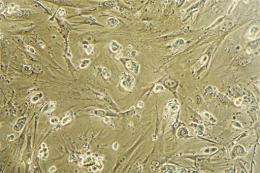
May 28, 2009 by Mira Oberman Embryonic stem cells are pictured through a microscope viewfinder in a laboratory

Enlarge

Embryonic stem cells are pictured through a microscope viewfinder in a laboratory. The quest for versatile, grow-in-a-dish transplant tissue took a step towards clinical use Thursday when researchers announced they have found a safe way to transform skin cells into stem cells.

The technology for versatile, grow-in-a-dish transplant tissue took a step toward clinical use Thursday when researchers announced they have found a safe way to turn skin cells into stem cells.

Researchers say the method is so promising they hope to apply for approval to begin clinic trials by the middle of next year.

"This is the first safe method of generating patient specific stem cells," said study author Robert Lanza, the chief scientific officer at Stem Cell & Regenerative Medicine International.

"This technology will soon allow us to expand the range of possible stem cell therapies for the entire human body," Lanza told AFP.

"This allows us to generate the raw material to solve the problem of rejection (by the immune system) so this is really going to accelerate the field of regenerative medicine."

The research builds on an award-winning breakthrough in 2007 by Shinya Yamanaka of Kyoto University.

Yamanaka and his team introduced four genes into skin cells, reprogramming them so that they became indistinguishable from embryonic stem cells.

That achievement conjured the distant vision of an almost limitless source of transplant material that would be free of controversy, as it would entail no cells derived from embryos.

But the downside of the technique for creating these so-called induced pluripotent stem cells (iPS) is that the genes are delivered by a "Trojan horse" virus.

Reprogramming cells using a virus modifies their DNA in such a way that they cannot be given to patients without boosting the risk of cancer and genetic mutation.

Other researchers have succeeded in delivering the genes with a method called DNA transfection or using a chemical wash, but these techniques also posed health risks.

Lanza and the team led by Kwang Soo Kim of Harvard University succeeded in delivering the genes by fusing them with a cell penetrating peptide which does not pose the risk of genetic mutation.

While this method took twice as long to generate pluripotent stem cells, Lanza said he believes his team can increase the efficiency of the transmission by purifying the protein.

The study was published in the online edition of Cell Stem Cell.

Stem cells have excited huge interest over the past decade.

Promoters say this material could reverse cancer, diabetes, Alzheimer's and other diseases and also allow researchers to grow patient-specific organ and tissue transplants which will not require harmful anti-rejection drugs.

But the dynamic has been sapped by opposition from religious conservatives, who argue that research on embryos -- the prime source of stem cells so far -- destroys human life.

Generating stem cells from bypasses the controversy and also dramatically increases the availability of patient-specific .

(c) 2009 AFP


print this article email this article download pdf blog this article bookmark this article     Stumble it Digg this share on Facebook retweet share on Reddit add to delicious
Rate this story - 5 /5 (13 votes)

Rank Filter

Move the slider to adjust rank threshold, so that you can hide some of the comments.


Display comments: newest first

  • El_Nose - May 28, 2009
    • Rank: not rated yet
    any word yet if the FDIC is still trying to imply that gene therapy is a drug and fall under their guidlines??
  • Hyperion1110 - May 28, 2009
    • Rank: not rated yet
    LOL...the Federal Deposit Insurance Corporation is going to regulate gene therapy?!

    I think you mean the FDA (Food and Drug Administration).
  • Gresh - May 29, 2009
    • Rank: not rated yet
    This is really good news!

    Though I'm not religious, I've always felt that embryonic stem cell therapies are not a path that medical science should explore. Using skin cells and reverting them to iPS's side steps this entire issue and allows tissue to be grown that is a perfect match to the patient.

    So lets hope they get the funding they need. It will be sad that I'm not longer able to help people by giving blood products though...

May 28, 2009 all stories

Comments: 3

5 /5 (13 votes)
  • Stumble this up

  • Digg this

  • share this

  • hide
  • Related Stories


  • hide
  • Relevant PhysicsForums posts

  • Human Leukocyte Antigen (HLA) typing
    created 7 hours ago
  • Breeding program
    created Nov 20, 2009
  • How does a concentration gradient provide energy?
    created Nov 20, 2009
  • Eyesight and Neural Damage from Electronics
    created Nov 19, 2009
  • More from Physics Forums - Biology

Other News

The Monarchs' annual migration ritual has yet to be scientifically explained

Tree-eating bugs threaten Monarch butterfly in Mexico

Biology / Ecology

created 8 hours ago | popularity 4 / 5 (1) | comments 0

The mysterious Monarch butterfly, which migrates en masse annually between Canada and Mexico, is now facing a new peril: another insect thriving in Western Mexican forests.


Bigger not necessarily better, when it comes to brains

Bigger not necessarily better, when it comes to brains

Biology / Plants & Animals

created Nov 17, 2009 | popularity 4.5 / 5 (17) | comments 11

(PhysOrg.com) -- Tiny insects could be as intelligent as much bigger animals, despite only having a brain the size of a pinhead, say scientists at Queen Mary, University of London.


Extinct goat Myotragus balearicus

Extinct goat was cold-blooded

Biology / Plants & Animals

created Nov 18, 2009 | popularity 4.9 / 5 (33) | comments 10

(PhysOrg.com) -- An extinct goat that lived on a barren Mediterranean island survived for millions of years by reducing in size and by becoming cold-blooded, which has never before been discovered in mammals.


Right-handed chimpanzees provide clues to the origin of human language

Biology / Plants & Animals

created Nov 16, 2009 | popularity 3 / 5 (1) | comments 7

Most of the linguistic functions in humans are controlled by the left cerebral hemisphere. A study of captive chimpanzees at the Yerkes National Primate Research Center (Atlanta, Georgia), reported in the January 2010 issue ...


The creature was found at a depth of 161 metres

Japanese researchers film rare baby fish 'fossil'

Biology / Plants & Animals

created Nov 17, 2009 | popularity 4.7 / 5 (7) | comments 4

Japanese marine researchers said Tuesday they had found and successfully filmed a young coelacanth -- a rare type of fish known as "a living fossil" -- in deep water off Indonesia.