Ghost remains after black hole eruption
May 28, 2009
Ghost remains after black hole eruption

Enlarge

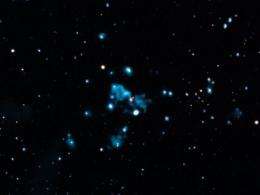
This composite image of Chandra X-ray data (blue) and radio emission (red) shows a small region of the Chandra Deep Field North, one of the deepest X-ray images ever obtained. An optical image from the Sloan Digital Sky Survey is shown in white, yellow and orange. The diffuse blue object near the center is thought to be a cosmic “ghost” generated by a huge eruption from a supermassive black hole in a distant galaxy. This X-ray ghost remains long after radio waves from the source have died off, giving astronomers an opportunity to study this phenomenon in the early Universe. Credit: X-ray: NASA/CXC/IoA/A. Fabian et al.; Optical: SDSS; Radio: STFC/JBO/MERLIN

NASA's Chandra X-ray Observatory has found a cosmic "ghost" lurking around a distant supermassive black hole. This is the first detection of such a high-energy apparition, and scientists think it is evidence of a huge eruption produced by the black hole.

This discovery presents astronomers with a valuable opportunity to observe phenomena that occurred when the Universe was very young. The X-ray ghost, so-called because a diffuse X-ray source has remained after other radiation from the outburst has died away, is in the Chandra Deep Field-North, one of the deepest X-ray images ever taken. The source, a.k.a. HDF 130, is over 10 billion light years away and existed at a time 3 billion years after the Big Bang, when galaxies and were forming at a high rate.

"We'd seen this fuzzy object a few years ago, but didn't realize until now that we were seeing a ghost", said Andy Fabian of the Cambridge University in the United Kingdom. "It's not out there to haunt us, rather it's telling us something - in this case what was happening in this galaxy billions of year ago."

Fabian and colleagues think the X-ray glow from HDF 130 is evidence for a powerful outburst from its central black hole in the form of jets of energetic particles traveling at almost the . When the eruption was ongoing, it produced prodigious amounts of radio and X-radiation, but after several million years, the radio signal faded from view as the electrons radiated away their energy.

However, less energetic electrons can still produce X-rays by interacting with the pervasive sea of photons remaining from the Big Bang - the cosmic background radiation. Collisions between these electrons and the background photons can impart enough energy to the photons to boost them into the X-ray energy band. This process produces an extended X-ray source that lasts for another 30 million years or so.

"This ghost tells us about the black hole's eruption long after it has died," said co-author Scott Chapman, also of Cambridge University. "This means we don't have to catch the black holes in the act to witness the big impact they have."

This is the first X-ray ghost ever seen after the demise of radio-bright jets. Astronomers have observed extensive X-ray emission with a similar origin, but only from galaxies with radio emission on large scales, signifying continued eruptions. In HDF 130, only a point source is detected in radio images, coinciding with the massive elliptical galaxy seen in its optical image. This radio source indicates the presence of a growing .

"This result hints that the X-ray sky should be littered with such ghosts," said co-author Caitlin Casey, also of Cambridge, "especially if black hole eruptions are as common as we think they are in the early Universe."

The power contained in the black hole eruption was likely to be considerable, equivalent to about a billion supernovas. The energy is dumped into the surroundings and transports and heats the gas.

"Even after the ghost disappears, most of the energy from the black hole's eruption remains", said Fabian. "Because they're so powerful, these eruptions can have profound effects lasting for billions of years."

The details of Chandra's data of HDF 130 helped secure its true nature. For example, in X-rays, HDF 130 has a cigar-like shape that extends for some 2.2 million light years. The linear shape of the X-ray source is consistent with the shape of radio jets and not with that of a galaxy cluster, which is expected to be circular. The energy distribution of the X-rays is also consistent with the interpretation of an X-ray ghost.

These results appear in the Monthly Notices of the Royal Astronomical Society. NASA's Marshall Space Flight Center in Huntsville, Ala., manages the Chandra program for NASA's Science Mission Directorate in Washington. The Smithsonian Astrophysical Observatory controls Chandra's science and flight operations from Cambridge, Mass.

Source: Chandra X-ray Center (news : web)

4.8 /5 (17 votes)  

Filter


Move the slider to adjust rank threshold, so that you can hide some of the comments.


Display comments: newest first

brant
May 28, 2009

Rank: 3 / 5 (2)
Left over from the early universe? I dont think so.
omatumr
May 28, 2009

Rank: 1 / 5 (5)
ASTROLOGY OR ASTRONOMY?

Cosmic "ghost" is evidence of a huge eruption produced by a black hole?

"This result hints that the X-ray sky should be littered with such ghosts."

The universe described here seems more mysterious than that described by astrologers.

With kind regards,
Oliver K. Manuel
http://www.omatumr.com

OckhamsRazor
May 29, 2009

Rank: 5 / 5 (1)
ASTROLOGY OR ASTRONOMY?

Cosmic "ghost" is evidence of a huge eruption produced by a black hole?

"This result hints that the X-ray sky should be littered with such ghosts."

The universe described here seems more mysterious than that described by astrologers.


Methinks you're reading a bit too much into the use of the word "ghost"? :P
earls
May 29, 2009

Rank: 3 / 5 (3)
"In general relativity, a black hole is a region of space in which the gravitational field is so powerful that nothing, including light, can escape its pull. The black hole has a one-way surface, called an event horizon, into which objects can fall, but out of which nothing can come."
OregonWind
May 29, 2009

Rank: 5 / 5 (1)
I agree with OckhamsRazor. The term "ghost" is not to be taken literally.
Noumenon
May 29, 2009

Rank: 5 / 5 (26)
Earls, I think the 'eruption' occured during the formation of the blackhole, collapse,... or from the matter feeding into it,... not erupting from 'inside'. They should have explained that for us.
omatumr
May 29, 2009

Rank: 1 / 5 (4)
"In general relativity, a black hole is a region of space in which the gravitational field is so powerful that nothing, including light, can escape its pull. The black hole has a one-way surface, called an event horizon, into which objects can fall, but out of which nothing can come."


Earls is right.

By definition, nothing, absolutely nothing, would be able to escape a Black Hole (BH) if these mystical objects existed.

They do not. Repulsive interactions between neutrons prevent the collapse of Neutron Stars (NS) into BH:

NS -//-> BH

Instead, NS emits neutrons (n) or violently fragments (fissions):

a) NS --> neutrons --> protons and electrons, or
b) NS --> violent cosmic explosions and supernovae

Reaction a) is the main energy source that powers the Sun today and generates solar wind H (proton/electron) that pours from the solar surface.

Reaction b) is the main energy source that caused the Sun to explode 5 billion years ago and eject the material that now orbits the Sun, a SN remnant.

http://arxiv.org/.../0411255

With kind regards,
Oliver K. Manuel


OregonWind
May 29, 2009

Rank: 3 / 5 (2)
Dr. Manuel,

The statement that %u201Cnothing can escape a BH%u201D is not entirely true when you consider Hawking radiation. The BH looses mass and that is the cause of its finite life. Considering that radiation, a black hole is not really black. General Relativity does predict the existence of strong gravitational collapses under certain circumstances and experimental data provides evidences for the existence of this exotic gravitational objects. Is there any way by using the argument you have laid out here that would explain the experimental data indicating the collapse of matter around a dense area in our galaxy, for example?

If you are to deny the existence of what people call BH then you would have to be prepared to explain all the data supporting otherwise.
earls
May 29, 2009

Rank: 2.3 / 5 (3)
"when you consider Hawking radiation"

But when considered that "Hawking radiation" is only an unobserved prediction, we're right back to square one.

The same goes for the rest of the wild theoretical speculation surrounding black holes. Constant contradictions continue to mount, all because of a fundamental misunderstanding.

In regards to all of the data supporting otherwise, to the best of my knowledge, the only data supporting the currently accepted definition of a "black hole" (posted above) is matter whipping around an invisible point in space.
omatumr
May 30, 2009

Rank: 1 / 5 (8)
THERE ARE NO BLACK HOLES

Earls is right again.

There are massive neutron stars that sometimes fission explosively, just as Uranium-238 sometimes fissions explosively.

Oliver K. Manuel
http://myprofile....anuelo09


Yes
May 30, 2009

Rank: 3.7 / 5 (3)
There are massive neutron stars that sometimes fission explosively, just as Uranium-238 sometimes fissions explosively.

?
Au-Pu
May 31, 2009

Rank: 1.3 / 5 (3)
Our visual horizon is about 13 billion light years away from us.
We know that as matter reaches this point it is no longer visible to us.
However despite it not being visible to us it still continues to exist
So why do we persist with this nonsense that the entire universe started approximately 13 billion years ago.
Is everything limited to what we can observe?
Had our cameras been good enough 100 or 200 years ago we could have photographed galaxies right on the edge of our visual event horizon and if we were to photograph that same area today those galaxies would no longer be visible
They haven't exploded or evaporated they have simply passed the point from which the light they emit can reach us, i.e. they are receding from us faster than the speed of light
But they continue to exist.
Our present science has absolutely no idea how old the universe is.
The big bang theory of 13 to 14 billion years ago does not compute.
omatumr
May 31, 2009

Rank: 1 / 5 (6)
There are massive neutron stars that sometimes fission explosively, just as Uranium-238 sometimes fissions explosively.


?


Repulsive interactions between neutrons cause heavy, neutron-rich nuclei and neutron stars to occasionally fission.

This is the energy source of nuclear reactors and atomic bombs.

In the cosmos the same energy source produces cosmic explosions.

Oliver K. Manuel
laserdaveb
May 31, 2009

Rank: 5 / 5 (1)
Au Pu..isnt the rest of the pie the same age as our slice..even if we cant see it?
JukriS
Jun 01, 2009

Rank: 1 / 5 (4)
This very clear/clean! There is energy who exploding/expanding all a time.

13,7 billion years ago energy was very density. This same energy it is not so density today!

What happening inside nucleus of atoms? All a time?

There is only energy. How this energy keeping this energy in same density? What is that force and how is working?

Why we dont have a theory of everything yet?

Are we have a wrong model an atom?

Maybe space dont expanding?

Maybe energy expanding/exploding all a time in space who dont changes at all?

Red shift mide proof, also photons expanding and emit energy. With that energy, photons pushing themselfs same way what phtons expanding. When light is old, photons start pushing themselfs faster what old phtons expanding?

You cant proof, space expanding. You cant make any test with space!
Rank 4.8 /5 (17 votes)
Related Stories
Relevant PhysicsForums posts
  • Is Venus Slowing Down?
    created9 hours ago
  • Never ending outer space.....
    createdFeb 11, 2012
  • Neutron Star fragments?
    createdFeb 11, 2012
  • stationary or not?
    createdFeb 11, 2012
  • Scale of the Universe
    createdFeb 10, 2012
  • Titan's lack of impact craters
    createdFeb 09, 2012
  • More from Physics Forums - General Astronomy

More news stories

Planck mission steps closer to the cosmic blueprint

(PhysOrg.com) -- ESA's Planck mission has revealed that our Galaxy contains previously undiscovered islands of cold gas and a mysterious haze of microwaves. These results give scientists new treasure to mine ...

Space & Earth / Astronomy

created 8 hours ago | popularity 5 / 5 (8) | comments 1 | with audio podcast

Scientists say Obama Mars cuts to hit research (Update)

The United States will scale back Mars exploration under a proposed budget by President Barack Obama released Monday that has some scientists fuming over the risk of a NASA brain-drain.

Space & Earth / Space Exploration

created 5 hours ago | popularity 5 / 5 (3) | comments 23

China's pollution related to E-cars may be more harmful than gasoline cars, researchers find

Electric cars have been heralded as environmentally friendly, but findings from University of Tennessee, Knoxville, researchers show that electric cars in China have an overall impact on pollution that could be more harmful ...

Space & Earth / Environment

created 6 hours ago | popularity 2.9 / 5 (9) | comments 13 | with audio podcast

Slowing ocean current caused Earth to spin faster

(PhysOrg.com) -- Most people probably didn’t notice it, but back in 2009, the Earth spun around on its axis a tiny bit faster than usual, making for some slightly shorter days. It only happened for a ...

Space & Earth / Earth Sciences

created 7 hours ago | popularity 3.7 / 5 (3) | comments 0 | with audio podcast report

Alien matter in the solar system: A galactic mismatch

This just in: The Solar System is different from the space just outside it.

Space & Earth / Space Exploration

created 9 hours ago | popularity 4.5 / 5 (10) | comments 10 | with audio podcast


Researchers illuminate link between sodium, calcium and heartbeat

Using the Canadian Light Source synchrotron, researchers from the University of British Columbia have revealed, for the first time, one of the molecular mechanisms that regulates the beating of heart cells by controlling ...

Music service gives Myspace second wind

Faded online social network Myspace said Monday it was getting a second wind due to the popularity of a freshly launched online music player.

Fetal exposure to radiation increases risk of testicular cancer

Male fetuses of mothers that are exposed to radiation during early pregnancy may have an increased chance of developing testicular cancer, according to a study in mice at The University of Texas MD Anderson Cancer Center. ...

Oxygen-deprived baby rats fare worse if kept warm

New study suggests that baby rats deprived of oxygen, but kept warm, had bigger swings in glucose and insulin, metabolic and physiologic effects that could increase the chances of brain damage. Findings could have implications ...

Challenges of identifying cognitive abilities in severely brain-injured patients

Only by employing complex machine-learning techniques to decipher repeated advanced brain scans were researchers at NewYork-Presbyterian/Weill Cornell able to provide evidence that a patient with a severe brain injury could, ...

Prolonged fructose intake not linked to rise in blood pressure

Eating fructose over an extended period of time does not lead to an increase in blood pressure, according to researchers at St. Michael's Hospital.