Planet-Hunting Method Succeeds at Last
May 28, 2009 Planet-Hunting Method Succeeds at Last

Enlarge

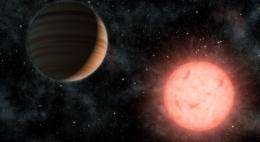
This artist's concept shows the smallest star known to host a planet. Image credit: NASA/JPL-Caltech

(PhysOrg.com) -- A long-proposed tool for hunting planets has netted its first catch -- a Jupiter-like planet orbiting one of the smallest stars known.

The technique, called astrometry, was first attempted 50 years ago to search for outside our , called exoplanets. It involves measuring the precise motions of a star on the sky as an unseen planet tugs the star back and forth. But the method requires very precise measurements over long periods of time, and until now, has failed to turn up any exoplanets.

A team of two astronomers from NASA's Jet Propulsion Laboratory, Pasadena, Calif., has, for the past 12 years, been mounting an astrometry instrument to a telescope at the Palomar Observatory near San Diego. After careful, intermittent observations of 30 stars, the team has identified a new around one of them -- the first ever to be discovered around a star using astrometry.

"This method is optimal for finding solar-system configurations like ours that might harbor other Earths," said astronomer Steven Pravdo of JPL, lead author of a study about the results to be published in the Astrophysical Journal. "We found a Jupiter-like planet at around the same relative place as our Jupiter, only around a much smaller star. It's possible this star also has inner rocky planets. And since more than seven out of 10 stars are small like this one, this could mean planets are more common than we thought."
Planet-Hunting Method Succeeds at Last
Enlarge

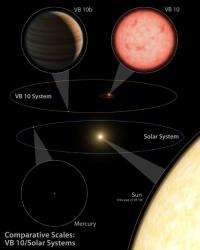
This artist's diagram compares our solar system to the VB 10 star system. Image credit: NASA/JPL-Caltech

The finding confirms that astrometry could be a powerful planet-hunting technique for both ground- and space-based telescopes. For example, a similar technique would be used by SIM Lite, a NASA concept for a space-based mission that is currently being explored.

The newfound exoplanet, called VB 10b, is about 20 away in the constellation Aquila. It is a gas giant, with a mass six times that of Jupiter's, and an orbit far enough away from its star to be labeled a "cold Jupiter" similar to our own. In reality, the planet's own internal heat would give it an Earth-like temperature.

The planet's star, called VB 10, is tiny. It is what's known as an M-dwarf and is only one-twelfth the mass of our sun, just barely big enough to fuse atoms at its core and shine with starlight. For years, VB 10 was the smallest star known -- now it has a new title: the smallest star known to host a planet. In fact, though the star is more massive than the newfound planet, the two bodies would have a similar girth.

Because the star is so small, its planetary system would be a miniature, scaled-down version of our own. For example, VB 10b, though considered a cold Jupiter, is located about as far from its star as Mercury is from the sun. Any rocky Earth-size planets that might happen to be in the neighborhood would lie even closer in.

"Some other exoplanets around larger M-dwarf stars are also similar to our , making the stars fertile ground for future Earth searches," said Stuart Shaklan, Pravdo's co-author and the SIM Lite instrument scientist at JPL. "Astrometry is best suited to find cold Jupiters around all kinds of stars, and thus to find more planetary systems arranged like our home."

Two to six times a year, for the past 12 years, Pravdo and Shaklan have bolted their Stellar Planet Survey instrument onto Palomar's five-meter Hale telescope to search for planets. The instrument, which has a 16-megapixel charge-coupled device, or CCD, can detect very minute changes in the positions of stars. The VB 10b planet, for instance, causes its star to wobble a small fraction of a degree. Detecting this wobble is equivalent to measuring the width of a human hair from about three kilometers away.

Other ground-based planet-hunting techniques in wide use include radial velocity and the transit method. Like astrometry, radial velocity detects the wobble of a star, but it measures Doppler shifts in the star's light caused by motion toward and away from us. The transit method looks for dips in a star's brightness as orbiting planets pass by and block the light. NASA's space-based Kepler mission, which began searching for planets on May 12, will use the transit method to look for Earth-like worlds around stars similar to the sun.

"This is an exciting discovery because it shows that planets can be found around extremely light-weight stars," said Wesley Traub, the chief scientist for NASA's Exoplanet Exploration Program at JPL. "This is a hint that nature likes to form planets, even around very different from the sun."

Provided by JPL/ (news : web)


print this article email this article download pdf blog this article bookmark this article     Stumble it Digg this share on Facebook retweet share on Reddit add to delicious
Rate this story - 4.8 /5 (12 votes)

Rank Filter

Move the slider to adjust rank threshold, so that you can hide some of the comments.


Display comments: newest first

  • omatumr - May 29, 2009
    • Rank: 1 / 5 (2)
    "This artist's concept shows the smallest star known to host a planet. Image credit: NASA/JPL-Caltech"

    Nope, not by a long shot!

    The smallest star known to host a planet is PSR 1257 12, the pulsar that Frail and Wolszczan discovered as the host of three, rocky Earth-like planets in the early 1990s [The second paper is in Science 264, 538-542 (1994)].

    With kind regards,
    Oliver K. Manuel
    http://www.omatumr.com

    .


  • Nik_2213 - May 29, 2009
    • Rank: 5 / 5 (2)
    Yup, sloppy wording of press-release.

    IIRC, though pulsars are radially smaller, they have more mass than this tiny M-dwarf star...

    FWIW, I remember how pioneering astrometry planet-hunters were thwarted by long-term instrument variations. Cruelly, none of their proposed planets matched recent 'hot jupiter' discoveries...
  • cybrbeast - May 30, 2009
    • Rank: 4 / 5 (1)
    A pulsar is a neutron star which doesn't really count as a star IMO.
  • omatumr - May 31, 2009
    • Rank: 1 / 5 (3)
    A pulsar is a neutron star which doesn't really count as a star IMO.


    That is very unfortunate. The star that heats planet Earth and sustains your life accreted on the neutron star that remained after material now orbiting the Sun was ejected in a supernova explosion 5 billion years (5Gy) ago.

    Oliver K. Manuel

May 28, 2009 all stories

Comments: 4

4.8 /5 (12 votes)
  • Stumble this up

  • Digg this

  • share this

  • hide
  • Related Stories

  • A trio of super-Earths
    created Jun 16, 2008 | popularity not rated yet | comments 0
  • Deep Impact Begins Hunt for Alien Worlds
    created Feb 08, 2008 | popularity not rated yet | comments 0
  • Increasing the odds of the sweep
    created Oct 04, 2006 | popularity not rated yet | comments 0
  • Scientists discover new planet orbiting dangerously close to giant star
    created Nov 18, 2008 | popularity not rated yet | comments 0
  • Undercover Stars Among Exoplanet Candidates
    created Mar 03, 2005 | popularity not rated yet | comments 0


  • hide
  • Relevant PhysicsForums posts

  • Sideral question
    created 18 hours ago
  • Doppler shifted blackbody spectrum
    created 21 hours ago
  • Earth v. Moon
    created 23 hours ago
  • help me with coordinates and orbits
    created 23 hours ago
  • basic 'our universe' question..
    created Nov 20, 2009
  • deriving keplers law
    created Nov 19, 2009
  • More from Physics Forums - General Astronomy

Other News

Astronauts finish another spacewalk, still no baby (AP)

Astronauts finish another spacewalk, still no baby

Space & Earth / Space Exploration

created 10 hours ago | popularity 3 / 5 (2) | comments 0

(AP) -- A spacewalking astronaut put aside the impending birth of his daughter and blazed through his first-ever venture outside the International Space Station on Saturday.


Unseasonably hot and dry weather combined with strong winds to fan scores of blazes in the country's southeastern states

Australia issues 'catastrophic' alerts as fires rage

Space & Earth / Environment

created 16 hours ago | popularity 4 / 5 (3) | comments 0

Australia has issued "catastrophic" alerts after record-breaking temperatures and wild lightning storms sparked more than 100 fires across the country, officials said Saturday.


Commuters wait on the platform shrouded by fog in London

Climate change not man-made, say majority of Britons: poll

Space & Earth / Environment

created Nov 15, 2009 | popularity 3.3 / 5 (15) | comments 46

Less than half of Britons believes that human activity is to blame for global warming, according to a poll carried out for The Times newspaper and published on Saturday.


Mysteriously warm times in Antarctica

Mysteriously warm times in Antarctica

Space & Earth / Earth Sciences

created Nov 18, 2009 | popularity 4.2 / 5 (21) | comments 28

(PhysOrg.com) -- A new study of Antarctica's past climate reveals that temperatures during the warm periods between ice ages (interglacials) may have been higher than previously thought. The latest analysis ...


UN: Fight climate change with free condoms (AP)

UN: Fight climate change with free condoms

Space & Earth / Environment

created Nov 18, 2009 | popularity 3.1 / 5 (11) | comments 24

(AP) -- The battle against global warming could be helped if the world slowed population growth by making free condoms and family planning advice more widely available, the U.N. Population Fund said Wednesday.